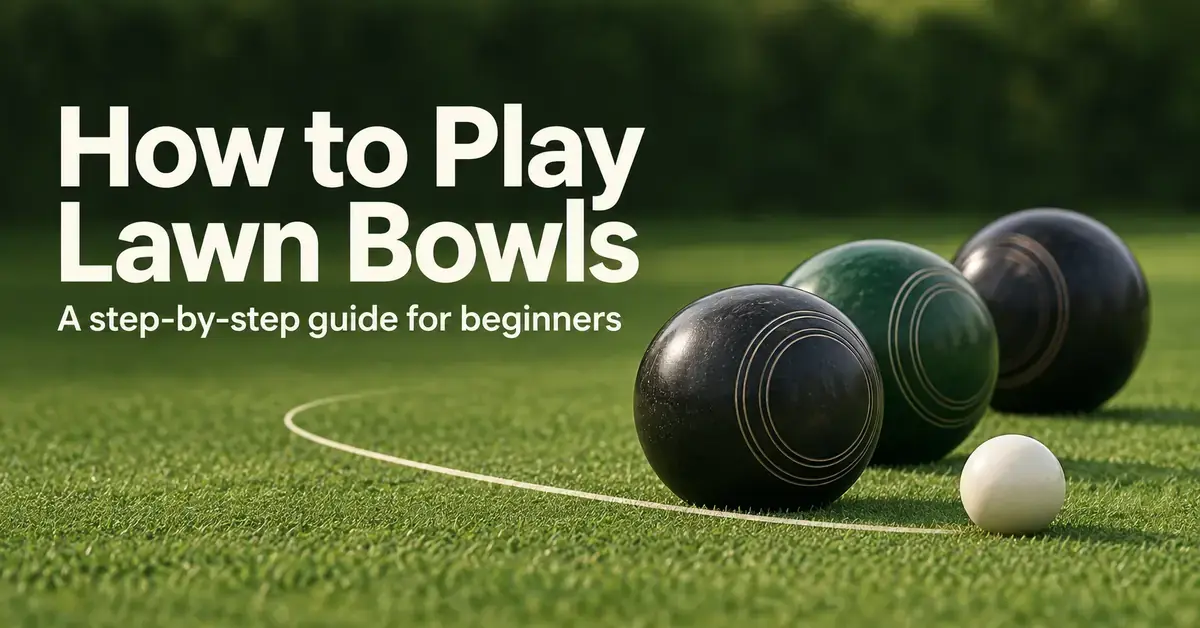
Lawn bowls is one of the most accessible sports you can pick up in New Zealand: the object is simply to roll your bowls closer to a small target ball than your opponent does. It rewards touch and tactics over raw strength, which is why players in their teens and players in their eighties compete on the same green. This guide explains how to play lawn bowls from scratch — the equipment, the playing area, how to deliver a bowl, how scoring works, the main game formats, and the beginner mistakes worth avoiding.
Key Points
- The goal: finish with your bowls closer to the jack than your opponent’s.
- Bias matters: bowls curve toward their smaller symbol, so aim wide, not straight.
- Footing rule: keep one foot on the mat until the bowl leaves your hand.
- Scoring: one shot for each bowl nearer the jack than the opponent’s best bowl; only one side scores per end.
- Formats: singles, pairs, triples and fours (rinks).
- Easy entry: clubs lend bowls to beginners, and the sport suits all ages and fitness levels.
What is lawn bowls?
Lawn bowls is a precision sport played on a flat, closely-mown grass or synthetic surface called a green. Each player rolls a set of weighted balls, called bowls, toward a smaller white or yellow target ball called the jack. Whoever finishes with a bowl nearest the jack wins that round, known as an end, and scores points for every bowl closer than the opponent’s best.
The sport is not the same as ten-pin bowling, even though both are called “bowling” and both are covered on this site. In lawn bowls you roll a biased bowl across grass toward a target ball; in ten-pin bowling in New Zealand you roll a heavy ball down a synthetic lane to knock over pins. The equipment, venues and scoring are completely different, so it helps to keep the two codes separate in your mind while you learn.
What makes lawn bowls distinctive is bias: every bowl is shaped so that it curves as it slows down, following a banana-shaped path rather than a straight line. Learning to read and use that curve is the heart of the game.
What equipment do you need to play lawn bowls?
You need very little to start, and clubs almost always lend gear to newcomers. The core items are the bowls, the jack, the mat and the green itself.
Quick Facts
| Object of the game | Roll your bowls closest to the jack |
|---|---|
| Jack (target ball) | 63-64 mm across, white or yellow |
| Mat size | 600 mm x 360 mm |
| Minimum jack distance | At least 23 m from the front of the mat |
| Rink width (NZ) | 3.6 m to 5.8 m |
| Green size | 31 m to 40 m along each side |
| Bowls in singles | 4 per player |
| Bias direction | Curves toward the smaller symbol/disc side |
| NZ governing body | Bowls New Zealand |
| World governing body | World Bowls |
The bowls and their bias
Bowls are not perfectly round — one side is shaped slightly differently from the other, which gives them their bias. As a bowl loses speed near the end of its journey, it curves toward the side marked with the smaller symbol or disc. This means you never aim straight at the jack; you aim off to one side and let the bias bring the bowl back in. Each bowl carries a large emblem on one side and a small emblem on the other, and the small emblem always faces the direction the bowl will curve. Bowls come in different sizes and weights so you can pick a set that fits your hand and delivery.
The jack
The jack is the small target ball that every end is played toward. For outdoor play on natural greens it measures between 63 and 64 millimetres across and is coloured white or yellow. It has little or no bias, so it runs almost straight when rolled.
The mat
The mat is a rectangular rubber pad, 600 mm long by 360 mm wide, that marks your legal delivery position. You must have at least part of one foot on or above the mat at the moment you release the bowl — this is the footing rule, and stepping fully off the mat before release is a foot fault.
The green and the rink
A bowling green is a large square of prepared turf or synthetic surface, typically 31 to 40 metres along each side. The green is divided into parallel playing lanes called rinks. Under Bowls New Zealand’s domestic regulations, a rink is between 3.6 and 5.8 metres wide. A shallow trench called the ditch runs around the edge, and the corners of each rink are marked with boundary pegs.
How to play lawn bowls step by step
Here is the sequence of a single end, which is the basic unit of every game. An end is complete once both sides have rolled all of their bowls; a full game is made up of many ends.
- Place the mat. The player or team who starts the end lays the mat on the centre line of the rink, with its front edge at least 2 metres from the rear ditch.
- Roll the jack. The same player delivers the jack up the centre line. Once it stops, it is centred on the rink. The jack must finish at least 23 metres from the front edge of the mat; if it comes to rest too close to the front ditch, it is moved so its nearest point sits 2 metres from that ditch.
- Choose your line and hand. Decide whether to curve the bowl in from the left (backhand) or the right (forehand). Stand on the mat facing the point out to the side where you want the bowl to begin its curve, not directly at the jack.
- Deliver the bowl. Step forward with a smooth stride, swing your arm back and then forward like a pendulum, and let the bowl roll off your hand close to the ground. Keep one foot on the mat until the bowl leaves your hand.
- Take turns. Players from each side alternate deliveries until every bowl has been rolled. Bowls gather around the jack in a cluster called the head.
- Count the shots. Once all bowls are still, measure which bowls are closest to the jack and award points, called shots.
- Play the next end. Pick up the bowls, move the mat and jack to the other end of the rink, and play back in the opposite direction. Repeat until the game is decided.
What is a toucher?
A toucher is a bowl that touches the jack on its way up the rink. Touchers are special because they stay live even if they roll into the ditch, where they can still count toward the score. To avoid disputes, players immediately mark a toucher with chalk. A bowl that has not touched the jack and ends up in the ditch is dead and is removed from play.
How does scoring work in lawn bowls?
Scoring is decided at the end of every end and is based only on distance to the jack. You score one shot for each of your bowls that is closer to the jack than your opponent’s nearest bowl. Only one side scores per end.
For example, if your two bowls are nearer the jack than any of your opponent’s, you score two shots and they score nothing. If distances are too close to judge by eye, players measure with a tape or callipers rather than guessing with hands or feet. The winning total depends on the format you are playing — for instance, singles is usually a race to 21 shots, while team games are often played over a set number of ends.
What are the main lawn bowls formats?
Lawn bowls can be played one-on-one or in teams. The format decides how many players are on each side, how many bowls each person rolls, and how the game is won. Bowl counts and end counts vary between clubs and competitions, so treat the table below as the common pattern rather than a fixed rule.
| Format | Players per side | Bowls per player | Typically decided by |
|---|---|---|---|
| Singles | 1 | 4 | First to 21 shots |
| Pairs | 2 | 2 to 4 | A set number of ends (often 18 or 21) |
| Triples | 3 | 3 | A set number of ends (often 18) |
| Fours (rinks) | 4 | 2 | A set number of ends (often 15 or 21) |
Who does what in a team?
In pairs, triples and fours each player has a role and a fixed batting order. The lead sets the mat, rolls the jack and delivers first. The second and third (the third is often called the vice-skip) build the head and keep the score. The skip plays last, directs the team’s tactics from the head, and calls the shots the others should attempt. Playing last gives the skip the chance to save or win the end with a well-placed bowl.
Common mistakes beginners make
Most early errors come from fighting the bias rather than working with it. Watch out for these:
- Aiming straight at the jack. A biased bowl always curves, so aiming directly at the target sends it wide. Aim out to the side and let the curve do the work.
- Delivering with the wrong side out. If you release the bowl with the large symbol facing the wrong way, it curves away from the jack instead of toward it. Check that the small symbol faces the direction you want the bowl to bend.
- Rolling too hard. Bias only takes effect as the bowl slows down. Bowling too firmly flattens the curve and overshoots the head; smooth, controlled weight is far more accurate.
- Standing off the mat. Lifting your foot off the mat before release is a foot fault. Keep one foot in contact until the bowl has left your hand.
- Bombing the head every time. Beginners often try to smash their opponent’s bowls out. A well-placed drawing bowl that sits close to the jack usually scores more reliably than a risky firing shot.
- Ignoring the green’s speed. Greens run at different speeds depending on the surface and weather, which changes how much a bowl curves. Roll a few practice bowls to judge the pace before it matters.
Lawn bowls etiquette
Etiquette keeps the game safe and enjoyable, and clubs take it seriously. Stay still and quiet while an opponent is on the mat so you do not distract them. Do not walk into another rink to fetch a bowl, and keep to the correct side of the head. Wear flat-soled, smooth or lightly-treaded footwear so you do not damage the green — many clubs will not let you play in ordinary shoes. Help set up and pack away the mats and jacks, and let faster groups play through if you are practising casually.
How to get started with lawn bowls in New Zealand
The easiest way to begin is to visit a local club, where beginners can borrow bowls and often join a free or low-cost “have-a-go” session. The sport is organised nationally by Bowls New Zealand, and clubs run from small suburban greens to large centres in every region.
If you are looking for somewhere to play, our regional guides cover lawn bowls in Auckland and the Canterbury bowls scene, and we profile individual clubs such as the Howick Bowling Club. For players in the capital, our bowling in Wellington guide lists local venues. Wear comfortable clothing you can move in, bring flat shoes, and expect your first session to focus on delivery and reading the bias before you play a full game.
Who is lawn bowls suitable for?
Lawn bowls suits almost anyone. Because it is low-impact and relies on accuracy rather than power, it is popular with older players and people returning to sport, yet the tactical depth also attracts competitive younger players. It can be played socially over a relaxed afternoon or seriously in club, centre and national competitions. If you enjoy games that reward patience, judgement and a steady hand, it is an easy and inexpensive sport to take up.
Sources
Frequently Asked Questions (FAQ)
Is lawn bowls hard to learn?
The basics are easy to pick up in a single session: roll a bowl toward the jack and try to finish closest. The challenge that keeps players interested is mastering the bias and judging the weight, or speed, of each bowl. Most beginners can play a social game on their first visit and keep improving their accuracy for years.
Do I need my own bowls to start playing?
No. Almost every club keeps sets of bowls for newcomers to borrow, so you can try the sport before buying anything. Once you are committed, you can buy a set sized and weighted to suit your hand. Starting with borrowed club bowls is the recommended way to learn what fits you.
What should I wear to play lawn bowls?
Wear comfortable, weather-appropriate clothing you can bend and swing in. The important item is footwear: soles must be flat and smooth or only lightly treaded so they do not mark or damage the green. Many clubs will not allow ordinary heeled or heavily-treaded shoes onto the surface.
How long does a game of lawn bowls take?
It depends on the format. A singles game to 21 shots or a team game over a set number of ends usually takes roughly two to three hours. Social roll-ups can be much shorter, and you can stop after any completed end, which makes it easy to fit around your day.
What is the difference between lawn bowls and ten-pin bowling?
They are separate sports that share the word “bowling”. Lawn bowls is played outdoors (or on indoor greens) by rolling biased bowls across grass toward a target jack, and it is scored on distance. Ten-pin bowling is played indoors by rolling a heavy ball down a lane to knock over ten pins, and it is scored on pins felled. The equipment, venues and rules have almost nothing in common.
