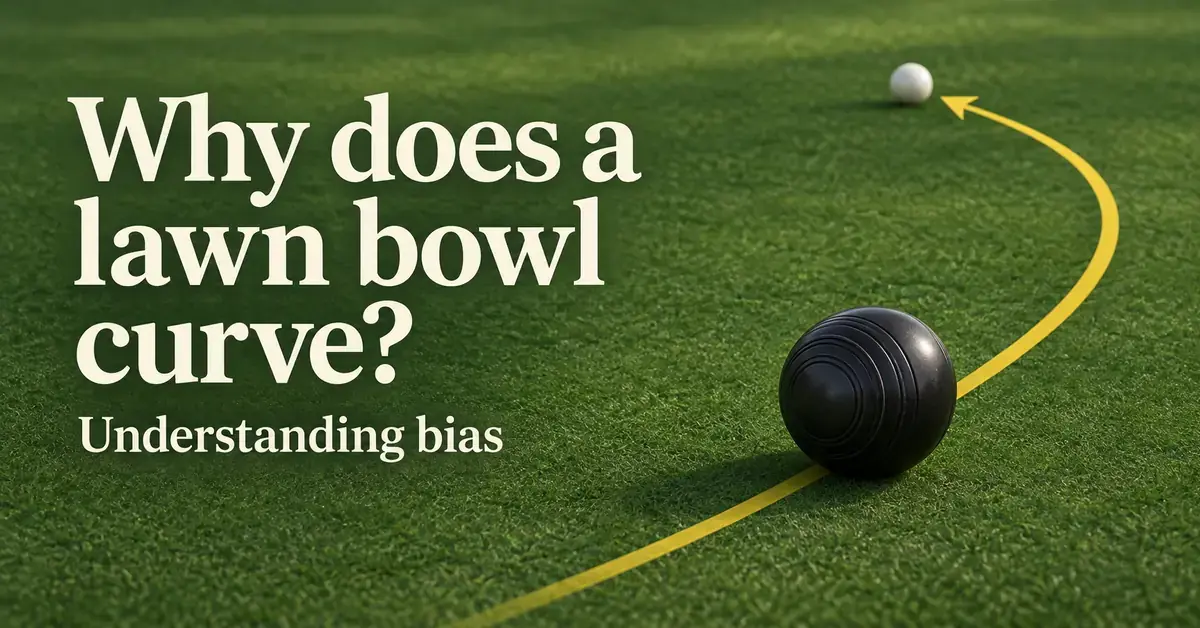
Bias is the built-in curve of a lawn bowl — the reason a bowl travels in a banana-shaped arc instead of a straight line to the jack. If you have watched lawn bowls and wondered why players aim well to the side of their target, the answer is bias. Every bowl is deliberately shaped so that it leans and curves as it slows down, and learning to read that curve is the first real skill in the sport. This guide explains what bias is, why the bowl curves, how to tell which way it will turn, and how much control you actually have over it.
Key Points
- Bias is the built-in curve of a lawn bowl — it makes the bowl travel in an arc, not a straight line.
- Shape, not weight: the curve comes from the bowl’s asymmetric shape. There is no hidden weight, and weighting a bowl is banned.
- Read the emblems: the small emblem marks the bias side and should face the inside of the curve (toward the jack); the large emblem marks the non-bias side.
- Draw changes with conditions: a bowl’s bias is fixed, but faster greens and gentler deliveries produce a wider curve.
- Regulated by World Bowls: bowls must meet a minimum bias, sit within 116–131 mm and 1.59 kg, and be re-tested at least every 10 years.
What is bias in lawn bowls?
Bias is the tendency of a lawn bowl to curve toward one side as it rolls and loses speed. It is not a flaw or a fault — it is designed into every bowl on purpose, and it is what makes lawn bowls a game of angles rather than a straight roll. A bowl is not a perfect sphere: one side is shaped differently from the other, and that difference makes the bowl arc in a predictable path across the green.
Because the curve is built in, players never aim straight at the jack (the small white or yellow target ball). Instead they deliver the bowl on a line to one side and let the bias bring it back in, so the bowl finishes travelling almost sideways as it settles next to the jack. The size of that curve is often called the bowl’s “draw” or “swing.”
Why does a lawn bowl curve? Shape, not weight
A lawn bowl curves because of its shape, not because of any weight hidden inside it. One side of the bowl — the bias side — is shaped with a slightly flatter, tighter curve than the other side. This makes the running surface (the part that rolls along the grass) asymmetric. While the bowl is moving quickly, its momentum keeps it running fairly straight. As it slows, the asymmetric shape takes over: the bowl settles onto its bias side and arcs in that direction until it stops.
Is there weight hidden inside a bowl?
No. Modern lawn bowls have no lead, no metal core and no loaded side. Adding weight to bias a bowl is banned by the sport’s rules. This is a genuinely common misconception, so it is worth stating plainly: the bias is created entirely by carving the bowl’s outer shape, not by weighting it. Bowls are typically made from a hard plastic resin (older sets were made from a dense wood called lignum vitae), and the material is spread evenly — the curve comes from the profile alone.
Where the idea of a “weighted” bowl comes from
Centuries ago some bowls really were loaded with lead on one side to make them curve. That practice was outlawed long ago, and today shaping is the only legal method. The old habit of calling the bias side the “heavy” side has stuck around in casual conversation, but it is not how a modern bowl works — nothing about it is heavier on one side.
How can you tell which side is the bias side?
You can identify the bias side by the small emblem or dimple stamped into it. Every bowl carries markings on both flat faces, and they are different sizes for a reason:
- The small emblem (a smaller circle, disc or set of grooved rings) marks the bias side — the side the bowl will curve toward.
- The large emblem (a bigger circle, usually carrying the maker’s logo) marks the non-bias side.
When you deliver the bowl, the small emblem should face the inside of the curve — that is, toward the jack. If you accidentally grip the bowl with the large emblem facing inward, the bowl will swing the wrong way and finish well off line. Checking the small emblem before every delivery is one of the first habits new bowlers are taught.
How does bias shape the way you play?
Bias is what makes the two basic deliveries — the forehand and the backhand — possible from the same spot. Because a bowl can be turned over in the hand so the bias side faces either left or right, a bowler can choose to curve the bowl in from either direction on every shot.
Forehand and backhand draws
For a right-handed bowler, the forehand draw starts out to the right of the jack and curves back to the left. Turning the bowl over in the hand delivers a backhand draw, which starts out to the left and curves back to the right. Left-handers mirror this. Having both options lets a player choose the clearer path to the target, avoiding bowls already lying on the green.
The draw shot and getting around blockers
The draw shot — rolling the bowl gently so it curves and comes to rest close to the jack — is the core skill of the sport, and it exists only because of bias. The curve lets a bowl bend around “blockers” (opponents’ bowls sitting in the direct line) and tuck in behind them. Without bias, every bowl would have to take the same straight path, and the tactical richness of the game would disappear. If you are learning at a club — whether that is one of the many lawn bowls clubs around Auckland or a green in the Canterbury region — the draw shot is almost always the first thing a coach helps you groove.
What controls how much a bowl curves?
A bowl’s built-in bias is fixed, but the amount of curve you actually see on the green is not. Two different things are easy to confuse:
- Bias is the bowl’s inherent, permanent bending characteristic, set by its shape and certified when it is made. You cannot change it.
- Draw (or swing) is how much curve you observe on a given day. This changes with conditions and delivery.
The main factors that change the visible draw are:
- Green speed: a fast, slick green lets the bowl run longer at the pace where bias takes hold, so it swings much wider. A slow, heavy green gives a tighter curve. Green speed is measured in seconds — the time a bowl takes to travel roughly 27 metres — and can vary a lot between venues and even through a single day.
- Delivery weight: the harder you send a bowl, the straighter and further it goes before the bias grips; a gentle, well-weighted delivery draws more.
- The bowl model: different bowls are made with narrower or wider inherent bias to suit different greens (covered below).
This is why the same bowl can look almost straight on a slow winter green and swing several metres on a fast summer green. Good bowlers constantly adjust their aiming line to match the conditions.
Narrow, medium and wide bias: choosing a bowl
Bowls are manufactured with different amounts of bias, usually described as narrow, medium or wide. The right choice depends mainly on how fast the greens you play on are, and on whether you play indoors or outdoors.
Bias Comparison
| Bias width | Typical use | How it behaves | Example makers |
|---|---|---|---|
| Narrow | Indoor greens and fast surfaces | Tighter, straighter line; less swing | Taylor, Henselite |
| Medium | All-round club play, outdoor greens | Balanced, natural draw for most conditions | Drakes Pride, Aero |
| Wide | Slower outdoor greens | Bigger, wider swing that bends around blockers | Henselite, Drakes Pride |
Each maker uses its own bias scale, so numbers do not translate directly between brands. Match the bowl to the greens you usually play, and make sure the size and weight feel comfortable in your hand.
Every manufacturer uses its own scale, which makes cross-brand comparison difficult: one maker’s numbers do not translate directly to another’s. The practical advice for a beginner is to try bowls that suit your usual greens and, just as importantly, to pick a size and weight that sits comfortably in your hand — bowls run from about size 00 (smallest) up to size 6 or 7, and comfort in the grip matters more than chasing a particular bias figure.
How is bias regulated and tested?
Bias is controlled by World Bowls, the international governing body, so that competition bowls behave within agreed limits. Bowls used in affiliated play must carry a valid World Bowls stamp, and the key standards are:
- Minimum bias: a bowl must bend at least as much as the official reference standard. World Bowls sets this with a “Master” or Working Reference Bowl, and a bowl on test must draw at least as much as that reference bowl. This stops anyone using a nearly straight bowl for an unfair advantage.
- Size: bowls made of rubber or plastic resin must measure between 116 mm and 131 mm across at their widest point.
- Weight: a bowl may weigh no more than 1.59 kg.
- Re-testing: bowls should be re-tested and re-stamped at least once every ten years, or sooner if the stamp is no longer clearly legible, because the running surface can wear over time.
Testing is done on a specially built, dead-level table where a bowl’s draw can be measured against the reference bowl without the variables of a real green. National bodies, including here in New Zealand, follow these World Bowls standards.
How is bias different from the curve in ten-pin bowling?
Lawn bowls curve because of built-in bias in the equipment; ten-pin bowling balls curve for completely different reasons. A ten-pin ball is symmetrical enough to roll straight, and any hook comes from the way the bowler releases it — spinning it with the fingers — combined with the ball’s internal weight block and the friction of its outer “coverstock” against the oiled lane. In other words, the ten-pin player creates the curve on release, while the lawn bowler relies on a curve that is permanently shaped into the bowl. The two codes should never be confused: a lawn bowl is not round and bends on its own; a ten-pin ball is round and only hooks if you make it. If you want the ten-pin side of the story, our overview of ten-pin bowling in New Zealand covers how that game works.
Common mistakes beginners make with bias
Most early errors come from misreading or misjudging the bias rather than from a poor delivery. The usual culprits are:
- Bowling with the wrong side in: gripping the bowl with the large emblem facing the jack sends it swinging away from the target instead of toward it. Always check that the small emblem faces the inside of your intended curve.
- Not aiming wide enough: beginners instinctively aim at the jack. You must aim well to the side and trust the bias to bring the bowl back.
- Ignoring green speed: using the same aiming line on a fast green as on a slow one leaves bowls short and off line. Watch how earlier bowls behave and adjust.
- Over-weighting the shot: throwing the bowl too hard flattens the curve, so it never draws in. A smooth, controlled delivery lets the bias work.
- Assuming all bowls swing the same: a friend’s wide-bias bowls will not follow the same line as your narrow set. Learn the draw of your own bowls.
Practice on a real green is the fastest cure. Local clubs — for example the Howick Bowling Club in east Auckland — usually welcome newcomers and run coaching sessions where you can learn to read the swing under guidance.
Sources
- World Bowls — Laws of the Sport of Bowls (Crystal Mark, Fourth Edition)
- World Bowls — Manufacturing and Testing Policy
- Bowls World — Bowls Bias Explained
- The Greenbowler — Lawn Bowl Bias: On the Green and on the Test Table
- NZ Herald — Bowls: Overcoming the natural bias in bowls
- Taylor Bowls — manufacturer information and bias range
Vanliga frågor (FAQ)
What is bias in lawn bowls in simple terms?
Bias is the built-in curve of a lawn bowl. Each bowl is shaped so that one side is different from the other, which makes the bowl arc to one side as it slows down instead of rolling straight. Players use that curve to bend their bowls in toward the jack.
Which side of the bowl is the bias side?
The bias side is marked by the smaller emblem or set of rings stamped on the bowl; the larger emblem marks the non-bias side. The bowl curves toward the small-emblem side, so that emblem should face the inside of your intended curve, toward the jack.
Do lawn bowls have weights inside them?
No. Modern lawn bowls contain no added weight, and weighting a bowl is against the rules. The curve comes entirely from the bowl’s asymmetric shape. The mistaken idea of a “heavy” side dates back centuries to when some bowls were loaded with lead, a practice that has long been banned.
Does the amount a bowl curves change from green to green?
Yes. The bowl’s inherent bias is fixed, but the curve you see depends on conditions. A fast, smooth green produces a much wider swing than a slow, heavy one, and a gentle delivery draws more than a hard one. Bowlers adjust their aiming line to match the green’s speed on the day.
Can you change or remove the bias of a bowl?
No. The bias is permanently shaped into the bowl when it is made and certified with a World Bowls stamp. You cannot legally add to it or take it away. If the running surface wears over many years, the bowl is re-tested and re-stamped rather than re-biased, and every bowl must still meet the minimum bias standard.
