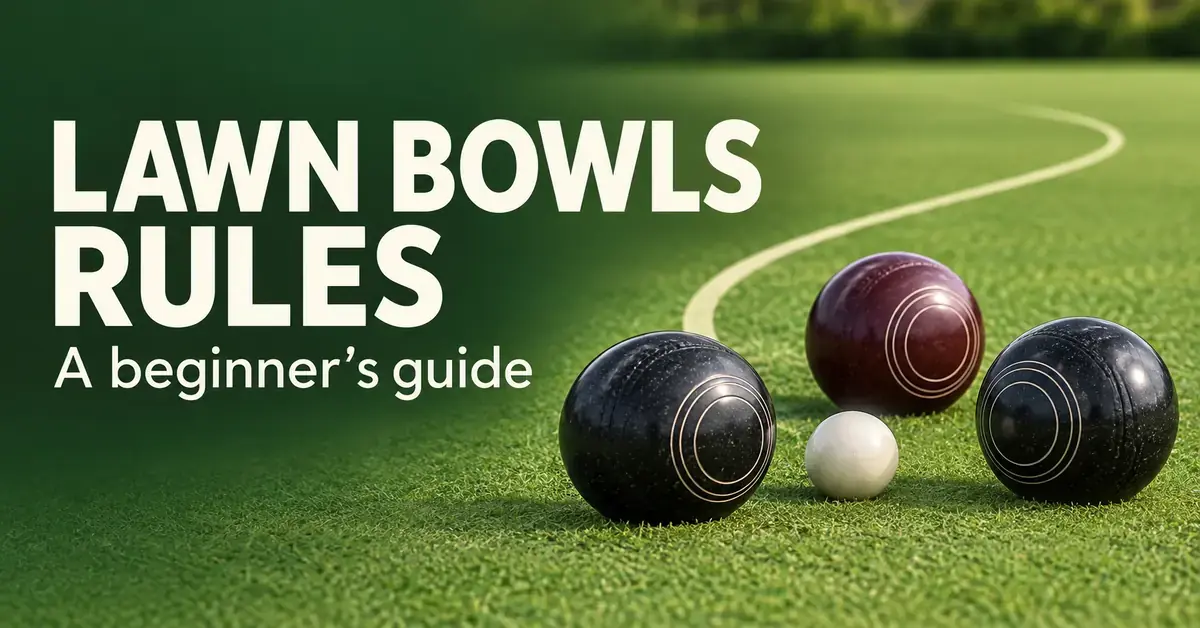
Lawn bowls is a precision sport in which players roll weighted, curving balls down a flat grass green, trying to finish closer to a small target ball than their opponent. It looks gentle, but the rules that decide who wins are exact — and they are quite different from ten-pin bowling, the indoor game played with pins and a heavy ball. This guide explains the rules of lawn bowls from the ground up: the equipment, how a game is played end by end, how scoring works, the main formats, and the points that most often trip up beginners. Everything here is based on the current official laws and how they apply in New Zealand.
Key Points
- Goal: finish your bowls closer to the small target ball (the jack) than your opponent’s.
- Bowls curve: they are biased and follow a curved path, so you aim to one side, not straight at the jack.
- Play is by ends: everyone bowls, the nearest bowls score, then play reverses direction for the next end.
- Scoring: only one side scores per end — one shot for each of your bowls closer to the jack than the opponent’s nearest bowl.
- Formats: singles and pairs use four bowls each, triples three, fours two; singles is usually first to 21 shots.
- Rules basis: World Bowls’ Laws of the Sport of Bowls (Crystal Mark Fourth Edition, 2023), with Bowls New Zealand domestic regulations for local play.
What is lawn bowls and what is the object of the game?
The object of lawn bowls is simple: deliver your bowls so that they come to rest closer to the small target ball — the jack — than any of your opponent’s bowls. Each round of play is called an end. Players take turns rolling their bowls up the green; once everyone has bowled, the bowls nearest the jack score points. The teams then play back in the opposite direction for the next end, and the game continues until someone reaches the target score or an agreed number of ends has been played.
What makes lawn bowls distinctive is that the bowls are not round. Each bowl is shaped so that it curves as it slows down, following a banana-shaped path rather than a straight line. Learning to read and use that curve — the bias — is the heart of the game. Lawn bowls is governed worldwide by World Bowls, whose rulebook, the Laws of the Sport of Bowls (Crystal Mark Fourth Edition), came into effect on 1 April 2023. In New Zealand the sport is run by Bowls New Zealand, which adopts those laws and adds its own domestic regulations for club, centre and national play.
What equipment do you need to play lawn bowls?
You need very little to start: a set of bowls, flat-soled shoes to protect the green, and access to a bowling green. Clubs almost always lend bowls to newcomers, so buying your own can wait. Understanding the equipment, though, helps the rules make sense.
The green and the rinks
Lawn bowls is played on a flat, closely mown grass (or artificial) surface called a green, surrounded by a shallow channel known as the ditch and a bank beyond it. A green is divided into parallel playing lanes called rinks. Each rink is a long strip roughly 4.3 to 5.8 metres wide, and the green itself is usually between 31 and 40 metres long from ditch to ditch. Play runs the full length of the rink, and after each end the direction of play reverses.
The mat
The mat is a rectangular rubber mat you stand on to deliver both the jack and your bowls. Under the official laws it measures 600 mm long by 360 mm wide. At least part of one foot must be on or above the mat at the moment you release each bowl — stepping fully off it is a fault (see the common-mistakes section below).
The jack
The jack is the small target ball, a solid white or yellow sphere between 63 mm and 67 mm in diameter. Unlike the bowls, the jack is round and has no bias, so it rolls straight. It is delivered at the start of each end and then becomes the target everyone aims for.
The bowls and bias
A bowl (sometimes called a wood, from the material once used) is made of hard plastic resin, rubber or wood, with a diameter between 112 mm and 134 mm. One side is shaped slightly differently from the other, giving the bowl its bias. Because of that shaping, a bowl curves toward its biased side as it loses speed, so players deliver it out to one side and let it swing back in toward the jack. A small dimple or set of rings on one side marks the bias side, which must face the inside of the intended curve. Learning how much your bowls curve on a given green — the line and weight — is the main skill you develop.
Quick Facts
| Item | Specification |
|---|---|
| Jack (target ball) | Solid white or yellow sphere, 63–67 mm diameter, rolls straight (no bias) |
| Bowls | Plastic resin, rubber or wood; 112–134 mm diameter; biased to curve |
| Mat | 600 mm long × 360 mm wide |
| Rink width | Approx. 4.3–5.8 m |
| Green length | Approx. 31–40 m ditch to ditch |
| Minimum jack distance | At least 23 m from the mat line (21 m allowed for NZ domestic play) |
| Mat placement | Mat line at least 2 m from rear ditch and 25 m from front ditch |
| Bowls per player | Singles 4, pairs 4, triples 3, fours 2 |
How is a game of lawn bowls played, step by step?
A game is built from repeated ends, and every end follows the same sequence. Once you understand one end, you understand the whole game.
Placing the mat and rolling the jack
The player who bowls first places the mat along the centre line of the rink. The mat line (the front edge of the mat) must be at least 2 metres from the rear ditch and at least 25 metres from the front ditch. That same player then rolls the jack up the green. The jack must come to rest at least 23 metres from the mat line to be legal; if it finishes short, it is respotted or the opponent may reposition the mat. Once the jack settles within the rink, it is moved sideways onto the centre line — this is called centring the jack. Note that Bowls New Zealand’s domestic regulations allow this minimum distance to be reduced from 23 metres to 21 metres for local play, so club games can use a slightly shorter jack.
Delivering your bowls
With the jack set, players take turns delivering their bowls, one at a time, alternating between the two sides. You stand on the mat, aim out to the correct side to allow for the bias, and roll the bowl smoothly along the green. The team or player whose bowl is not nearest the jack bowls next, so play swings back and forth. Only one side has possession of the rink at any moment — you must wait for the previous bowl to come to rest before delivering yours.
Completing the end
The end is finished once every bowl has been delivered. The bowls closest to the jack are then measured, points are awarded, the bowls and jack are cleared, and play begins again from the opposite end of the rink. A tape measure or callipers are used when bowls are too close to judge by eye.
How does scoring work in lawn bowls?
Scoring is decided at the end of each end, and only one side scores per end. After all bowls are delivered, you count how many of your bowls are closer to the jack than your opponent’s nearest bowl. Each of those counts as one shot. For example, if your two closest bowls are both nearer the jack than anything your opponent has, you score two shots; your opponent scores nothing that end.
Because only the side holding the closest bowl can score, and it scores for every one of its bowls beating the opponent’s best, a single end can be worth anywhere from one shot up to the maximum number of bowls a player holds. Running totals are kept end by end until the game is won.
What are the different formats of lawn bowls?
Lawn bowls is played in four main formats, which differ in team size and in how many bowls each person delivers per end. The format also decides how the game ends.
- Singles: one player against another, four bowls each. Singles is usually the first player to reach 21 shots.
- Pairs: two players a side, usually four bowls each per end, played over a set number of ends.
- Triples: three players a side, three bowls each per end.
- Fours (or rinks): four players a side, two bowls each per end — the classic team game.
In team games the players have set roles and bowl in a fixed order: the lead rolls the jack and bowls first, followed by the second and third, with the skip bowling last and directing the team’s tactics. Team games are decided over an agreed number of ends — commonly 18 or 21 — rather than a target score, and the side with the most shots at the finish wins.
What key rules should every beginner know?
Beyond the basic sequence, a handful of specific rules decide many tight situations. These are the ones worth learning early.
Foot faults and possession of the rink
When you deliver a bowl, at least part of one foot must be on or over the mat as you release it. Stepping completely off the mat is a foot fault. You also cannot bowl until the previous bowl has stopped and possession of the rink has passed to your side — hurrying a delivery is against the rules and unsafe.
Touchers and bowls in the ditch
A bowl that touches the jack on its way down the green is a toucher. Touchers stay in play even if they roll into the ditch, and they are marked with chalk so everyone knows they still count. A bowl that finishes in the ditch without having touched the jack is a dead bowl — it is removed and takes no part in the end.
Dead ends and a moved jack
The jack can be knocked about during an end, and that is allowed. If the jack is driven into the ditch but stays within the boundaries of the rink, it remains live and is still the target. But if the jack is pushed over the side boundary of the rink or beyond it entirely, the end becomes a dead end — no one scores, and the end is replayed. Understanding when the jack is still live versus when the end is dead saves a lot of confusion for newcomers.
How do the rules apply to lawn bowls in New Zealand?
In New Zealand, lawn bowls runs on the World Bowls laws plus Bowls New Zealand’s domestic regulations, which fill in local details such as the shorter 21-metre jack option and competition formats. The rules are the same whether you play in a national championship or a casual club roll-up, so learning them once sets you up anywhere in the country. Greens are maintained by hundreds of local clubs, and joining one is the easiest way to learn — most run free coaching for beginners and lend bowls.
If you want to see where the game is played and how it is organised regionally, our guides to lawn bowls in Auckland and lawn bowls in Canterbury are good starting points, and the Howick Bowling Club page shows what a typical club offers newcomers. If you are weighing up the two very different codes, our overview of ten-pin bowling in New Zealand explains how the indoor pin game compares with the outdoor green game described here.
What common mistakes do beginners make in lawn bowls?
Most beginner errors come from misjudging the equipment or forgetting a specific rule rather than from lack of strength. Knowing them in advance saves frustration.
- Bowling with the bias the wrong way round. If the biased side faces outward, the bowl curves away from the jack instead of toward it. Always check the small rings or dimple are on the side you want the bowl to swing toward.
- Aiming straight at the jack. Because bowls curve, aiming directly at the jack sends the bowl wide. You must deliver out to one side and let the bias bring it back in.
- Using too much weight. New players often roll far too hard and shoot past the jack into the ditch. Gentle, controlled deliveries that finish near the jack score far more often.
- Stepping off the mat. Forgetting to keep a foot on or over the mat is a common foot fault.
- Bowling out of turn. Delivering before the previous bowl has stopped, or when your side does not hold possession of the rink, breaks the rules — wait your turn.
- Wearing the wrong shoes. Heeled or ridged soles damage the green; flat-soled shoes are required at almost every club.
Sources
Frequently Asked Questions (FAQ)
How many bowls does each player use in lawn bowls?
It depends on the format. In singles each player delivers four bowls per end, and pairs is usually four bowls each as well. In triples each player delivers three bowls, and in fours each player delivers two bowls per end.
How do you win a game of lawn bowls?
Singles is normally won by the first player to reach 21 shots. Team games — pairs, triples and fours — are played over an agreed number of ends, often 18 or 21, and the side with the most total shots when the last end is finished wins.
Why do lawn bowls curve instead of rolling straight?
Each bowl is shaped so that one side is weighted differently from the other, a feature called bias. As the bowl slows down, that bias makes it curve toward its biased side, so players aim out to one side and let the bowl swing back in toward the jack.
What is a toucher in lawn bowls?
A toucher is a bowl that touches the jack while travelling down the green. It is marked with chalk and stays in play even if it rolls into the ditch, whereas a bowl that reaches the ditch without touching the jack is dead and removed.
How far does the jack have to be rolled?
Under the World Bowls laws the jack must come to rest at least 23 metres from the mat line after it is centred. Bowls New Zealand’s domestic regulations allow clubs to reduce this to 21 metres for local play.
