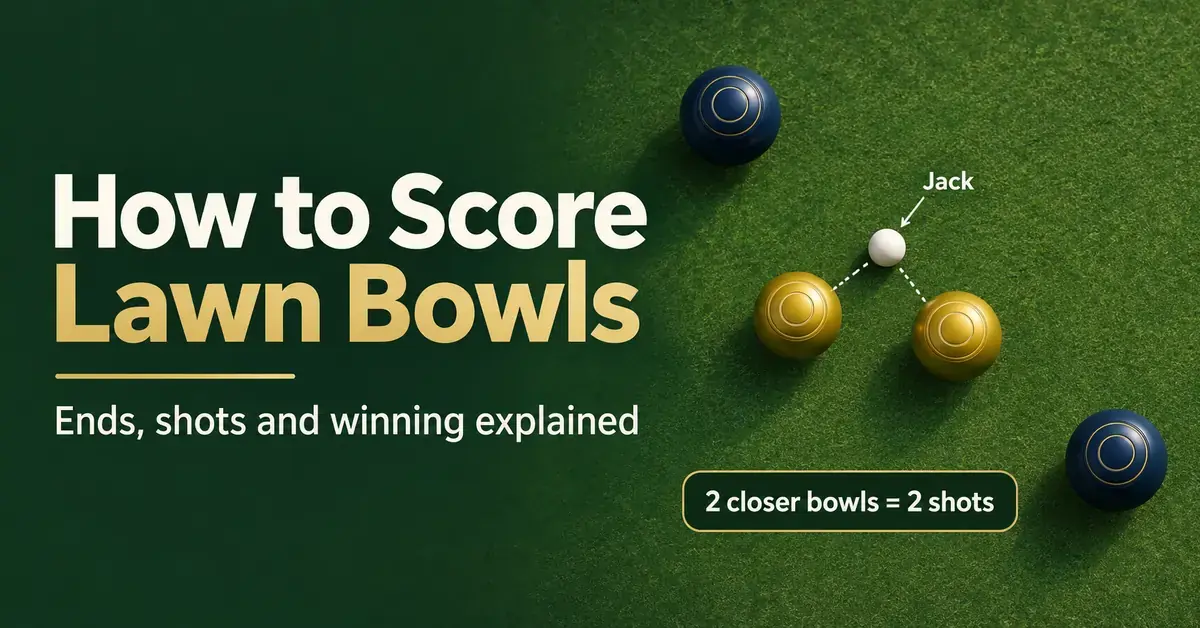
Scoring in lawn bowls comes down to one simple idea: at the end of each round of play, you count how many of your bowls are closer to the small target ball than your opponent’s nearest bowl. Each of those closer bowls is worth one point, called a shot. That single rule sits behind every format of the game, from a one-on-one singles match to a four-player team. This guide explains what an end is, how shots are counted, how a full game is won, and the rules that settle the close calls that beginners find confusing.
Key points
- You score one shot (point) for every bowl closer to the jack than your opponent’s nearest bowl.
- Only one player or team scores on each end; the other side scores zero.
- An end = the jack is set, all bowls are delivered, then shots are counted.
- Singles is usually won by the first to 21 shots; pairs, triples and fours go to the highest total over a set number of ends.
- Close results are settled by measuring; bowls exactly equal in distance score to neither side.
- There are no bonus points for hitting the jack.
The goal of lawn bowls: get closer to the jack
The aim of lawn bowls is to roll your bowls so they finish closer to the jack than your opponent’s bowls. The jack is the small white (or yellow) target ball that is rolled up the green first. Your bowls are the larger, weighted balls that are not perfectly round — they are shaped so they curve, or “bias”, as they slow down, which is why players roll them on a curving arc rather than straight at the target.
Players take turns rolling their bowls from a mat at one end of the rink toward the jack. A rink is the marked lane of the green a game is played on. The cluster of bowls and the jack that builds up around the target is called the head. Nothing is scored until every bowl has been delivered — only then do you look at the head and count.
What is an “end” in lawn bowls?
An end is one complete round of play in a single direction: the jack is set, both sides deliver all of their bowls, and the shots are counted. When an end is finished, players simply turn around and play the next end back down the rink in the opposite direction, using the bowls that are already lying there. A game is made up of many ends played back and forth.
Think of an end as a single hand in a card game. It has its own small result — one side wins the end and scores; the other side scores nothing for that end. Those end-by-end results add up to decide the whole game.
What is a “shot”? How points are counted
A shot is a single point, and it is awarded for every one of your bowls that is closer to the jack than your opponent’s nearest bowl. Only one player or team can score on any given end — the side whose bowl is nearest the jack. The other side scores zero for that end, no matter how many bowls they have in play.
Counting shots after an end
Once all bowls have stopped, work through it in order:
- Find the single bowl nearest the jack. That bowl belongs to the winning side of the end.
- The winning side then scores one shot for that bowl, plus one more shot for every additional bowl of theirs that is closer to the jack than the opponent’s best (nearest) bowl.
- As soon as you reach the opponent’s nearest bowl, counting stops. Everything behind it scores nothing.
There is no fixed maximum score for an end. The most shots you can win on one end is limited only by how many bowls your side delivers — for example up to four in a singles end, where each player rolls four bowls.
A worked example
Imagine a singles end where you and your opponent have each rolled four bowls. Measuring out from the jack, the closest three bowls are all yours, and the fourth-closest bowl belongs to your opponent. You score 3 shots, because you have three bowls closer than your opponent’s nearest one. Your opponent scores nothing this end, even though their remaining bowls are on the green. If the order had been your bowl, then your opponent’s bowl, then two more of yours, you would score only 1 shot — counting stops at their nearest bowl.
How a game of lawn bowls is won
How a full game is won depends on the format being played. Singles is decided by a points target, while team games are usually decided by the highest total over a fixed number of ends. Clubs and national bodies such as Bowls New Zealand set their own “conditions of play”, so exact numbers can vary between social club games and formal competitions.
Singles: first to 21 shots
In a standard singles match, the first player to reach 21 shots wins, and the game stops the moment they get there — even mid-end. Each player rolls four bowls per end. Because you keep a running total across every end, a player can win 21–15 or 21–3; only the winner’s total needs to reach 21.
Pairs, triples and fours: most shots over a set number of ends
Team formats are usually played over a set number of ends rather than to a points target. When the last end is finished, the side with the higher total of shots wins. If the totals are level, competitions may declare a draw or play an extra end to break the tie, depending on the conditions of play.
- Pairs (two players a side) — commonly 18 or 21 ends.
- Triples (three players a side) — commonly 18 ends.
- Fours, also called rinks (four players a side) — commonly played over 15 to 21 ends depending on the competition.
You can find plenty of clubs running all of these formats around the country, from lawn bowls clubs in Auckland to Canterbury lawn bowls, and the scoring principle is identical across every one of them.
Format comparison
| Format | Players per side | Bowls per player | Bowls per side each end | Typical game length |
|---|---|---|---|---|
| Singles | 1 | 4 | 4 | First to 21 shots |
| Pairs | 2 | 4 | 8 | 18 or 21 ends |
| Triples | 3 | 3 | 9 | 18 ends |
| Fours (rinks) | 4 | 2 | 8 | 15–21 ends |
| International/Commonwealth standard. Domestic and social games may use fewer bowls or different lengths — check your club’s conditions of play. | ||||
Who measures and decides the score?
The score for each end is agreed by the players themselves, and it is settled by measuring when the result is not obvious to the eye. In team games the players in charge of the head — the thirds or the skips — agree the count, while in singles the two players (helped by a marker) agree it.
If it is too close to call, a measure is taken from the nearest point of the jack to the nearest point of each bowl using a tape or measure. Nothing should be moved until the measuring is finished. If players cannot agree, an umpire is called to make the final decision. Only bowls that could reasonably affect the count need to be measured — you do not have to measure every bowl on the green.
Special scoring situations you need to know
A handful of rules decide what counts and what does not when things do not go to plan. Knowing them stops arguments and prevents you from claiming or conceding shots you should not.
The jack must travel far enough
The jack has to come to rest a minimum distance up the green to make the end valid. Under the World Bowls Laws of the Sport of Bowls, the jack must finish at least 23 metres from the mat line; national bodies may reduce this to 21 metres for domestic play. If the jack is rolled too short or off the rink, the other player gets to reset it. If neither player sets a valid jack, it is re-spotted on the centre line with its nearest point 2 metres from the front ditch, so the end can still be played.
Dead ends and a dead jack
An end is “dead” and scores nothing if the jack is knocked outside the side boundary of the rink or off the end of the green. A dead end is simply replayed — usually in the same direction — with no score recorded, so no one gains or loses. Importantly, if the jack is only knocked into the ditch but stays within the rink’s side boundaries, it is still “alive” and the end continues to be played and scored.
Touchers and bowls in the ditch
A bowl that touches the jack on its way down the green is called a toucher and stays live even if it then rolls into the ditch — it is usually marked with chalk and still counts for shots. By contrast, an ordinary bowl that runs into the ditch without touching the jack is dead: it is taken out of play and cannot score. This is why a toucher resting in the ditch, right up against the bank, can still be the shot.
Equal distance: a tied measure
If a measure shows one of your bowls and one of your opponent’s bowls are exactly the same distance from the jack, neither of those bowls scores. The count then moves on to the next nearest bowl. If the two closest bowls are tied and there are no other bowls in contention, the end is a tie and no shots are scored by either side for that end.
How team positions affect the head and the score
In team formats each player has a role, and the order they bowl in shapes the head that is finally scored. The lead bowls first and tries to draw bowls close to the jack. The second builds on that, protecting good bowls or adding cover. The third (also called the vice-skip) plays tactical shots and often helps agree the measure. The skip bowls last, directs the team, and plays the match-defining shots when the head is at its most crowded. Because the last bowls of an end can change the count completely — turning a losing end into a winning one — the score is never safe until every bowl has stopped.
Common scoring mistakes beginners make
Most scoring errors come from misreading the head rather than from the maths itself. Watch out for these:
- Counting both sides. Only one side scores per end. If you and your opponent each have bowls near the jack, only the side with the nearest bowl scores, and only for the bowls closer than the opponent’s best bowl.
- Adding shots for hitting the jack. There are no bonus points for striking the jack. Contact only matters because it can create a toucher or move the jack to a new position.
- Moving bowls before measuring. Once you touch the head, an accurate measure may be impossible. Agree the obvious shots first and leave close bowls exactly where they lie.
- Forgetting the running total in singles. Singles is won at 21 shots overall, not per end — keep the cumulative score, not just the last end.
- Assuming a ditched bowl is out. A marked toucher in the ditch still counts; only non-touchers in the ditch are dead.
How lawn bowls scoring differs from ten-pin bowling
Lawn bowls and ten-pin bowling share a name but score in completely different ways. In lawn bowls you compare your bowls against your opponent’s on each end, and points (shots) are relative — they depend on who is nearest the jack. In ten-pin bowling in New Zealand you score against a fixed target of ten pins over ten frames, with strikes and spares adding bonus pins, and your opponent’s play does not change your own score. If you are exploring both codes, it helps to keep the terminology separate: lawn bowls has a jack, ends and shots, while ten-pin has pins, frames and strikes. Clubs such as Howick Bowling Club are a good place to try lawn bowls, and city guides like bowling in Wellington list venues for both sports.
Sources
Frequently Asked Questions (FAQ)
How do you score a point in lawn bowls?
You score one point, called a shot, for every bowl of yours that finishes closer to the jack than your opponent’s nearest bowl. Only the side with the closest bowl scores on that end, and counting stops as soon as you reach the opponent’s best bowl.
How many points can you score on one end?
Only one side scores on each end, and there is no fixed maximum — it is limited by how many bowls your side rolls. In singles, where each player has four bowls, the most you can score on a single end is four shots.
How long is a game of lawn bowls?
Singles is usually played to 21 shots, with the first player to reach that total winning. Team games such as pairs, triples and fours are played over a set number of ends — often 15 to 21 — and the side with the most shots at the end wins.
What happens if two bowls are the same distance from the jack?
If a measure shows opposing bowls are exactly equal, neither of those bowls scores and the count moves to the next nearest bowl. If those tied bowls are the only ones in contention, the end scores nothing for either side.
Do you get extra points for hitting the jack?
No. There are no bonus points for hitting the jack. Touching it only matters because it can turn your bowl into a “toucher”, which stays live even in the ditch, or because moving the jack can change which bowls end up nearest.
