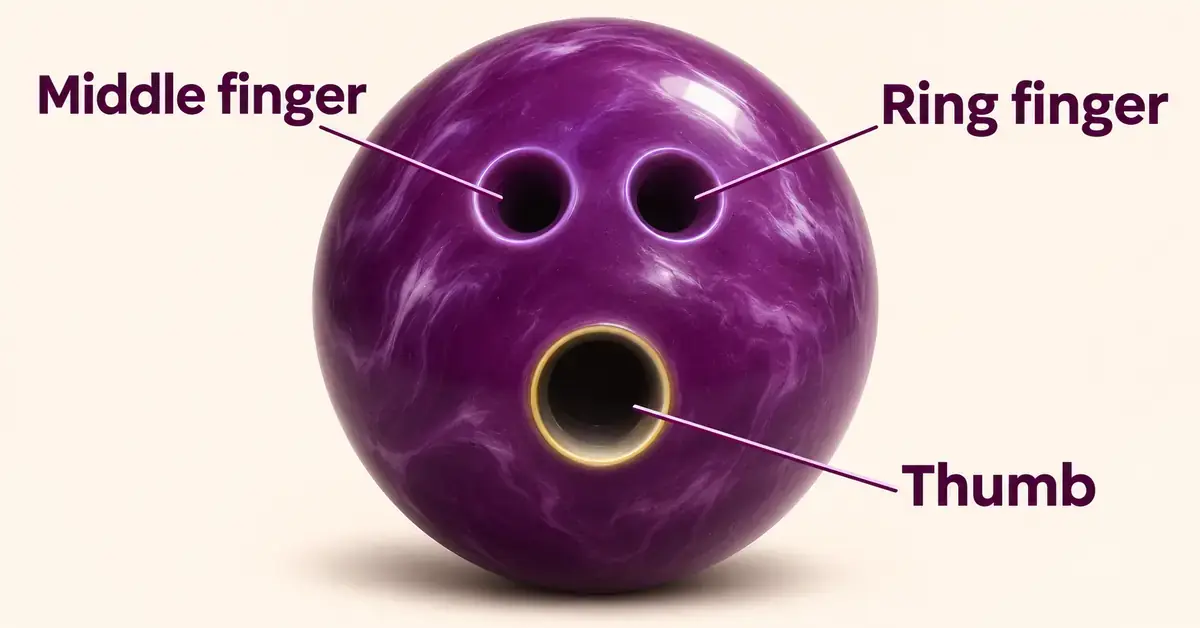
Holding a ten-pin bowling ball is simple once you know where everything goes: your middle and ring fingers slide into the two holes that sit close together, your thumb drops into the single hole below them, and your hand stays relaxed rather than clenched. Get those basics right and the ball is far easier to swing, release and control — and you save your thumb from the aches that come with squeezing a ball that does not fit. This guide explains the grip step by step for complete beginners. It covers ten-pin bowling, the game with the three-holed ball you roll down a lane, and not lawn bowls, which uses a solid, hole-less bowl with a built-in curve.
Key Points
- Middle and ring fingers go in the two holes set close together; the thumb goes in the single hole below.
- Your index and little fingers stay outside the ball to help steady it.
- Hold the ball just firmly enough that it will not slip — squeezing causes tension and a sore thumb.
- Conventional grip (fingers inserted deep) is standard on house balls and best for beginners; fingertip grip (fingers in only shallowly, on the fingertips) adds hook but needs a custom-drilled ball.
- Pick the lightest ball you can control whose holes slide on and off cleanly; on release, the thumb comes out first, then the fingers.
How do you hold a ten-pin bowling ball?
Hold the ball with your fingers in the two top holes and your thumb in the lower hole, letting it rest against your hand rather than hanging from your fingers. Here is the sequence a first-time bowler can follow at the lane:
- Lift it with both hands. Take the ball off the return and cradle it in your non-throwing hand so your bowling fingers are not carrying the weight yet.
- Set your fingers. Slide your middle and ring fingers into the two holes that sit close together.
- Add your thumb. Push your thumb all the way into the single hole below the finger holes.
- Let the ball settle. Rest it against the pads of your fingers and the base of your palm, with your wrist firm but not stiff.
- Relax your hold. Grip just firmly enough that the ball will not slip — no clawing or squeezing.
That is the whole grip. Everything else on this page is about doing each step well: which holes your fingers use, how deep they go, how hard to hold, and how to pick a ball that fits your hand in the first place.
Which fingers go in which holes?
Your middle and ring fingers go in the two holes set close together, and your thumb goes in the single hole on its own. A standard rental ball at the alley — a “house ball” — is drilled with exactly three holes for this reason.
- Middle and ring fingers: the two holes positioned near each other, usually toward the top of the ball as you hold it.
- Thumb: the lone hole set a little apart from the other two.
- Index finger and little finger: these stay outside the ball, spread comfortably on the surface to help steady it.
Conventional grip vs fingertip grip
The two main grips differ only in how deep your fingers go. That one change has a big effect on control and on how much the ball curves.
Conventional grip: your middle and ring fingers go deep into the holes, and your thumb goes fully in. This is the grip on almost every house ball. The deep finger insertion gives you the most control and a straighter, more predictable roll, which is why it suits beginners and anyone focused on throwing straight at the pins or picking up spares.
Fingertip grip: your middle and ring fingers go in only shallowly, so the ball hangs on your fingertips, while your thumb still goes all the way in. Because the fingers are shallower and the span between thumb and fingers is longer, the ball hangs on your fingertips instead of sitting deep in your hand. That gives you more leverage and lets the fingers put extra revolutions on the ball, which is what creates a stronger hook. The trade-off is that a fingertip grip needs a ball drilled to your exact hand, so it is a step for bowlers who are ready to throw a hook rather than for a first visit. A fingertip ball is usually paired with grippier covers, which you can read about in our guide to the types of bowling balls.
Grip Comparison
| Grip | Finger depth | Control vs hook | Best for |
|---|---|---|---|
| Conventional | Fingers inserted deep, thumb fully in | Most control, straighter roll, less hook | Beginners, house balls, throwing straight and spare shooting |
| Fingertip | Fingers in only shallowly (on the fingertips), thumb fully in, longer span | More leverage and revolutions, stronger hook, less margin for error | Developing bowlers with a custom-drilled ball who want to hook |
| Two-handed (no thumb) | Two fingers only, thumb left out of the ball | Highest rev rate and biggest hook, hardest to learn | Advanced bowlers, usually with coaching and a dedicated ball |
How firmly should you hold the ball?
Hold the ball just firmly enough that it will not slip, and no tighter. Good grip pressure is steady, not tight. Squeezing or clawing the ball creates tension that runs up your arm, produces an inconsistent release, tires your hand out over a few games and leaves your thumb sore.
A useful test: if the ball feels like it is slipping or you feel you need to grab it hard to keep hold, that almost always means the fit is wrong — the holes are too big, or the span is off — not that you should squeeze harder. The goal is a relaxed hand that lets the ball swing like a pendulum, with the weight doing the work.
Do your fingers or thumb go in first?
Most coaches suggest settling your fingers into the top two holes first, then sliding your thumb in last. Putting the fingers in first and the thumb in last helps you set the same hand position every time and tends to give a cleaner release. Some bowlers prefer to seat the thumb first and lay the fingers in after — that is fine too.
The order itself matters less than doing it the same way on every shot. A repeatable grip is what lets you repeat your throw, so pick one routine and stick to it.
How to pick a house ball that fits
Choose the lightest ball you can control whose finger and thumb holes slide on and off cleanly. Two things decide whether a house ball will work for you: its weight and the fit of its holes.
Weight. House balls run from about 6 lb (2.7 kg) up to 16 lb (7.3 kg). A common starting point is a ball around 10 percent of your body weight, up to a maximum of 16 lb, that still feels comfortable to swing — but comfort wins over any formula. If lifting and swinging the ball strains your arm or shoulder, it is too heavy. Our full guide to choosing a bowling ball weight walks through this in kilograms for New Zealand bowlers.
Hole fit. Your fingers and thumb should slide into the holes easily and pull out cleanly as you release — a little resistance is fine, but no pinching and no sloppy looseness. Because house balls come in a wide variety of hole sizes to suit all sorts of hands rather than being drilled for yours, you will often have to settle for a “good enough” fit rather than a perfect one. Try several balls on the rack until you find holes that suit your hand.
If no house ball ever feels right, that is the usual sign it is time to look at your own equipment; our guide to the best bowling ball for beginners covers where to start.
What about the two-handed (no-thumb) grip?
In the two-handed style, the bowler leaves the thumb out of the ball entirely and uses only the two fingers, with the non-throwing hand cupping and supporting the ball through the swing. Taking the thumb out lets the fingers put far more revolutions on the ball, which produces a big hook. It has become popular at the top level thanks to two-handed professionals.
It is an advanced technique, though. It usually needs a ball drilled specifically for it and some coaching to learn safely, so it is not where a beginner should start. Learn the standard one-handed grip with your thumb in the ball first; you can always explore two-handed play later.
From grip to release
A good grip sets up a good release, because the two are linked. On a proper throw, your thumb leaves the ball first as it reaches the bottom of your swing, and then your fingers lift and roll off the ball. That order is what gives the ball its forward roll, and with a fingertip grip, its hook.
If your thumb hangs up in the hole instead of exiting cleanly, you will feel the ball drag or you may loft it down the lane. Nine times out of ten the cause is fit or a too-tight grip rather than your technique. A pro shop can check your thumb-hole size and your span, and a ball drilled to fit your hand solves most grip problems at once.
Common grip mistakes beginners make
- Squeezing the ball. The most common fault. It creates tension, an inconsistent release and a sore thumb. Hold it just firmly enough not to drop it.
- Using a ball with the wrong hole size. Holes that pinch make your thumb stick; holes that are too loose make you grab. Neither lets you relax.
- Picking too heavy a ball. A ball you cannot swing in a relaxed, controlled arc forces you to muscle it, which wrecks your grip and your accuracy.
- Trying to hook with a house ball. A conventional house ball and a deep finger grip are built for a straighter roll. Chasing a big hook before you have the equipment and consistency for it usually just adds errors.
- Not getting the thumb out first. Hanging on with the thumb kills the lift and roll and can send the ball sideways. Let the thumb release before the fingers.
- Changing your grip every shot. Inserting your hand differently each time makes your throw impossible to repeat. Settle on one routine and use it every frame.
Sources
- Bowling.com — What Is a Fingertip Grip and Why Should I Use It? (conventional vs fingertip finger depth)
- Bowling.com — How Do I Hook a Bowling Ball? (grip pressure and thumb-first release)
- AMF — How to Hold a Bowling Ball for Better Grip and Control (relaxed grip pressure)
- Bowling.com — What Weight Bowling Ball Should I Use? (6–16 lb range and the 10% rule)
- Bowling This Month — House Balls: Everything You Need to Know (house-ball weight range and hole-size variety)
- Bowling.com — What Is a Two-Hander Bowler? (no thumb hole, high rev rate, popularised by professionals)
Frequently Asked Questions (FAQ)
Is holding a ten-pin bowling ball the same as holding a lawn bowl?
No. They are two different sports. A ten-pin ball has three holes and is controlled with your fingers and thumb inside it. A lawn bowl is solid, has no holes and sits cupped in your open palm, and it is weighted to curve on its own. The grips have nothing in common, so do not carry the feel of one across to the other.
Why does my thumb get stuck or my hand feel sore after bowling?
Usually the hole fit is off or you are gripping too hard. A thumb hole that is slightly too small or a span that is too long makes the thumb hang up, and squeezing the ball tires and chafes your hand. Try a different house ball with a cleaner-releasing thumb hole, keep your grip relaxed, and if the problem continues, ask a pro shop to measure you.
Do left-handed bowlers hold the ball any differently?
The grip is identical — middle and ring fingers in the top holes, thumb in the lower hole — just mirrored on the left hand. House balls are shared rental balls rather than ones drilled for a particular person, so a left-hander picks from the same rack as everyone else and simply grips the ball the other way around.
Is it worth getting my own ball just for a better grip?
If you bowl often and no house ball ever feels comfortable, yes. A ball drilled to your hand gives you holes at the right size, depth and span, which fixes slipping, sticking and sore thumbs far better than any grip trick on a rental ball. For an occasional social game, a well-chosen house ball is perfectly fine.
