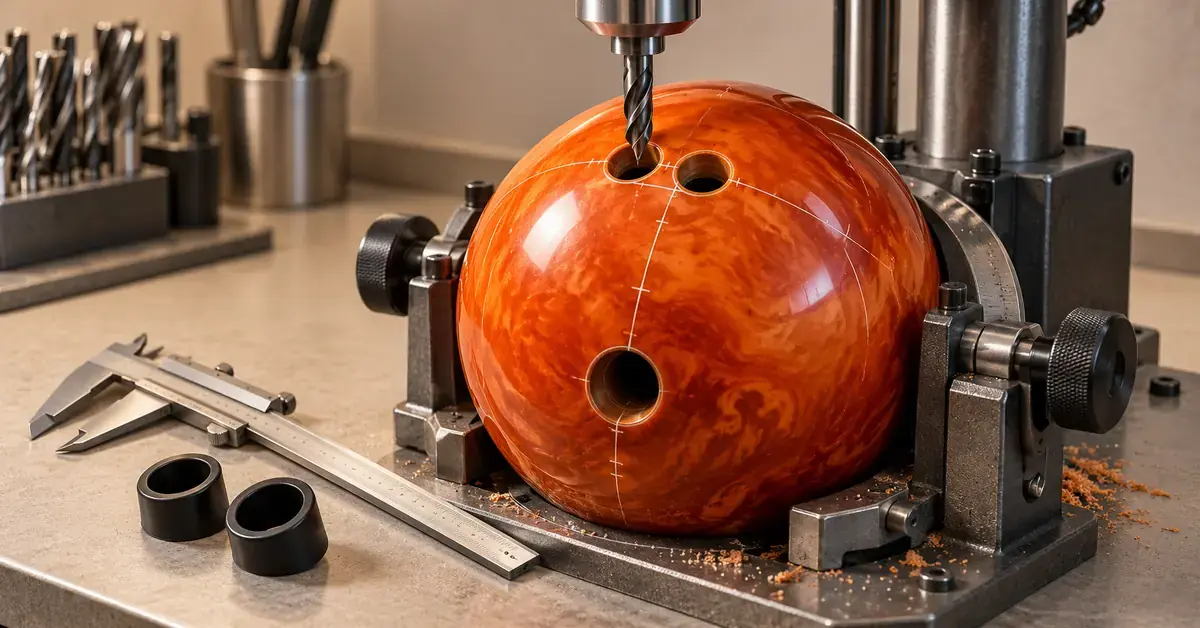
Bowling ball drilling is the process of cutting and shaping finger and thumb holes in a ten-pin bowling ball so it fits one bowler’s hand exactly. It is the single biggest step up from grabbing a house ball off the rack, because a properly drilled ball lets you hold on with less grip pressure, release cleanly and repeat the same shot far more consistently. This guide explains what happens at a pro shop, the difference between a conventional and a fingertip grip, what the work costs in New Zealand dollars, where to get it done, the rules your ball has to meet, and the mistakes that leave bowlers with a ball that hurts or underperforms.
Key Facts
- What it is: cutting and shaping finger and thumb holes in a ten-pin ball to fit one bowler’s hand.
- Applies to: ten-pin bowling only — lawn bowls are moulded and never drilled.
- Done by: a pro shop, usually attached to a ten-pin centre.
- Two grips: conventional (fingers to the second knuckle, best for beginners) and fingertip (first knuckle, longer span, more hook).
- Key measurements: span (thumb-to-finger distance), pitch (hole angle) and bridge (gap between finger holes).
- Typical NZ cost: about $40 conventional and $60 fingertip on top of the ball, more if the ball is bought elsewhere.
- The rule: up to five gripping holes, and no balance holes since 1 August 2020.
What does it mean to have a bowling ball drilled?
Drilling means a technician bores holes into a solid ten-pin ball and shapes them to your exact hand so the ball grips and releases the way you want. A brand-new reactive or urethane ball is sold undrilled (or with a factory “pin” marker only), because every hand is different. The pro shop measures your fingers and thumb, decides where the holes should sit relative to the ball’s internal core, then drills the thumb hole and finger holes and finishes them so the edges are smooth and the depth is right.
This only applies to ten-pin bowling. Lawn bowls are moulded with a fixed, built-in curve (the bias) and are never drilled — doing so would destroy them. If you have landed here looking at lawn bowls, see the site’s guide to what size lawn bowls you need instead. Everything below is about the ten-pin game.
Why is a custom-drilled ball better than a house ball?
A custom-drilled ball fits your hand, so you grip it with far less tension and can release it the same way every time. House balls are drilled with wide, generic holes meant to fit the largest possible range of hands, which forces most people to squeeze. That squeezing tires the hand, strips power out of the release and makes a repeatable shot almost impossible.
There are three practical gains from your own drilled ball:
- Fit and comfort. The span and hole sizes match your hand, so the ball hangs on your fingers rather than being gripped like a suitcase handle.
- A cleaner release. With the thumb hole shaped to exit smoothly, the ball comes off your hand without catching, which is the foundation of a good hook.
- Consistency. The same hand position every delivery means the ball reacts the same way, so you can actually learn and adjust.
A drilled ball is also usually paired with a modern coverstock. If you are weighing up what ball to buy before drilling, the site’s guides to the types of bowling balls and the best bowling ball for beginners explain coverstocks and cores.
How does a pro shop fit and drill your ball?
A pro shop fits a ball by measuring your hand, marking a layout on the ball, drilling the holes and then test-fitting before finishing them. Good drillers do not rush this — the measuring usually takes longer than the drilling itself, and most will have you put your hand in sample balls or a dummy grip first.
Measuring your hand
The fitter measures the length and thickness of your gripping fingers and thumb, and how far your fingers reach from the thumb. They also check how flexible your joints are, because a stiff hand and a double-jointed hand need different hole angles. These measurements set your span and pitches (explained below). Getting the ball weight right happens at the same time — a ball that fits but is too heavy still causes problems.
Span, pitch and bridge explained
Three measurements decide how a ball fits your hand:
- Span is the distance between the thumb hole and the finger holes. A short span suits a conventional grip; a longer span is used for a fingertip grip so only the first knuckle of each finger goes in.
- Pitch is the angle at which each hole is drilled — tilted toward the centre of the ball (forward pitch), away from it (reverse pitch), or to the side (lateral pitch). Pitch controls how easily your fingers and thumb go in and come out. Too much forward pitch can lock the thumb in; reverse pitch helps it release early.
- Bridge is the strip of ball left between the two finger holes. It is kept wide enough (commonly around a quarter of an inch) that the ball does not crack between the holes.
On a modern ball the fitter also works around the pin, a coloured dot marking the top of the weight block (core) inside the ball. Where the holes sit relative to the pin and your positive axis point (PAP, the spot the ball spins around) is the “layout”, and it changes how early or late the ball hooks. For a first ball you do not need to understand layouts in depth — a good shop will pick a sensible one for your style.
Drilling, inserts and the thumb slug
Once the layout is marked, the technician drills the holes on a press, bevels the sharp edges and sands them smooth. On a fingertip ball they usually fit finger inserts — soft rubber sleeves glued into the finger holes that give a grippier, more comfortable feel — and sometimes a thumb slug, a replaceable plug drilled to your thumb so the hole can be re-shaped later without plugging the whole ball. Expect to test the fit and have small adjustments made; a hole that feels slightly tight on the day will feel tight for every game afterwards.
Conventional vs fingertip grip: which should you choose?
Beginners should almost always start with a conventional grip; fingertip is the step you take once you want to hook the ball with real power. The two grips differ only in how far your fingers go into the ball, but that changes everything about the release.
A conventional grip seats your middle and ring fingers up to the second knuckle. It feels secure, it is forgiving, and it is how every house ball is drilled — ideal for straight shots and for picking up spares. The trade-off is that your fingers cannot rotate the ball much at release, so it is hard to generate a strong hook.
A fingertip grip stops those fingers at the first knuckle while the thumb still goes all the way in, using a longer span. At release the thumb exits first and the fingers lift and roll the ball, producing far more spin and a stronger hook. It takes more hand strength and better timing, and it is less forgiving of a poor release, which is why it is recommended once your fundamentals are sound.
Comparison
| Feature | Conventional grip | Fingertip grip |
|---|---|---|
| Finger depth | In to the second knuckle | In to the first knuckle only |
| Span | Shorter | Longer |
| Feel | Secure and forgiving | Less forgiving, more athletic |
| Hook potential | Limited | Strong |
| Best for | Beginners, straight shots, spares | Developing bowlers who hook the ball |
| Usually needs inserts | No | Often (finger inserts, thumb slug) |
| Typical NZ drill cost | About $40 + ball | About $60 + ball and accessories |
What does bowling ball drilling cost in New Zealand?
In New Zealand, expect to pay roughly $40 for a conventional grip and $60 for a fingertip grip when the ball is bought from the same pro shop, with higher fees if you bring a ball from elsewhere. Drilling is charged on top of the ball itself, and a fingertip layout costs more because it usually includes inserts and a thumb slug that have to be bought and fitted.
These are the published pro-shop rates at North City Tenpin in Porirua, a useful benchmark for the rest of the country:
| Service | Price (NZD) |
|---|---|
| Conventional grip (ball bought in-shop) | $40 + cost of ball |
| Fingertip grip (ball bought in-shop) | $60 + ball and accessories |
| Conventional grip (ball bought elsewhere) | $60 |
| Fingertip grip (ball bought elsewhere) | $80 |
| Plug and re-drill a thumb or balance hole | $25 |
| Plug and re-drill finger holes | $20 (one) / $30 (both) |
Prices vary between shops and change over time, so confirm before you book. As a rough all-up figure, a first setup in New Zealand — an entry-level reactive or urethane ball plus a fingertip drill with inserts — commonly lands somewhere around $200 to $350 depending on the ball you choose. If you later want the holes changed because your hand or style has changed, plugging and re-drilling is far cheaper than buying a new ball.
Where can you get a ball drilled in New Zealand?
Ball drilling in New Zealand is done at pro shops, which are small specialist counters usually attached to a ten-pin centre rather than standalone stores. Because the sport is smaller here than in the United States or Australia, there are only a handful, so plan to travel or post your ball if there is none in your town.
- Pro shops at ten-pin centres. Larger centres run or host a pro shop — for example the pro shop at North City Tenpin in Porirua, near Wellington, which drills balls, fits inserts and does plugging and re-drilling. Ask your local centre whether they have a driller on site or on call.
- League and club contacts. The quickest way to find a good driller is to ask experienced league bowlers. If you are not in a league yet, the site’s guide to joining a ten-pin league in NZ is a good place to start, and the people there will know who does the best work.
- Travel or ship. If no shop is nearby, bowlers often take their ball to a city centre or send it to a driller, then have small adjustments made on a later visit.
For an overview of where the main centres are, see the guide to bowling alleys in New Zealand.
What are the rules for drilling a bowling ball?
A legal ten-pin ball may have at most five gripping holes — one for each finger and the thumb, all on the same hand — and, since 2020, it can no longer have a separate weight-adjusting balance hole. New Zealand follows the specifications set by the United States Bowling Congress (USBC), which Tenpin Bowling New Zealand uses for sanctioned play.
The two rules that matter most when you have a ball drilled:
- No balance holes. Effective 1 August 2020, the USBC removed the extra non-gripping “balance” hole some bowlers used to fine-tune a ball’s reaction. If you buy a used ball with a plugged-over hole, that is why.
- Gripping holes are for gripping. Holes must be used to actually hold the ball during delivery. A thumb hole that a “no-thumb” bowler does not use is now treated as a balance hole, and a ball may have only one of those — so most modern no-thumb bowlers have no thumb hole drilled at all.
For casual social bowling none of this will ever come up, but if you plan to bowl in sanctioned leagues or tournaments it is worth having your driller confirm the ball is legal.
What are the most common bowling ball drilling mistakes?
The most common mistake is jumping straight to a fingertip grip before your release can handle it. Here are the errors that cost beginners the most comfort, money and progress:
- Going fingertip too early. If your timing and hand strength are not ready, a fingertip ball drops off your hand and feels worse than a house ball. Start conventional, then convert once you can repeat a clean release.
- Chasing a tight thumb hole. A thumb that feels snug when you are relaxed becomes a trap when your hand swells during play. The thumb should release freely; grip security comes from pitch and span, not from squeezing.
- Buying a ball online and guessing the holes. A pre-drilled ball bought sight-unseen almost never fits. Pay a pro shop to fit it — the drilling fee is small next to the price of the ball.
- Ignoring weight. A ball that fits but is too heavy wrecks your timing and your shoulder. Fit and weight have to be right together.
- Skipping the test fit. Always put your hand in and take a few practice swings before the holes are finalised. Small tweaks are easy before the ball leaves the press and expensive afterwards.
- Neglecting the ball afterwards. Oil soaks into the coverstock and dulls the reaction over time. Keep it working with a regular wipe-down, as covered in how to clean a bowling ball.
Who should get a bowling ball drilled?
You should get your own ball drilled once you are bowling regularly and want to improve, rather than just rolling the odd social game. If you bowl a few times a year with friends, house balls are fine and a custom ball is money you do not need to spend. The case for your own drilled ball is strong when any of these are true:
- You have joined, or are about to join, a league and want consistent results week to week.
- You are trying to learn to hook the ball and need a reactive coverstock with a grip that fits.
- House balls hurt your hand or thumb, or you can never find one that fits.
- You want to carry the same ball reaction every time instead of adapting to whatever is on the rack.
For most New Zealand bowlers the sensible path is: learn the basics with house balls, confirm you enjoy the sport, then buy an entry-level ball and have it drilled conventional. Move to a fingertip grip and a stronger ball later, when your release has caught up.
Sources
- North City Tenpin — Pro Shop services and drilling prices (Porirua, NZ)
- United States Bowling Congress — USBC modifies rule on bowling ball gripping holes
- United States Bowling Congress — USBC sets new specifications for bowling balls (balance-hole removal)
- Bowling.com — What is a fingertip grip, and conventional vs fingertip
- Storm Bowling — Drilling specification (span, pitch, bridge and pin clearance)
Frequently Asked Questions (FAQ)
How long does it take to drill a bowling ball?
The drilling itself usually takes well under an hour, but a pro shop needs time to measure your hand and test the fit, and busy shops often ask you to book. If the ball has to be ordered in, allow a week or two for it to arrive before the work can start.
Can I drill a bowling ball myself at home?
It is not recommended. Drilling needs a specialist press, accurate hand measurements and an understanding of span, pitch and the ball’s internal core. A wrong angle or depth can ruin the ball, void the warranty and leave you with a grip that hurts, so the small fitting fee is well worth paying.
Can a bowling ball be re-drilled if the holes do not fit?
Yes. A pro shop can plug the existing holes with a resin filler and drill new ones, which is common when your hand changes or you switch from a conventional to a fingertip grip. Re-drilling costs far less than a new ball, though heavily re-worked balls eventually run out of usable space.
Do I need inserts and a thumb slug?
Not for a basic conventional drill, but they are common on fingertip balls. Finger inserts make the grip more comfortable and consistent, and a thumb slug lets the thumb hole be re-shaped later without plugging the whole ball. Your driller will advise what suits your hand and budget.
How many holes can a legal bowling ball have?
A sanctioned ten-pin ball may have up to five gripping holes — one for each finger and one for the thumb, all on the same hand. Since August 2020 extra balance holes are not allowed, and any hole not used to grip the ball during delivery counts against that limit.
