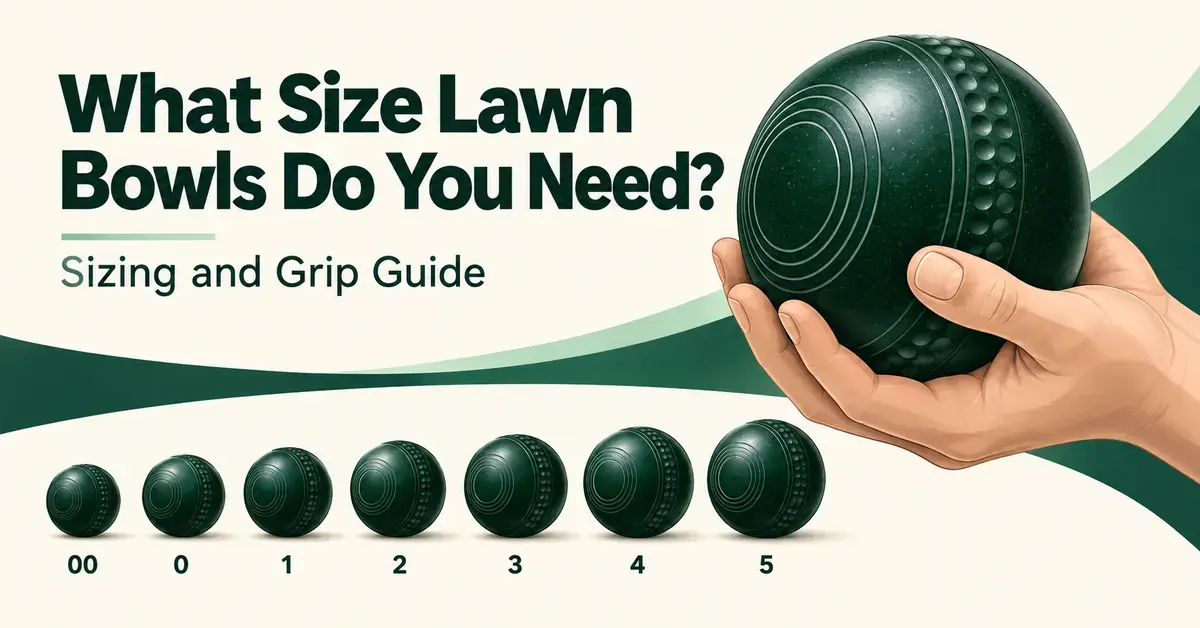
Choosing the right size lawn bowl comes down to one thing: how well the bowl fits your hand. Lawn bowls are made in a range of sizes from 00 (the smallest) up to 5 (the largest), and that number reflects the bowl’s diameter — not your height, your strength or how long you have played. Get the fit right and the bowl rolls off your fingers smoothly and repeatably; get it wrong and your line, length and consistency all suffer. This guide explains how bowl sizes work, how to measure the size you need using a few simple hand tests, and how weight, grip and bias fit into the decision, with a focus on New Zealand greens and the rules that apply here.
Key Points
- Size = diameter. Lawn bowls run from 00 (smallest) to 5 (largest); the number is the bowl’s width, not your height or strength.
- Fit to your hand. Most adults need size 1-4. Use the span test: fingers and thumb should just meet around the bowl with a small gap.
- Typical ranges. Women often use 0-2, men often 3-4, but comfort beats the average every time.
- Weight is separate. Heavy weight is the modern standard; medium suits players who want an easier delivery. No legal bowl exceeds 1.59 kg.
- Try before you buy. Borrow club bowls, test all four in the set, and re-check the fit when switching brands.
- Check the stamp. Competition bowls in New Zealand must carry a Bowls NZ or World Bowls test stamp dated 1982 or later.
The short answer: what size lawn bowls do I need?
Most adult players need a bowl between size 1 and size 4, and the correct size is the one where your fingers and thumb wrap comfortably around the bowl with just a small gap. Larger hands take a larger number; smaller hands take a smaller number. As a rough starting point, many women use sizes 0 to 2 and many men use sizes 3 to 4, but this is only a guide — a small-handed man may be a size 2 and a large-handed woman may be a size 4. Comfort and a secure, relaxed grip always matter more than the number stamped on the bowl.
What does lawn bowl “size” actually mean?
The size number on a lawn bowl refers to its diameter — the distance straight across the bowl at its widest point. A higher number means a physically bigger bowl. Under the World Bowls Laws of the Sport, bowls made of rubber or plastic resin (the modern norm) must measure between 116 millimetres and 131 millimetres across, and bowls made of wood between 116 millimetres and 134 millimetres. Every legal bowl also weighs no more than 1.59 kilograms.
In practice, that legal range is split into the familiar sizing scale. The smallest common size, 00, sits close to the 116 mm minimum, and each step up adds roughly one to two millimetres of diameter. Because the differences between sizes are small, trying the bowls in your hand is far more reliable than guessing from a chart. Size affects fit and grip; it does not, on its own, change how far or how straight the bowl runs.
Lawn bowls size chart
The chart below shows typical diameters for modern composite bowls and the hand size each is usually suited to. Exact figures vary between brands — a size 3 is about 121 mm in a Taylor bowl but closer to 123-124 mm in a Henselite, Drakes Pride or Aero — so treat these as a guide and always confirm the fit by hand.
Bowls Size Chart
| Size | Approx. diameter | Typical hand | Often chosen by |
|---|---|---|---|
| 00 | ~116-117 mm | Very small | Juniors, very small hands |
| 0 | ~118-119 mm | Small | Smaller-handed players |
| 1 | ~120-121 mm | Small-medium | Many women |
| 2 | ~122 mm | Medium | Many women, smaller-handed men |
| 3 | ~123-124 mm | Medium-large | Most common men’s size |
| 4 | ~125 mm | Large | Larger-handed men |
| 5 | ~127 mm | Very large | Very large hands |
How do I work out my correct bowl size?
The most reliable way to find your size is to hold real bowls and run a few quick fit tests, ideally at a club or a bowls retailer that lets you try before you buy. The tests below check the same thing from different angles: a bowl that fits will feel secure in your hand without any clenching or strain.
The span (cradle) test
The span test is the classic method and the one most coaches start with. Hold the bowl in one hand and spread your middle fingers along one side and your thumb along the other, so they wrap around the running surface (the smooth band that circles the bowl). Ideally the tips of your middle finger and thumb should just about meet at the top, or leave only a very small gap. If they overlap easily, the bowl is too small; if there is a wide gap, it is too big.
The gravity (drop) test
Hold the bowl in your hand, turn your palm face-down and stretch your arm out in front of you with the bowl held only by your fingers and thumb. A correctly sized bowl should stay put without you having to squeeze. If it starts to slip, or your hand aches and shakes after 20 to 30 seconds, the bowl is likely too big for a relaxed grip.
The swing and four-bowl test
Stand as if you are on the mat and gently swing the bowl by your side a few times. It should feel completely secure without you clenching your fist or tensing your wrist. Then pick up all four bowls in the set one after another and grip each as you would to deliver it. A size that feels fine for one bowl can feel strenuous by the third or fourth, so this test checks that the fit holds up over a full end rather than a single shot.
Do men and women need different sizes?
Men and women do not use a separate scale — everyone chooses from the same 00-to-5 range based on hand size. The common pattern is simply that larger hands, which are more often men’s, take larger numbers. Typical buying ranges are sizes 0 to 3 for women and sizes 3 to 6 for men, with 1, 2, 3 and 4 the most popular overall. These are averages, not rules: pick the size that passes the fit tests for your own hand, regardless of which range it falls in.
Heavy or medium weight — does it matter?
Weight is a separate choice from size, and for most players today the answer is heavy. Historically bowls came in medium and heavy weights of the same diameter, but the modern game leans heavily toward heavy weight because it holds its line better in wind and stays truer on faster greens. Some brands have dropped medium weight altogether — Henselite, for example, now produces heavy weight only, while Taylor and Drakes Pride still offer both.
Heavier is not automatically better for everyone. Players with less hand strength, younger bowlers, or anyone managing a wrist or shoulder issue may find a medium-weight bowl (where available) easier to deliver smoothly for a full game. Because weight is tied to size — a size 5 heavy bowl is heavier than a size 1 heavy bowl — the fit test and the weight decision work together. No legal bowl exceeds 1.59 kilograms.
How does grip affect the size you choose?
Your grip style changes how a bowl should sit in your hand, so it feeds directly into sizing. There are two main grips in lawn bowls, and the right size should work with yours.
- Cradle (or claw) grip: the bowl rests in the palm with the fingers spread across the running surface. This grip suits players who want maximum control and forgives a slightly larger bowl.
- Fingertip (or finger) grip: the bowl is held more on the fingers with the thumb higher up the side, giving a cleaner release. This grip usually calls for a bowl on the smaller, more secure end of your comfortable range.
Whichever grip you use, the delivery should end with the bowl rolling off your fingers, not being thrown or squeezed. If you have to grip hard to keep control, the bowl is probably too big; if it feels loose in your hand as you swing, it is probably too small.
Should beginners buy bowls straight away?
Beginners usually do not need to buy bowls immediately. Most New Zealand clubs keep sets of club bowls that new members can borrow, which lets you try different sizes and weights on a real green before spending anything. It is worth playing a few sessions, testing the span and swing on a couple of sizes, and settling on a fit before you commit to a set of your own. When you are ready to buy, take the size you have been comfortable with to a retailer and re-check the fit, since diameters differ slightly between brands and models.
If you are just getting started and want to find a club, our regional guides to lawn bowls in Auckland and Canterbury lawn bowls are good starting points, and clubs such as Howick Bowling Club welcome newcomers and often run introductory sessions where you can try borrowed bowls.
What else matters besides size?
Size gets you a bowl that fits your hand, but three other factors shape how it performs and whether you can use it in competition.
Bias
Every lawn bowl is shaped so that it curves as it slows down — this built-in curve is called bias, and it is fixed at manufacture; it is not adjustable. Different models have narrower or wider bias, which changes how much the bowl bends on its way to the jack. Bias is a model choice, not a size choice, so decide on your size first and then pick a model whose bias suits your green and playing style.
Model, colour and grip finish
Bowls come in many models, colours and surface finishes, and some have a dimpled or textured grip that helps in wet conditions. These are personal preferences and do not affect the legal size or weight limits.
The World Bowls stamp
To be used in official competition, a bowl must carry a valid test stamp. In New Zealand, the Bowls New Zealand Domestic Regulations require bowls to bear a Bowls NZ or World Bowls test stamp dated 1982 or later. Very old or unstamped bowls may be fine for casual social play but will not be permitted in club and national events, and stamps can require re-testing over time — so check the stamp before buying second-hand bowls.
Common mistakes when choosing bowl size
Most sizing errors come from choosing on the wrong basis rather than testing the fit. Watch out for these:
- Sizing by height or strength. Bowl size matches your hand, not your build. A tall, strong player with average-sized hands still needs an average-sized bowl.
- Going too big “to be safe.” An oversized bowl forces you to grip hard, which tightens your wrist and ruins a smooth release. When in doubt, size down.
- Testing with only one bowl. A size that feels fine for one delivery can fatigue your hand over an end. Grip all four before deciding.
- Confusing weight with size. These are separate choices; a bigger number is a bigger diameter, not simply a heavier bowl.
- Assuming brands are identical. A size 3 varies by a couple of millimetres between makers, so re-check the fit when you switch brands.
- Buying unstamped second-hand bowls. Bowls without a valid, in-date stamp cannot be used in competition, so confirm the stamp before you pay.
How many bowls do I need in a set?
A full set for singles and most competition play is four bowls of the same size, model and bias. For social and some short-format games you may only use two or three, but buying a matched set of four keeps your options open and ensures every bowl in your hand feels identical. Whatever the number, they should all be the same size — the whole point of finding your fit is that every bowl in the set behaves the same way. You can read more about the guides we publish on our about us page.
Sources
Frequently Asked Questions (FAQ)
What is the most common lawn bowl size?
Sizes 1, 2, 3 and 4 are the most popular overall. Many women use sizes 0 to 2 and many men use sizes 3 to 4, but the right size is always the one that fits your hand, not an average.
How do I measure my hand for lawn bowls?
Use the span test: wrap your middle fingers and thumb around the running surface of the bowl. If the tips just about meet at the top with only a small gap, the size is right. A wide gap means it is too big, and easy overlap means it is too small.
Is a bigger lawn bowl better?
No. A bowl that is too big for your hand forces you to grip tightly and disrupts your release, hurting accuracy. When you are unsure between two sizes, choosing the smaller one usually gives a more secure and relaxed grip.
What is the difference between size and weight in lawn bowls?
Size is the bowl’s diameter and is chosen to fit your hand. Weight is how heavy the bowl is, offered as medium or heavy by some brands. Most modern players use heavy weight because it holds its line better, but weight is a separate decision from size.
Do I need special bowls to play at a New Zealand club?
For social play you can usually borrow club bowls, so you do not need your own straight away. For official competition your bowls must carry a valid Bowls New Zealand or World Bowls test stamp dated 1982 or later.
