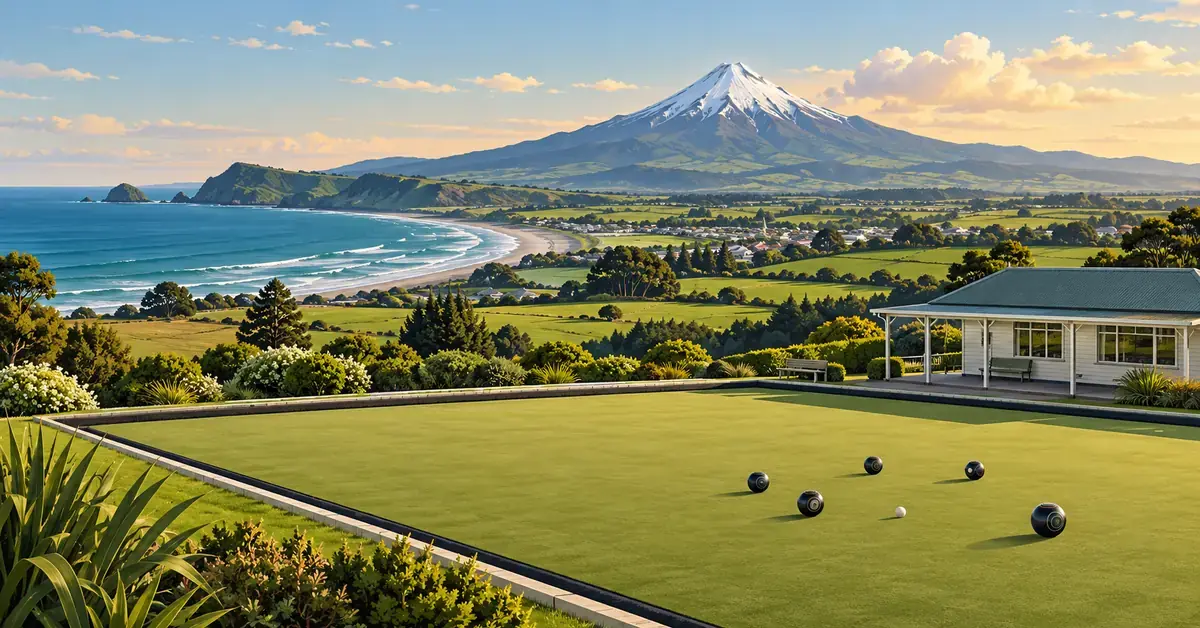
Taranaki, the mountain-and-coast region on the west of the North Island, has a long lawn bowls tradition and around 21 clubs scattered from New Plymouth down to the South Taranaki towns. Whether you live in the city, in a rural district or along the surf coast, there is almost certainly a green within easy reach. This guide maps the region’s clubs by area, explains how they are organised under Bowls Taranaki, and sets out what the season looks like, what it costs and how to join as a complete beginner.
Key Points
- Governing Centre: Bowls Taranaki runs the sport across the region under Bowls New Zealand.
- Clubs: around 21 affiliated clubs in three divisions — Northern, Southern and Western.
- Main hub: New Plymouth has the most clubs, including West End, Paritutu and the historic New Plymouth Bowling Club.
- Wider region: town and coastal clubs serve Waitara, Inglewood, Stratford, Hawera, Opunake and beyond.
- Season: outdoors roughly September/October to April; some clubs offer indoor carpet or artificial greens year-round.
- Getting started: clubs lend bowls, offer coaching, and need only flat-soled shoes to begin.
How lawn bowls is organised in Taranaki
Lawn bowls across the region is run by Bowls Taranaki, the local Centre of the national body. New Zealand is divided into regional Centres that look after clubs in their area, run inter-club competitions and representative teams, and help new players get started. Taranaki is one of those Centres, sitting under Bowls New Zealand, the governing body for the sport nationwide.
Bowls Taranaki’s own directory lists about 21 affiliated clubs grouped into three geographic divisions — Northern, Southern and Western. The divisions mainly exist for organising competition and travel; as a player you simply join the club nearest you or the one whose people you click with. The Centre office is at 445 St Aubyn Street, Moturoa, New Plymouth, and is staffed on Tuesdays and Fridays from 10am to 1pm, which is a useful first point of contact if you are not sure which club to approach.
A “club” in lawn bowls means a clubhouse with one or more flat greens, each divided into playing lanes called rinks. Most Taranaki clubs are incorporated societies run largely by volunteers, with a licensed bar, a social calendar and competitive teams that play other clubs through the summer.
Lawn bowls clubs in New Plymouth
New Plymouth, the region’s main city, holds the largest concentration of clubs. Between them they offer natural and artificial greens, indoor carpet rinks for year-round play, and some of the oldest bowling history in Taranaki. If you want a broader look at the city — including ten-pin bowling — see our guide to bowling in New Plymouth.
New Plymouth Bowling Club
Based on Brooklands Road near Pukekura Park, the New Plymouth Bowling Club is the city’s oldest and traces its roots to the late 1800s. It runs two greens, one natural grass and one artificial, so play can carry on in a wider range of weather. Its central, parkside setting makes it a convenient option for anyone living in or near the city centre.
West End Bowling Club
West End, at 101 Cutfield Road in the Westown area, is one of the biggest and oldest clubs in Taranaki. It has three premium outdoor greens of eight rinks each, plus two indoor spaces with their own bars, a main hall, dining room and commercial kitchen. That scale makes it a strong choice if you want a busy competitive programme and a full social scene. The club can be reached on 06 758 0089.
Paritutu Bowling Club
Paritutu, at 445 St Aubyn Street in Moturoa, shares a site with the Bowls Taranaki office near the port. Alongside its outdoor greens it has a six-rink indoor carpet stadium, which is relatively rare in the region and lets members bowl through winter and in poor weather. It is a good pick for players who want to keep their eye in all year.
Waimea, Fitzroy and Vogeltown clubs
Three smaller New Plymouth clubs round out the city. Waimea, in Westown, is a compact, friendly club dating from 1950 with a single green and a social focus. Fitzroy, in the Strandon area to the east, runs two natural greens. Vogeltown serves the suburb of the same name on the city’s southern side. These clubs tend to suit players who prefer a quieter, more intimate feel than the big city clubs.
Lawn bowls clubs in North Taranaki
North of New Plymouth, a cluster of district clubs serves the coastal towns and farming communities along State Highway 3. These are smaller, community-centred clubs where a visitor is quickly made to feel at home.
- Waitara — the main town club north of the city, serving the Waitara River community.
- Urenui — a small coastal club further up the highway, popular over the summer holidays.
- Lepperton — a rural club inland from Waitara.
- Awakino — the northernmost club in the Centre, near the top of the Taranaki coast.
Because these clubs are small, greens and bar hours can be more limited and run by a handful of volunteers. It is always worth phoning ahead before turning up, especially outside the main playing days.
Lawn bowls clubs in South and central Taranaki
South and inland Taranaki — around Inglewood, Stratford, Hawera and the smaller towns — is home to several established clubs, including some that have merged to stay strong.
Hawera clubs: Tower and Hawera Park
Hawera, the largest town in South Taranaki, has two clubs. Tower Bowls was formed in 2017 when the Hawera and Nolantown clubs merged, pooling members and resources into one stronger club — a common and sensible step as volunteer numbers tighten. Hawera Park, on High Street, is the town’s other option. Between them they give South Taranaki players a solid competitive base.
Stratford-Avon Bowling Club
In Stratford, at the foot of the mountain in central Taranaki, the Stratford-Avon club is a non-profit incorporated society with two natural greens. It has hosted Bowls Taranaki meetings and is the natural home club for the central part of the region.
Inglewood, Manaia and Patea
Three more town clubs serve the wider south. Inglewood sits between New Plymouth and Stratford and draws from the surrounding dairy country. Manaia and Patea serve the coastal south of the region; Patea is the southernmost club in the Southern Division. All three are small, welcoming clubs where beginners are an asset rather than an inconvenience.
Coastal and western Taranaki clubs
The surf coast and western side of the mountain have their own small clubs, several of them a short drive from New Plymouth and popular with holidaymakers and semi-retired players.
- Oakura — on the coast just southwest of New Plymouth, handy for the beach communities.
- Okato — a rural coastal club further around the mountain on Surf Highway 45.
- Opunake — the main western coastal club, the endpoint of the Western Division.
- Rahotu and Pihama — two small country clubs between Opunake and the south.
Taranaki Clubs at a Glance
| Club | Area | Notable facilities |
|---|---|---|
| New Plymouth | New Plymouth (Brooklands Rd) | City’s oldest club; natural and artificial greens |
| West End | New Plymouth (Westown) | Three 8-rink greens, two indoor spaces with bars |
| Paritutu | New Plymouth (Moturoa) | Outdoor greens plus six-rink indoor carpet stadium |
| Waimea / Fitzroy / Vogeltown | New Plymouth suburbs | Smaller, social clubs |
| Waitara / Urenui / Lepperton / Awakino | North Taranaki | Small community and coastal clubs |
| Inglewood | Central Taranaki | Rural town club |
| Stratford-Avon | Stratford | Non-profit club with two natural greens |
| Tower / Hawera Park | Hawera (South Taranaki) | Tower formed from a 2017 merger of two clubs |
| Manaia / Patea | South Taranaki coast | Small town clubs |
| Oakura / Okato / Opunake / Rahotu / Pihama | Western / surf coast | Small coastal and country clubs |
When is the lawn bowls season in Taranaki?
The main outdoor lawn bowls season in Taranaki runs through the warmer months, broadly from September or October to around April, in line with the rest of New Zealand. Exact opening and closing dates vary by club and depend on green conditions, so check with the club you plan to join. Clubs with an artificial green or an indoor carpet stadium — such as New Plymouth and Paritutu — can offer play well outside the standard summer window.
During the season most clubs hold a regular club day (often a weekend morning) plus one or more club nights, alongside the inter-club competitions organised by Bowls Taranaki. Winter is usually quieter outdoors, though indoor bowls and social sessions keep some clubs active year-round.
How to join a lawn bowls club in Taranaki
Joining is simpler than most newcomers expect, and you do not need any gear to start. The usual path looks like this:
- Pick a club by location. Choose the green nearest you, or the one with the social scene or competition level you want. Any Taranaki club will point you to a better-fitting one if needed.
- Make contact. Phone or email the club, or ask Bowls Taranaki, and say you are a beginner. Many clubs run come-and-try days or open mornings.
- Turn up and have a roll. Clubs lend bowls to newcomers, so you can try the game before spending anything. A volunteer or coach will usually show you the basics.
- Join and get coaching. If you enjoy it, pay the season’s membership and take the free or low-cost coaching most clubs offer. For the full national picture, see our guide on how to join a lawn bowls club in New Zealand.
If you just want a relaxed, one-off social session with friends rather than full membership, ask whether the club runs barefoot bowls — a casual, come-as-you-are version played in flat shoes or bare feet.
What does it cost to play in Taranaki?
Lawn bowls is one of the cheaper club sports in New Zealand. Full annual membership at a Taranaki club typically runs from around $100 to a few hundred dollars for the season, depending on the club’s size and facilities, and often includes free coaching and use of the greens. Many clubs offer cheaper first-year, student or social memberships to help newcomers in gently. Casual visitors and barefoot bowls groups usually pay a small green fee instead.
You can play your first few sessions with borrowed bowls, so there is no upfront equipment cost. When you are ready to buy your own set, our guide to how much lawn bowls cost in New Zealand breaks down new and second-hand prices.
What to wear and bring
The one firm rule is footwear: bowls must be played in flat-soled shoes that will not mark or damage the green, and many clubs will lend or sell suitable shoes. Beyond that, clubs are relaxed for social play — sun hat, sunscreen and a water bottle are the real essentials given Taranaki’s changeable, often breezy coastal weather. Formal competition may call for club colours or whites, but you will not need those as a beginner. Our guide to the lawn bowls dress code and shoes covers the details.
Common mistakes beginners make
A few avoidable missteps trip up newcomers across the region:
- Buying bowls before trying the game. Borrow first. The right size and bias only make sense once you have rolled a few ends and know your grip.
- Turning up unannounced at a small club. Rural North and South Taranaki clubs are volunteer-run with limited hours. A quick phone call avoids finding the gates locked.
- Assuming you are too young or too old. Clubs welcome all ages, and many are actively recruiting younger players; you do not need to be retired to belong.
- Wearing the wrong shoes. Heeled or hard-soled footwear can mark the green and will not be allowed on. Flat soles are non-negotiable.
- Overlooking the social side. The clubhouse, shared meals and club nights are a big part of the appeal — treating bowls as sport only misses half of what a Taranaki club offers.
Who lawn bowls in Taranaki suits
Lawn bowls in Taranaki suits almost anyone looking for a low-cost, outdoor, social sport with a strong community around it. Retirees and semi-retired players make up a large share of members and value the gentle exercise and companionship, but the clubs increasingly welcome families, younger players and workmates after a friendly summer activity. If you want serious competition, the larger New Plymouth clubs and Bowls Taranaki’s inter-club programme provide it; if you simply want a relaxed roll and a drink afterwards, any of the smaller district clubs will fit the bill. If you are brand new to the game, our beginner’s guide to how to play lawn bowls is the best place to start.
Sources
- Bowls Taranaki — Club Directory
- Bowls Taranaki — Clubs
- Bowls New Zealand — Find a Club
- Bowls New Zealand — West End NP Bowling Club
- Bowls New Zealand — New Plymouth Bowling Club
- Bowls New Zealand — Paritutu Bowling Club
- Bowls New Zealand — Stratford Avon Bowling Club
- Bowls New Zealand — Tower Hawera Bowling Club
Frequently Asked Questions (FAQ)
How many lawn bowls clubs are there in Taranaki?
Bowls Taranaki’s club directory lists around 21 affiliated clubs, grouped into three geographic divisions — Northern, Southern and Western. They range from large multi-green city clubs in New Plymouth to small single-green clubs in rural and coastal towns. Numbers change over time as clubs occasionally merge, so the Centre is the best place to confirm the current list.
Which are the biggest lawn bowls clubs in New Plymouth?
West End, on Cutfield Road, is one of the largest, with three eight-rink outdoor greens and two indoor function spaces. Paritutu in Moturoa pairs outdoor greens with a six-rink indoor carpet stadium for year-round play, and the New Plymouth Bowling Club near Pukekura Park is the city’s oldest. Each offers coaching and a full competitive and social programme.
Do I need my own bowls to start?
No. Taranaki clubs lend bowls to beginners and visitors, so you can play your first sessions at no equipment cost. You only need flat-soled shoes that will not damage the green, which many clubs can also provide. Buying your own set makes sense later, once you know the size and bias that suit you.
When can I play lawn bowls in Taranaki?
The main outdoor season runs roughly from September or October to April, matching the New Zealand summer. Exact dates depend on the club and green conditions. Clubs with an artificial green or indoor carpet rinks, such as New Plymouth and Paritutu, can offer bowling outside the standard season and in poor weather.
How much does it cost to join a club in Taranaki?
Full season membership usually costs from about $100 to a few hundred dollars, depending on the club and its facilities, often including free coaching and green use. Many clubs offer discounted first-year, student or social memberships, and casual or barefoot bowls visitors pay a small green fee instead of joining.
