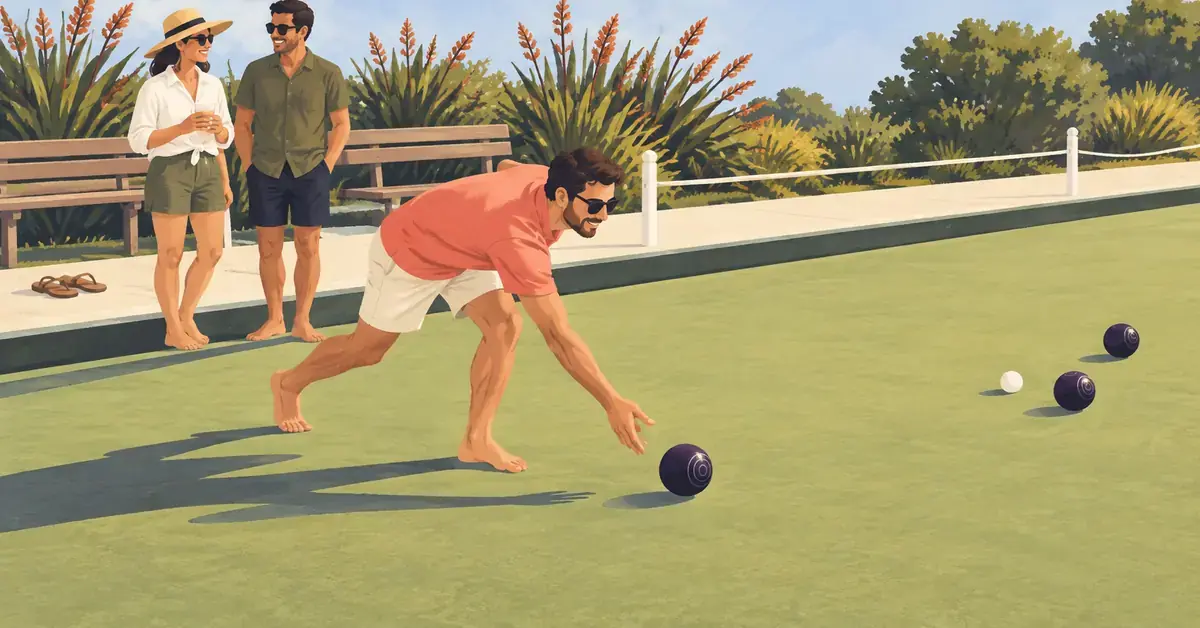
Barefoot bowls is a relaxed, social version of lawn bowls that you play in bare feet or flat shoes, with no experience needed and the club supplying everything you roll. It has become one of the most popular ways for groups of friends, workmates and families to spend a summer afternoon in New Zealand, and it is also how a lot of people first discover the sport. This guide explains exactly what barefoot bowls is, where it came from, how a casual session actually runs, what it costs here, and how to book one and give it a go.
What is barefoot bowls?
Barefoot bowls is lawn bowls stripped of its formality: the same green, the same bowls and the same basic aim, but played casually for fun rather than as a structured competition. Players turn up in everyday clothes, slip off their shoes or wear flat soles, and roll a few ends while chatting, often with a drink or a barbecue on the side.
The key difference from club or competition bowls is the atmosphere, not the equipment. There is no dress code of club whites, no umpire, and no requirement to know the rules before you arrive. A club member or staff member gives a short how-to, hands out the bowls, and lets your group play at its own pace. That makes it an easy, low-pressure introduction to a sport that can otherwise look intimidating from the outside.
Because it is so informal, “barefoot bowls” is used loosely. Some clubs run it as a regular weekly social evening, others book it out for private groups, work functions, birthdays, and hen’s or stag parties, and a few treat it as a come-and-try taster to recruit new members.
Key Facts
- What it is: a relaxed, social form of lawn bowls played in bare feet or flat shoes
- Experience needed: none — clubs give a short how-to and provide the bowls
- Typical cost (NZ): about $10–$20 per person; members often free; some clubs charge per rink
- Session length: around 2–3 hours
- Footwear: bare feet or flat, smooth soles — no heels, studs or ridged/serrated soles
- Best for: groups, work functions, birthdays, families and curious beginners
- How to start: phone or email a local lawn bowls club and book a session, especially in summer
Where did barefoot bowls come from?
Barefoot bowls grew out of Australian “bowlo” culture, where local bowling clubs reinvented themselves as casual social venues. As traditional membership aged and declined, clubs across Australia began opening their greens to a younger, more relaxed crowd who came for the social scene as much as the sport. Playing in bare feet became the symbol of that shift: no uniform, no fuss, just a green, a few bowls and a group of mates.
The idea travelled easily across the Tasman. New Zealand clubs have long run social and summer formats to broaden their appeal, and barefoot bowls fits neatly alongside them. Today it is common for Kiwi clubs to market barefoot sessions to groups and tourists over the warmer months, using them both as a revenue stream and as a gentle pathway into membership for anyone who enjoys it enough to come back.
How a game of barefoot bowls works
The aim of barefoot bowls is simple: roll your bowls as close as possible to the small white target ball. Everything else is detail you can pick up as you go, which is why a quick introduction from the club is usually all you need.
The basic aim
A player rolls the small white ball, called the jack, down the green to set a target. Each player or team then takes turns rolling their larger bowls, trying to finish nearer the jack than their opponents. Once everyone has bowled, the side with the closest bowl or bowls wins that “end” and scores a point for each of its bowls that is closer than the opponent’s best. You then play back in the other direction for the next end. If you want the full walk-through, see our guides to how to play lawn bowls and how scoring works in lawn bowls.
Why the bowls curve
Lawn bowls are not perfectly round. Each one is shaped so that it is weighted to one side, which makes it curve, or “draw,” as it slows down. This built-in curve is called the bias, and learning to aim off to one side so the bowl swings back towards the jack is the single most satisfying thing beginners discover. Our explainer on what bias is and why the bowl curves covers it in plain English.
Do you keep score?
You can, but you do not have to. At a casual barefoot session many groups keep a loose tally or simply play until it is time to pack up. If your group is competitive, keeping score adds a bit of edge; if you are there mainly to socialise, nobody minds if the maths gets fuzzy. That flexibility is part of the appeal.
What happens at a barefoot bowls session
A typical barefoot bowls session runs for about two to three hours and is built around groups rather than individuals. When you arrive, staff organise everyone into teams, hand out bowls and give a short demonstration of how to deliver them and how the scoring works. From there your group plays across one or more rinks (the lanes marked out on the green), rotating players in and out as you like.
Most clubs pair the bowls with hospitality. A bar is usually open, and many venues offer a barbecue, platters or a bistro, so a barefoot afternoon often doubles as a casual function. Drinks generally have to stay off the green itself, and clubs ask you not to bowl with a glass in hand, both for safety and to protect the playing surface. Where alcohol is served, please drink responsibly and sort a way home in advance.
Group sizes are flexible. Small groups can often just turn up and pay per head, while larger bookings of 10 or more usually need to reserve rinks ahead of time, sometimes with a deposit. A single green can host dozens of players at once, so barefoot bowls scales comfortably from a handful of friends to a whole workplace.
What to wear and bring
The one firm rule at barefoot bowls is footwear, and it is easy to get right. Everything else is about being comfortable outdoors.
Footwear: bare feet or flat soles
You play in bare feet or in flat, smooth-soled shoes such as sneakers. The reason is the green: bowling greens are a fine, closely mown surface that is easily damaged, so heels, sports studs, steel-capped boots, golf spikes and ridged or serrated soles are not allowed because they dig in and leave marks. Jandals are accepted at some clubs but not all. If you would rather not go barefoot, flat trainers are the safe choice. Our guide to the lawn bowls dress code and shoes explains the footwear rule in more detail.
Clothing
Wear casual, comfortable clothes suited to the weather. There is no requirement for club whites at a social session. Bring a hat, sunglasses and sunscreen for a sunny afternoon, and a light rain jacket in case of a passing shower, since light rain usually does not stop play. Some clubs ask people to avoid singlets or to keep costumes green-friendly, so it is worth checking when you book.
What the club provides and what to bring
Clubs supply the bowls, the green and the coaching, so you do not need any equipment of your own. Bring cash or a card for the session fee and the bar, your group’s enthusiasm, and not much else. Outside food and drink are usually not permitted where the club has its own bar and kitchen.
How much does barefoot bowls cost in New Zealand?
Barefoot bowls in New Zealand typically costs about $10 to $20 per person for a session, with existing club members often playing free. Some clubs instead charge per rink for a private booking, and larger groups may be asked for a deposit to hold their space.
- Kohimarama Bowling Club (Auckland): ran Sunday barefoot afternoons at $20 per person, free for members, with the fee covering rink hire and use of the club’s equipment.
- Queenstown Bowling Club: charges around $10 per person for functions, including the use of the club’s bowls, and regularly hosts groups of roughly 30 to 100 people. Using the bar for a private function requires a Special Function Licence arranged in advance.
- Browns Bay Bowling Club (Auckland): offers private and corporate hire that includes bowls and coaching, with pricing on request.
Prices, session times and availability change from club to club and season to season, so always confirm the current rate when you book rather than relying on a figure you saw online.
Who is barefoot bowls for?
Barefoot bowls suits almost anyone, which is exactly why clubs promote it. The short answer: if you can roll a ball along the ground, you can play.
- Groups and social outings: work functions, team-building days, club nights and get-togethers where you want an activity that keeps everyone involved.
- Celebrations: birthdays, hen’s and stag parties, reunions and fundraisers.
- Families: many clubs welcome children, often from around age 12 with adult supervision, though younger kids may need to watch from the side. Check each club’s policy.
- Visitors and tourists: a low-cost, uniquely local way to spend an afternoon, especially in summer holiday spots.
- Curious beginners: anyone thinking about taking up lawn bowls properly can use a barefoot session as a no-commitment trial.
Because it needs no experience, fitness or gear, barefoot bowls is genuinely multi-generational, which is rare among group activities.
How to give barefoot bowls a go
Getting started with barefoot bowls takes one phone call or email. The process is the same almost everywhere.
- Find a local club: most towns have at least one lawn bowls club, and many run or host barefoot sessions over summer. Regional bodies such as Bowls Auckland can point you to member clubs.
- Call or email ahead: ask whether they run barefoot bowls, what it costs, and whether greens are available on your date. Barefoot sessions are weather- and season-dependent, so booking matters.
- Confirm the details: group minimum, deposit, how long you get, whether the bar and food are available, and the footwear policy.
- Turn up and play: arrive a little early, pay at the bar or on registration, get your quick lesson, and start rolling.
If you enjoy it and want to keep going, a barefoot session is the natural first step towards club membership. Our guide on how to join a lawn bowls club in New Zealand walks through membership types, fees and the beginner pathway.
Common mistakes to avoid
Most barefoot bowls hiccups come from treating it like a pub booking rather than a club activity. A few things to get right:
- Not booking ahead: greens have limited rinks and are weather-dependent, so turning up unannounced with a big group often means no space. Book, especially in summer.
- Wearing the wrong shoes: heels, studded sports shoes, boots or ridged soles will be turned away to protect the green. Bring flat trainers or plan to go barefoot.
- Putting drinks on the green: keep glasses and food off the playing surface and do not bowl with a drink in hand.
- Treating it as a drinking session only: it is a sport first. Pace yourself, and arrange safe transport home if the bar is open.
- Overcomplicating it: do not stress about rules or technique. Listen to the quick lesson, aim for the bias to curve the bowl back, and enjoy it.
- Forgetting sun protection: you are outdoors for hours, so a hat, sunglasses and sunscreen make a real difference.
Barefoot bowls vs regular lawn bowls
Barefoot bowls and regular club lawn bowls are the same game played with very different expectations. The table below sums up how they compare, so you can see which one suits what you are after.
Barefoot Bowls vs Regular Lawn Bowls
| Feature | Barefoot bowls | Regular club lawn bowls |
|---|---|---|
| Main purpose | Casual fun and socialising | Structured play and competition |
| Experience | None needed; quick lesson on arrival | Players learn skills and rules over time |
| Footwear | Bare feet or flat shoes | Approved flat-soled bowls shoes |
| Dress | Casual, weather-appropriate clothes | Club colours or whites for many events |
| Equipment | Supplied by the club | Often your own set of bowls |
| Scoring | Optional and informal | Scored and often officiated |
| Commitment | One-off booking, pay per session | Club membership and fees |
| Typical players | Groups, visitors, first-timers | Members across all levels |
Sources
- Bowls New Zealand — How to Play Bowls
- OurAuckland (Auckland Council) — Barefoot Bowls Afternoons, Kohimarama Bowling Club
- Queenstown Bowling Club — Visitors and Functions
- The Wānaka App — Barefoot bowls a success (Hāwea Bowling Club)
- Te Ara, the Encyclopedia of New Zealand — Bowls, pétanque and tenpin
- Australian Traveller — Great Aussie bowlos with a twist
Frequently Asked Questions (FAQ)
Do you actually play barefoot?
You can, but you do not have to. Barefoot bowls simply means you play in bare feet or in flat, smooth-soled shoes such as sneakers. The point is to protect the fine grass surface from heels, studs and ridged soles, so either bare feet or flat trainers are fine.
Do I need any experience to play barefoot bowls?
No. Barefoot bowls is designed for complete beginners. A club member or staff member gives a short demonstration of how to roll the bowls and how scoring works, provides all the equipment, and helps organise teams, so you can turn up knowing nothing about the sport.
How much does a barefoot bowls session cost in New Zealand?
Expect roughly $10 to $20 per person for a session, with existing club members often playing free. Some clubs charge per rink for private bookings instead, and larger groups may need to pay a deposit. Prices vary by club and season, so confirm the current rate when you book.
How long does a barefoot bowls session last?
A typical session runs about two to three hours, which is enough time for a short lesson and several ends of relaxed play. Many clubs let you stay on afterwards for food and drinks at the bar, so the afternoon or evening can run longer as a social event.
Can children play barefoot bowls?
Often yes. Many clubs welcome children with adult supervision, commonly from around age 12, while younger kids may need to watch from the side. Policies differ between clubs, so check the age rules when you make your booking.
