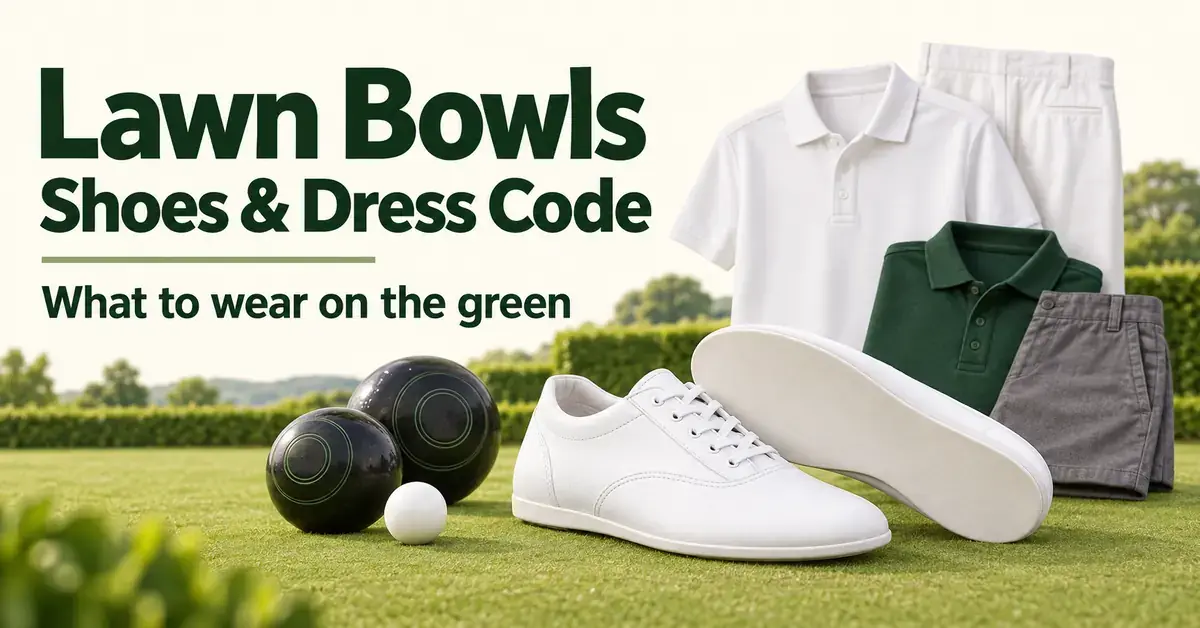
Lawn bowls has two separate wardrobe questions: what you must wear (footwear) and what you are expected to wear (clothing). The footwear rule is strict and enforced because the wrong shoes damage the green; the clothing side ranges from traditional whites to relaxed casual gear, depending on where and how you play. This guide explains both for New Zealand players — the flat-soled shoe requirement set by Bowls New Zealand, the difference between whites and club colours, and what is fine for a social roll-up — so you can turn up to any green dressed correctly.
Key Points
- Footwear is the one strict rule: players, umpires and markers must wear flat-soled, heel-less shoes on the green (Bowls New Zealand, effective 1 April 2023).
- Why: heels and grooved treads dent and scuff the green, especially when wet, changing how bowls run.
- Clothing has three tiers: traditional whites for formal competition, club colours/greys for everyday play, and neat casual or barefoot for social bowls.
- Beginners need little: flat-soled shoes or bare feet, comfortable clothes, a hat and sunscreen — clubs usually lend the bowls.
- When unsure, ask: the club, centre or event’s conditions of play set the required standard.
What is the lawn bowls dress code?
The lawn bowls dress code is a mix of one mandatory rule and several conventions. The only requirement enforced everywhere is footwear: you must wear flat-soled, heel-less shoes (or play barefoot where allowed) to protect the playing surface. Everything else — collared shirts, whites, club colours — is a convention set by your club, your centre or the competition you are entering, and it varies from formal championship dress to “neat casual” for a social game.
In practice this means a beginner turning up for social bowls needs almost nothing special, while a player in a national final follows a detailed uniform code. Understanding which situation you are in is the key to dressing correctly, and the sections below break the topic down question by question.
Why do lawn bowls require flat-soled shoes?
Flat-soled shoes are required because heels and heavy tread damage the green. A bowling green is a finely mown, level surface — often manicured grass or synthetic turf — and a bowl only runs true if that surface stays smooth. Heeled shoes punch small indentations into the turf, and the damage is worst when the green is wet or soft, when a heel can churn the surface. Ridged or grooved soles (like ordinary trainers or running shoes) can also carry in small stones and weed seeds, and can lift or scuff the grass.
Because a single scuffed or pitted patch changes how bowls behave across the whole rink, clubs treat footwear as a protection-of-the-green issue rather than a fashion one. That is why it is the one clothing rule that is enforced consistently across social, club and championship play alike.
What counts as a flat-soled bowls shoe?
A flat-soled bowls shoe has no raised or attached heel and a smooth, one-piece sole that sits level on the grass. The sole can be a non-slip material with a slightly abrasive surface for grip, but it must not have deep channels, pronounced ripples or a distinct heel block. Purpose-made bowls shoes are designed to this standard, but any genuinely flat, heel-less shoe with a smooth sole can meet it.
What footwear is not allowed?
Footwear that damages the green is not permitted, and the offending player can be asked to change their shoes. The usual culprits are:
- Any shoe with a raised or built-up heel, including most casual and dress shoes.
- Sports trainers, running shoes and cross-trainers with deep, grooved or knobbly treads.
- Boots, hiking shoes and anything with a chunky sole.
- Spikes, cleats or studded footwear of any kind.
If your shoes are not suitable at a casual session, most clubs will simply ask you to take them off and play barefoot rather than turn you away.
The Bowls New Zealand footwear rule explained
Bowls New Zealand’s domestic regulation states that players, umpires and markers must wear flat-soled (heel-less) footwear when they play on the green or act as an umpire or marker, and that soles may be of a non-slip material with a slightly abrasive surface. The rule took effect on 1 April 2023 and applies to all domestic play in New Zealand — club, centre, regional and national competitions. Footwear that damages the green is not permitted, and the controlling body can require a player to remove and replace such shoes.
This is the authoritative standard for organised play in New Zealand. Individual clubs and centres can add clothing requirements on top, but they cannot waive the flat-soled footwear rule for competition.
How is footwear approved?
Bowls New Zealand can approve footwear for use on greens, and a player or a manufacturer/supplier can submit a sample for assessment. Approval is based on features including the contour of the sole, a one-piece sole, channel depth, no raised heel, no attached heel, rounded edges, an indented non-slip sole and no excessively pronounced ripples. Once footwear is approved it is notified to centres. In everyday terms, buying shoes marketed specifically as lawn bowls shoes is the simplest way to be sure your footwear complies.
What about medical needs and barefoot play?
Bowls New Zealand may grant a dispensation to wear a particular type of footwear, or no footwear at all, on medical grounds. Separately, playing barefoot is common and accepted at social or “barefoot bowls” sessions because bare feet do not damage the green. If you have a foot condition or an injury that stops you wearing standard flat-soled shoes in competition, ask your club how to apply for a dispensation rather than turning up in non-compliant shoes.
What clothing should you wear on the green?
Clothing depends on the occasion, and it falls into three broad tiers: traditional whites for formal competition, club colours or greys for everyday play, and neat casual for social or barefoot bowls. Collared shirts are the norm across the more formal tiers, and the dress standard is generally set by the club, the centre or the specific event.
Whites — the traditional formal look
Whites are the classic bowls uniform: a white collared top with white trousers, shorts or a skirt. They are usually reserved for formal occasions such as the later stages of club competitions and national championships, or when representing a centre or region. The look reflects the sport’s heritage, and where an event calls for whites, the requirement is normally spelled out in its conditions of play.
Club colours and greys — everyday play
Club colours (often called “greys”) are now the most common attire for club matches, pennant play and roll-ups. This typically means grey or black trousers, shorts or a skirt with a white or club-branded coloured top. Many clubs issue or sell a branded shirt in the club’s colours, and formal competitions may require that branded shirt rather than a plain white one. This tier keeps a smart, uniform appearance while being more practical and affordable than full whites.
Mufti, social and barefoot bowls
For social bowls, twilight sessions and barefoot bowls, neat casual clothing is fine — comfortable shorts, trousers or a dress with a decent top. Despite the name, most clubs let you keep your shoes on for barefoot bowls as long as they are flat-soled; otherwise you play in bare feet. Some clubs also run “mufti” days where the usual whites or colours are relaxed. If you are new and just trying the game, comfortable clothes, flat-soled shoes or bare feet, a hat and sunscreen are all you need — clubs usually lend the bowls themselves.
What to Wear at a Glance
| Play type | Top | Bottoms | Footwear |
|---|---|---|---|
| Formal competition / championships | White collared shirt (or club-branded shirt if specified) | White trousers, shorts or skirt | Flat-soled bowls shoes (white) |
| Club matches / pennants / roll-ups | White or club-branded coloured top | Grey or black trousers, shorts or skirt | Flat-soled bowls shoes (white or grey) |
| Social / twilight / barefoot bowls | Neat casual top | Comfortable casual shorts, trousers or dress | Any flat-soled shoes, jandals or bare feet |
How do you choose bowls shoes?
Choose bowls shoes on sole compliance and comfort first, then on style. Because you spend hours standing and walking on grass, fit and support matter as much as looks. Points to weigh up:
- Compliant flat sole: confirm the shoe is heel-less with a smooth, one-piece sole — shoes sold specifically as lawn bowls shoes meet the standard.
- Traditional shoe or trainer style: classic slip-on and lace-up bowls shoes give a formal look, while modern bowls “trainers” are lighter and more cushioned for long days.
- Colour: white to go with whites, and grey or neutral tones for club-colours play; some players own a pair of each.
- Weather features: water-resistant or waterproof uppers help on damp mornings, and breathable materials help in summer.
- Support and fit: arch support and a secure fit reduce fatigue; try shoes on with the socks you will wear.
Established brands such as Henselite, Drakes Pride, Taylor and Asics make dedicated bowls footwear in both traditional and trainer styles. You do not need the most expensive pair to comply — you need a genuinely flat, heel-less sole.
What about sun protection and the weather?
Sun protection is a practical part of bowls attire in New Zealand, where players spend long stretches outdoors under strong UV. A wide-brimmed hat or a visor shields your face and eyes and cuts glare, and sunscreen and sunglasses are sensible additions. For cooler or changeable conditions, layers work well: a club-branded jacket, vest or jumper over your shirt lets you adjust as the day warms up or the wind picks up. Waterproof shoes and a light rain layer are worth having for damp greens.
Common mistakes with bowls attire
The most common mistake is arriving in ordinary trainers or running shoes and assuming they count as flat — many have ridged or heeled soles and will not be allowed. Other frequent errors include:
- Confusing lawn bowls with ten-pin bowling shoes. Ten-pin uses hired sliding shoes worn indoors; they are the wrong footwear for a green and are a completely separate item.
- Assuming every game needs whites. Full whites are usually only for formal competition; turning up in whites to a casual roll-up is unnecessary, and turning up in casual gear to a championship can breach its conditions.
- Ignoring the club or event dress notice. The required standard is set locally, so check the conditions of play or ask before a competition rather than guessing.
- Skipping sun protection. A game can last a couple of hours in full sun; no hat and no sunscreen is an easy day to regret.
- Wearing brand-new shoes to a big game. Break bowls shoes in first so they are comfortable over a long match.
Who sets the dress code?
Responsibility for the dress code is layered. Bowls New Zealand sets the national footwear regulation that applies to all domestic play, and it publishes conditions of play for national events. Regional centres — such as the bodies behind lawn bowls in Auckland and Canterbury’s bowling scene — set conditions for their competitions, including whether whites or club colours apply. Individual clubs like the Howick Bowling Club then set their own day-to-day and social standards. If you are unsure, the club running the session is the right place to ask, and it is worth checking the local scene wherever you play, from bowling in Wellington to smaller centres.
Sources
- Bowls New Zealand — Regulations (footwear regulation)
- Bowls New Zealand — New Zealand Domestic Regulations
- Bowls Auckland — General Conditions of Play (attire and footwear)
- Premier Bowlswear — What is the Dress Code for Lawn Bowls?
- Bowls World — What to Wear for Lawn Bowls: Clothing, Footwear and Club Dress Codes
- Stuff — Why social lawn bowls is pulling in a new generation of Kiwis
Frequently asked questions (FAQ)
Do I need special shoes to try lawn bowls for the first time?
No. For social or barefoot bowls you can wear any flat-soled shoes you already own, or play in bare feet. You only need to invest in dedicated bowls shoes if you start playing club competitions regularly, where compliant flat-soled footwear is required.
Are ordinary sneakers or trainers allowed on the green?
Only if they are genuinely flat and heel-less with a smooth sole. Many sneakers and running shoes have raised heels or deep, grooved treads that damage the green, so they are not permitted. If in doubt, the club will ask you to play barefoot instead.
What is the difference between whites and club colours?
Whites are a white top with white trousers, shorts or a skirt, worn for formal competition. Club colours (or greys) usually mean grey or black bottoms with a white or club-branded top, and this is the more common everyday attire for club matches and roll-ups.
Can I play lawn bowls barefoot?
Yes, at social and barefoot bowls sessions, and where a club allows it. Bare feet do not damage the green, so many clubs are happy for you to play without shoes. In organised competition, standard flat-soled footwear is expected unless you have a medical dispensation.
Who decides what I have to wear?
Bowls New Zealand sets the national flat-soled footwear rule, while regional centres and individual clubs set clothing requirements for their competitions and social play. Check the event’s conditions of play or ask the host club if you are unsure what standard applies.
