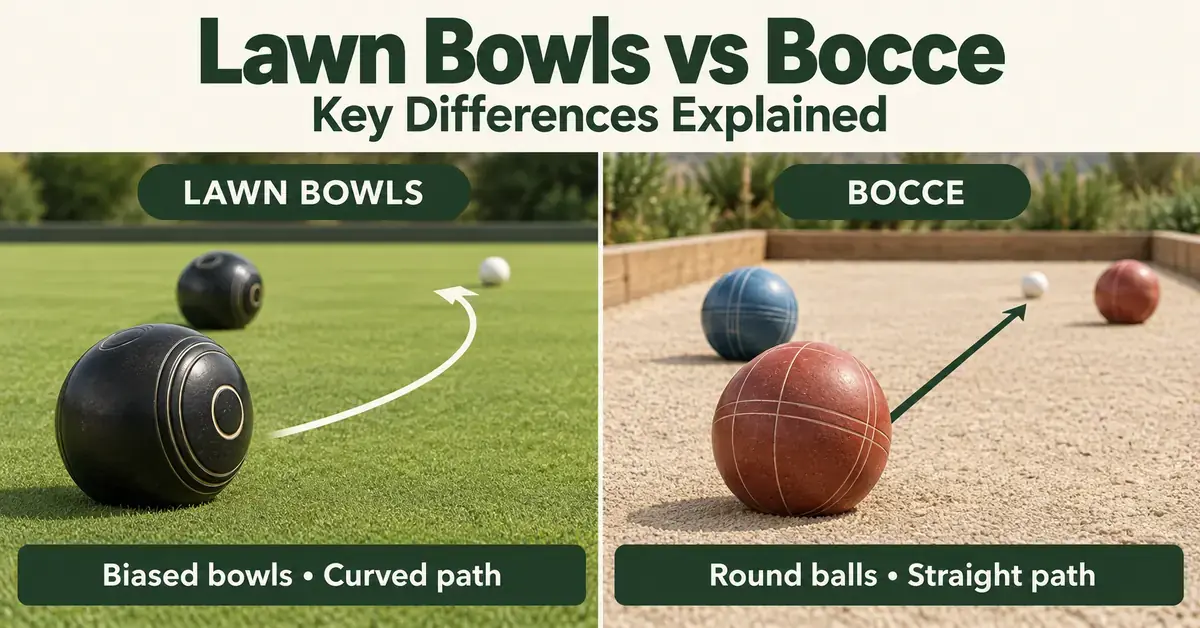
Lawn bowls and bocce look alike from a distance — both are target sports where players roll heavy balls toward a smaller target ball on the ground — but they are two distinct games with different equipment, playing surfaces, rules and histories. The biggest single difference is the ball itself: a lawn bowl is deliberately shaped to curve, while a bocce ball is perfectly round and travels straight. This guide breaks down every key difference so you can tell the two apart, understand how each is played, and decide which one suits you.
Key Points
- Ball shape: Lawn bowls are asymmetric and curve (biased); bocce balls are perfectly round and roll straight.
- Surface: Lawn bowls is played on a large flat green (31–40 m); bocce on a small walled court.
- Delivery: Lawn bowls are rolled from a mat; bocce balls are rolled or tossed underarm from behind a foul line.
- Target ball: Called the jack in lawn bowls and the pallino in bocce.
- Scoring: Both score points for balls closest to the target, but only one side scores per end.
- Origins: Bocce traces to the ancient Mediterranean and modern Italy; flat-green lawn bowls is linked to England and reached New Zealand in the 1860s.
What are lawn bowls and bocce?
Both sports belong to the same broad family of “target” or “boules” games, in which the aim is to finish with your ball or balls closer to a small target ball than your opponent’s. They share a common ancestry in games played across the ancient and medieval worlds, but they developed into separate codes with their own governing bodies and equipment standards.
What is lawn bowls?
Lawn bowls is a precision sport played on a large, closely-mown flat surface called a green. Players roll asymmetric balls, known as bowls, toward a smaller white or yellow target ball called the jack. Because each bowl is shaped to curve, players must send it out on a wide arc rather than straight at the target. In New Zealand the sport is governed by Bowls New Zealand and internationally by World Bowls, which publishes the official Laws of the Sport of Bowls. It is a well-established club sport with formal competitions, national championships and Commonwealth Games representation.
What is bocce?
Bocce is an Italian target game played with round balls on a narrow court, typically bounded by side and end walls. Players roll or toss their balls toward a small target ball called the pallino (also spelled pallina, and sometimes called the jack). Because bocce balls are perfectly spherical, they travel in a straight line, so the game rewards accuracy and touch rather than reading a curve. Bocce is played both casually in backyards and parks and competitively under bodies such as the Confederazione Boccistica Internazionale (CBI) and, in the United States, the United States Bocce Federation. It is closely related to French pétanque and to lawn bowls itself.
The equipment: biased bowls vs round balls
The clearest difference between the two sports is in the balls, both their shape and how they are made. This single distinction changes how each game is played from the very first delivery.
Why lawn bowls curve
A lawn bowl is not a perfect sphere. One side is shaped with a slightly different curve from the other, which shifts the bowl’s centre of gravity away from its geometric centre. While the bowl is rolling quickly, momentum keeps it running fairly straight; as it slows near the jack, the asymmetry takes over and the bowl leans and curves toward its biased side. This built-in curve is called the bias.
A widespread misconception is that a bowl curves because it has extra weight hidden inside one side. That is incorrect. Centuries ago, bowls genuinely were weighted, but internal weighting has long been banned. Every modern bowl gets its bias purely from its shape. Under World Bowls specifications, bowls are made of wood, hard rubber or plastic resin, measure roughly 112–134 mm in diameter, and weigh up to around 1.59 kg (3 lb 8 oz). Each bowl carries a stamped minimum bias set by the governing body and is usually black or brown.
Bocce balls and the pallino
A bocce ball is completely round, so it rolls in whatever direction you send it, with no built-in curve. A standard set contains eight balls — typically four in one colour and four in another, such as red and green or blue — plus one small target ball, the pallino. Tournament bocce balls are made of wood or a composite material and measure about 107–110 mm in diameter, weighing roughly 920 grams (about 2 lb). The pallino is much smaller, around 40 mm in diameter and about 90 grams. Because both colours are identical in size and weight, the only thing separating a good shot from a bad one is where the player places it.
Where you play: greens vs courts
The playing surface is the second major difference, and it shapes the whole character of each game. Lawn bowls needs a large, meticulously maintained lawn, while bocce can be played on a compact court or even a rough backyard strip.
The lawn bowls green
A lawn bowls green is a large square or rectangle of finely cut grass or approved synthetic turf. Under the Laws of the Sport of Bowls, the green must measure between 31 and 40 metres in the direction of play and is divided into playing lanes called rinks, each between about 4.3 and 5.8 metres wide. The green is level and surrounded by a shallow trench called the ditch, backed by a raised bank at least 23 cm high. If the jack or a bowl is driven into the ditch it can, under certain conditions, still count as being in play — a rule that has no equivalent in bocce.
The bocce court
A bocce court is far smaller and is usually bounded by walls or boards on all sides. Competitive courts vary but commonly run roughly 3–4 metres wide and anywhere from about 18 up to 27 metres long, with official CBI-style courts around 26.5 metres. The surface may be packed stone dust, clay, crushed oyster shell, grass or an artificial carpet. The walls are part of the game: in many rule sets a ball may be played off a side wall, and hitting the back wall without first striking another ball can cost you that shot.
How you deliver the ball
The way players release the ball differs between the two codes, and it is one of the quickest ways to tell them apart when watching. Lawn bowls is delivered by rolling from a fixed spot, while bocce allows both rolling and a controlled underarm toss.
In lawn bowls, the player stands on a rubber mat, steps forward and rolls the bowl smoothly along the ground. The bowl must be delivered along the surface; lofting it into the air is not part of the game. Because of the bias, players aim well to the left or right of the jack and let the curve bring the bowl back in.
In bocce, the player delivers from behind a foul line. The ball can be rolled along the ground (a technique often called punto or pointing) or tossed underarm through the air to land near the target or knock an opponent’s ball away (a technique called raffa or volo, depending on the style). Stepping over the foul line before releasing the ball is a fault. Because the ball is round, aim is direct rather than curved.
Scoring and rules compared
Both games score the same core way: after all balls are delivered in an end (a single round of play), points go to whichever side has the ball or bowls closest to the target. Only one team scores per end, earning one point for each of its balls that is closer to the target than the opponent’s nearest ball. Games are played to an agreed number of points or ends.
The differences lie in the details. In lawn bowls, striking and displacing other bowls — and even moving the jack — is a legitimate and often deliberate tactic. In bocce, there are stricter faults tied to the walls and the foul line, and an indoor rule in some venues that a ball tossed higher than the overhead lights is invalid. Lawn bowls competitions are highly formalised, with singles, pairs, triples and fours formats and international laws; bocce ranges from strict federation play to relaxed park and backyard games with locally agreed house rules.
Side-by-Side Comparison
| Feature | Lawn Bowls | Bocce |
|---|---|---|
| Ball shape | Asymmetric, biased (curves) | Perfectly round (straight) |
| Ball diameter | ~112–134 mm | ~107–110 mm |
| Ball weight | Up to ~1.59 kg (3 lb 8 oz) | ~920 g (about 2 lb) |
| Target ball | Jack (~63–67 mm) | Pallino (~40 mm) |
| Playing surface | Large flat green (31–40 m), grass or synthetic | Small walled court, clay/stone dust/grass/carpet |
| Delivery | Rolled from a mat | Rolled or tossed underarm from a foul line |
| Aim | Wide arc to allow for bias | Direct at the target |
| Governing bodies | World Bowls; Bowls New Zealand | CBI internationally; USBF (USA) |
| Typical setting | Formal clubs and competitions | Casual to competitive; parks and backyards |
History and origins
Both sports descend from ancient ball games, but they took shape in different countries. Bocce’s roots are usually traced to the ancient Mediterranean; historians point to early ball-rolling games in Egypt and later refinement by the Greeks and Romans, with the modern game developing its present form in Italy. The first organised World Bocce Championships were held in the mid-20th century, and the game spread worldwide with Italian migration.
Lawn bowls, in its flat-green form, is closely associated with England, where it was popular by the 16th century and famously linked to figures such as Sir Francis Drake. Settlers brought the game to New Zealand in the early 1860s: the Auckland Bowling Club formed in 1861 and opened the country’s first green in Grafton the following year, with clubs in Dunedin, Christchurch and Wellington soon after. The New Zealand Bowling Association was formed in 1886, when a set of national rules was agreed and the first national tournament was held in Dunedin. The sport remains strong today: Bowls New Zealand’s 2025 Annual Report recorded casual participation of 126,889 in 2024, driven by social formats such as twilight and barefoot bowls.
Which sport suits you?
Choose lawn bowls if you enjoy a formal club sport with a technical challenge. Reading the bias, judging the pace of the green and delivering a smooth, curving bowl take practice, and clubs offer coaching, competitions and a strong social scene. It needs access to a maintained green, so it is a club-based activity rather than something you set up at home. If you are in a main centre, there are established options such as lawn bowls clubs in Auckland, bowls in Canterbury, and long-standing venues like Howick Bowling Club.
Choose bocce if you want something simple to start and easy to set up almost anywhere. A basic set and a flat patch of ground are enough, the rules are quick to learn, and round balls mean beginners can aim directly at the target without learning to read a curve. Bocce is ideal for casual social play, parks, holidays and family gatherings, while still offering serious competition for those who want it. If you are after other social bowling options in New Zealand, you can also compare ten-pin bowling in New Zealand or find venues for bowling in Wellington.
Common mistakes when comparing the two
The most common error is assuming lawn bowls and bocce are the same game with different names. They are not: the ball shapes, surfaces and rules differ significantly, and mixing up their terminology (a jack is not identical to a pallino, and a green is not a court) leads to confusion.
A second frequent mistake is believing lawn bowls curve because of hidden internal weights. As explained above, the bias comes from the bowl’s asymmetric shape, not from added weight. Trying to play bocce with the same wide, curving aim used in lawn bowls is another error — a round bocce ball goes straight, so you should aim directly at the target. Finally, people often assume you can play lawn bowls at home like bocce; in reality it requires a regulation green, which is why it is almost always a club sport. Understanding these distinctions makes both games far easier to appreciate and to play well.
Sources
Frequently Asked Questions (FAQ)
Is lawn bowls the same as bocce?
No. Although both are target sports played by rolling balls toward a smaller target ball, they use different equipment and rules. Lawn bowls uses biased (asymmetric) bowls that curve, played on a large flat green, while bocce uses perfectly round balls that travel straight, played on a small walled court.
Why do lawn bowls curve but bocce balls do not?
A lawn bowl is shaped so that one side has a different curve from the other, shifting its centre of gravity and making it arc as it slows down. A bocce ball is a perfect sphere with no bias, so it rolls in a straight line in whatever direction it is delivered.
What is the target ball called in each sport?
In lawn bowls the target is a small white or yellow ball called the jack, roughly 63–67 mm across. In bocce the target is the pallino (also called the pallina or jack), which is smaller at about 40 mm and weighs around 90 grams.
Can you play lawn bowls at home like bocce?
Not really. Lawn bowls needs a large, level, closely-mown green with a surrounding ditch and bank, so it is almost always played at a club. Bocce, by contrast, can be set up on a flat patch of grass, gravel or a simple backyard court, making it far easier to play at home.
Which is easier for beginners, lawn bowls or bocce?
Bocce is generally quicker to pick up because the balls are round and you aim straight at the target, and it needs no special surface. Lawn bowls has a steeper learning curve because you must read the bias and judge the pace of the green, but clubs offer coaching to help new players improve.
