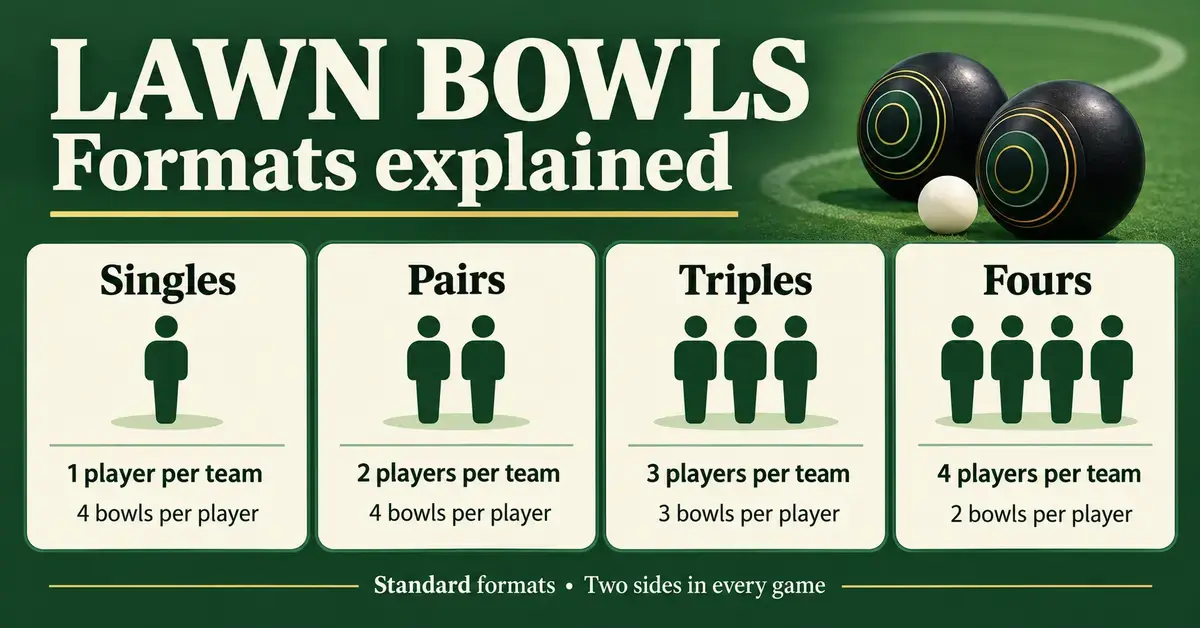
Lawn bowls is played in four standard formats — singles, pairs, triples and fours — and the format you choose decides how many people are on your team, how many bowls each person delivers, and how the tactics of an end unfold. The rules of delivery, bias and scoring stay the same across all four; what changes is the size of the team and the number of bowls in play. This guide explains each format in plain English, describes the player positions, and shows how the four compare so you can work out which one fits you.
Key Points
- Four formats: singles (1 player), pairs (2), triples (3) and fours/rinks (4) — two sides in each.
- Bowls per player: four in singles and pairs, three in triples, two in fours (standard; some events vary).
- Winning: singles is first to 21 shots; pairs, triples and fours are decided on total shots after a set number of ends.
- Positions: lead, second, third (vice-skip) and skip — added as the team grows.
- Same everywhere: the green, rink, jack, mat, bias and scoring are identical across all four formats.
What are the four lawn bowls formats?
The four formats are named after the number of players in each team: singles (one player), pairs (two), triples (three) and fours (also called a rink of four). Every format is a contest between two sides on the same strip of green, taking turns to roll bowls toward a small target ball. The differences that matter most are the team size and how many bowls each player rolls per end.
- Singles: one player against one player, four bowls each.
- Pairs: two against two, usually four bowls each.
- Triples: three against three, usually three bowls each.
- Fours (rinks): four against four, two bowls each.
These are the formats used in club competitions, national championships and international events. Bowls New Zealand runs singles, pairs, triples and fours at its national championship series, alongside a mixed pairs event. The exact number of bowls and ends can vary between controlling bodies and competitions, so the figures below describe the most widely used standard and note where variation is allowed.
The basics every format shares
Before the formats make sense, it helps to know the parts of the game they all use. These elements are identical whether you play singles or fours.
- The green and the rink: Bowls is played on a flat, closely mown square of grass called a green, usually 31–40 metres on each side. The green is divided into parallel playing lanes called rinks, each roughly 4.3–5.8 metres wide. Each game is played up and down one rink.
- The jack: The jack is the small white (or yellow) target ball, about 63–67 mm across. It is rolled first to set the target for the end and must travel a minimum distance (at least 23 metres) before it counts.
- The mat: Players stand on a rubber mat (about 61 × 36 cm) to deliver. At least part of one foot must be on or above the mat at the moment of release — this is called keeping your footing.
- The bowls: Bowls are not perfectly round. Each one is shaped with a bias, so it travels in a curved path and finishes by hooking toward one side. Learning to read that curve is the core skill of the sport.
- An end: An end is one complete round of play — the jack is set, both sides deliver all their bowls, and the shots are counted. A game is a fixed number of ends (or, in singles, a race to a target score).
- Scoring a shot: After every bowl is played, the side with the bowl closest to the jack wins the end and scores one point (called a shot) for each of its bowls that is closer than the opponent’s nearest bowl. Only one side scores per end.
Singles: one-on-one bowls
Singles is a direct duel between two players, with no team to rely on. Each player delivers four bowls per end, alternating one bowl at a time, and the match is normally a race to 21 shots rather than a set number of ends — the first player to reach 21 wins. Because the target score is fixed, a singles match can be short or long depending on how the ends fall.
Singles rewards all-round skill. You have to roll the jack, read the green, play draw shots that finish close to the jack, and also play attacking shots to break up your opponent’s position — there is no teammate to cover a weakness. It is the purest test of an individual bowler and the format most often used to crown a champion.
Pairs: the two-player team
Pairs puts two players on each side, and it is the smallest team format. The two positions are the lead, who rolls the jack and plays first, and the skip, who plays last and directs the end. Each player usually delivers four bowls per end, and a game is commonly played over 18 or 21 ends.
Pairs is a popular social and competitive format because it blends individual skill with simple teamwork. The lead sets up the end by drawing close to the jack, and the skip finishes it — either adding more scoring bowls or playing a rescue shot when the lead’s bowls are covered. World Bowls rules also allow variations where each player uses two or three bowls, so always check the conditions of play for a given competition.
Triples: three-a-side
Triples adds a third player and a middle role to the team. The three positions are the lead, the second and the skip, and each player usually delivers three bowls per end over 18 ends. With more bowls on the rink than in pairs, the head — the cluster of bowls gathered around the jack — becomes busier and more tactical.
The extra player means more shot-making variety within a single end. The lead builds the foundation, the second develops the position, and the skip controls the finish. Some competitions run triples with two bowls per player instead of three; the team size stays the same, but the end plays faster.
Fours (rinks): the classic team game
Fours, also called a rink, is the full four-player team and the traditional showpiece of lawn bowls. The four positions are the lead, second, third (also called the vice-skip) and skip. Each player delivers only two bowls per end — the fewest of any format — and a game is commonly played over 21 ends (some competitions use 15 or 18).
Even though each player rolls just two bowls, fours has the most bowls contributed by a full team working in sequence, so the head can become crowded and the tactics are the deepest of any format. It demands coordination: every player must trust the others to do their job, because a single weak position can undo the whole rink. Fours is where teamwork, communication and role discipline matter most.
Player positions explained
The team formats share the same set of positions, added one at a time as the team grows. Knowing each role makes it much easier to understand triples and fours.
Lead
The lead sets the mat, rolls the jack to the length the skip wants, and plays first every end. The lead’s job is to build a solid foundation by drawing bowls close to the jack — consistent, accurate draw bowling from the lead sets up the whole end.
Second
The second (used in triples and fours) consolidates the position the lead has started — adding a scoring bowl, playing a blocker, or repairing a weak start. In many teams the second also keeps the scorecard, recording the shots for and against and confirming the score with the opposing second.
Third (vice-skip)
The third, used in fours, is the team’s second-in-charge and often its most versatile bowler. The third must be able to play every type of shot, agrees the count with the opposing third, and measures close ends. When the skip is at the mat, the third takes charge of the head and gives directions.
Skip
The skip is the team captain and plays last, when the end is decided. The skip directs every teammate’s shot from the head, reads the overall tactics, and plays the pressure bowls at the finish — drawing the winning shot or driving to change a losing position. In pairs the skip is one of only two players; in fours the skip leads a team of four.
How the formats compare
The clearest way to see the differences is side by side. The table below shows team size, bowls per player, bowls contributed by each team per end, the positions used and the typical game length. Treat the ends and shots as the common standard — individual competitions may set their own conditions of play.
Format Comparison
| Format | Players per side | Bowls per player | Bowls per team, per end | Positions | Typical game length |
|---|---|---|---|---|---|
| Singles | 1 | 4 | 4 | — | First to 21 shots |
| Pairs | 2 | 4 | 8 | Lead, skip | 18–21 ends |
| Triples | 3 | 3 | 9 | Lead, second, skip | 18 ends |
| Fours (rinks) | 4 | 2 | 8 | Lead, second, third, skip | 21 ends (some 15–18) |
A few patterns stand out. As the team grows, the number of bowls each individual rolls falls — from four in singles down to two in fours — but the number of decisions and the amount of teamwork rises. Singles is the most individual and physically demanding for one person; fours spreads the workload but demands the tightest coordination.
How scoring and winning differ by format
Scoring works the same way in every format: the side with the bowl nearest the jack scores one shot for each bowl closer than the opponent’s best. What differs is how a match is won. Singles is a race to a set score (usually 21 shots), so it ends when a player reaches the target. Pairs, triples and fours are played over a fixed number of ends, and the side with the higher total of shots when the ends run out wins.
Because team formats put more bowls on the rink, big-scoring ends are more common in triples and fours — a well-built head can yield four, five or more shots in a single end, which can swing a game quickly. In singles, with only eight bowls in play per end, scores tend to build one or two shots at a time.
Common mistakes when choosing and playing a format
New bowlers often trip over the same avoidable errors when they move between formats. Watch for these:
- Assuming the numbers never change. The most common mistake is treating one set of figures as fixed. Bowls per player and number of ends vary by competition and controlling body — always read the conditions of play before a match.
- Confusing the roles in bigger teams. Beginners sometimes think the skip does everything. In fours the lead’s accuracy and the third’s measuring and shot-making are just as important as the skip’s finish.
- Playing singles tactics in a team format. In singles you must play both draw and attacking shots yourself. In pairs, triples and fours, the lead should focus on drawing and leave the attacking shots to the skip — overreaching in an early position wastes bowls.
- Neglecting the scorecard. In team formats the second or third records the score. Failing to confirm the count with your opposing number is a frequent source of disputes.
- Ignoring bias direction. Every bowl curves; playing the wrong hand (forehand or backhand) sends the bowl off the rink. This catches out beginners in every format equally.
Which format suits you, and how to get started in New Zealand
The best starting format for most beginners is fours, because you deliver only two bowls per end and play alongside more experienced teammates who guide you. Pairs and triples are good next steps as your draw bowling becomes reliable, and singles is best left until you are confident playing every shot on your own.
If you want to try the game, the easiest path is to visit a local club — most run beginner sessions and lend equipment. New Zealand has an active club network in every main centre, from lawn bowls clubs across Auckland to the bowling scene in Canterbury. Community clubs such as the Howick Bowling Club welcome newcomers, and there are greens to try around most cities including Wellington. If you prefer an indoor lane game instead, ten-pin bowling is a different sport with its own rules — the two codes share a name but little else.
Sources
Vanliga frågor (FAQ)
How many bowls does each player use in each format?
In singles and pairs each player normally delivers four bowls per end. In triples each player usually delivers three, and in fours each player delivers two. These are the common standard, but some competitions allow two or three bowls in pairs and triples, so check the conditions of play.
What is the difference between triples and fours?
Triples has three players a side (lead, second and skip) with three bowls each, while fours has four players a side (lead, second, third and skip) with two bowls each. Fours adds the third, or vice-skip, position and is played with more players working through each end.
How do you win a game of lawn bowls?
You win by scoring more shots than your opponent. In singles the first player to reach 21 shots wins. In pairs, triples and fours the side with the most shots after a set number of ends wins. A shot is scored for each of your bowls that finishes closer to the jack than your opponent’s nearest bowl.
What does the skip do in lawn bowls?
The skip is the team captain, plays last, and directs the team’s tactics from the head. The skip decides which shots teammates should play, reads the state of the end, and delivers the pressure bowls that often decide the result.
Which lawn bowls format is best for beginners?
Fours is usually the friendliest format for beginners because you deliver only two bowls per end and play alongside experienced teammates who can guide you. As your accuracy improves you can move on to pairs, triples and eventually singles, which demands the most all-round skill.
