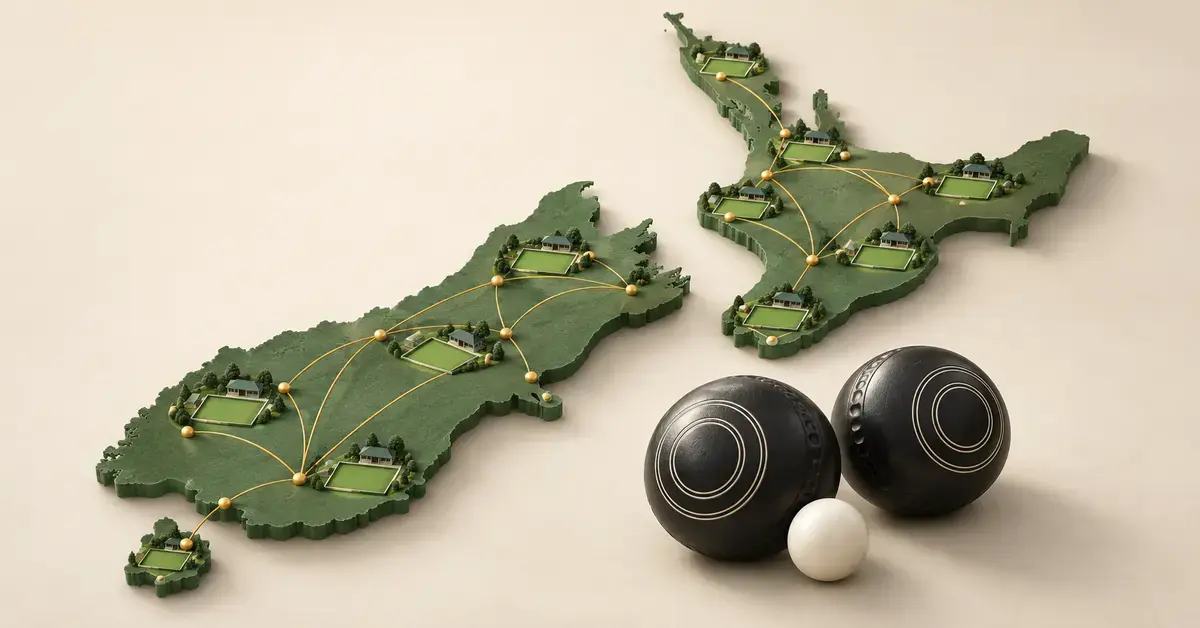
Bowls New Zealand is the national governing body for the sport of lawn bowls in New Zealand. It is the organisation that sets the rules, runs the national championships, selects the national team known as the Blackjacks, and supports the roughly 450 clubs where New Zealanders actually play. If you have ever wondered who sits above your local bowling club, or how a social roll-up on a summer evening connects to a world championship, Bowls New Zealand is the thread that links them. This guide explains what the organisation is, how it is structured, what it does, and how it differs from the body that runs ten-pin bowling.
Key Facts
| Organisation | Bowls New Zealand Incorporated (Bowls NZ) |
|---|---|
| Role | National governing body (NSO) for lawn bowls |
| Sport / code | Lawn bowls — outdoor, flat green, biased bowls |
| Headquarters | 105A Jervois Road, Herne Bay, Auckland |
| Formed | 1 May 1996 (merger of the men’s and women’s associations) |
| Earliest national body | New Zealand Bowling Association, Dunedin, 1886 |
| Structure | ~27 regional Centres and around 450 affiliated clubs |
| Participation | ~43,000 members plus 120,000+ casual participants (2024/25) |
| National team | The Blackjacks |
| World body | World Bowls |
| Official website | bowlsnewzealand.co.nz |
What is Bowls New Zealand?
Bowls New Zealand (often shortened to Bowls NZ) is the national sporting organisation, or NSO, responsible for lawn bowls across the country. A national sporting organisation is the single recognised body that governs a sport nationally — it holds the rulebook, runs the top competitions, manages the national teams, and distributes government and partner funding down to the regions and clubs. Bowls New Zealand plays that role for lawn bowls, the outdoor game played with biased bowls on a large flat grass or synthetic green.
The organisation is a registered incorporated society, Bowls New Zealand Incorporated, based at 105A Jervois Road in Herne Bay, Auckland. It receives funding from Sport New Zealand (the government agency for sport and recreation) alongside commercial partners and member subscriptions. Its stated aim is to make bowls “inclusive, accessible and enjoyable for all New Zealanders” — a deliberate shift away from the sport’s old image as a pastime only for retirees in club whites.
Crucially, Bowls New Zealand governs lawn bowls specifically. It is a separate organisation from both Tenpin Bowling New Zealand, which runs indoor ten-pin bowling, and the New Zealand Indoor Bowls body, which runs the carpet-based indoor game. The three codes share a word in their name but are distinct sports with their own national bodies.
A short history: from 1886 to one national body
Organised lawn bowls in New Zealand dates back more than 150 years, and the national body as it exists today was formed in 1996. Scottish settlers brought the game with them in the nineteenth century, and the Auckland Bowling Club, founded in 1861, is generally recognised as the country’s first club.
The governing structure grew in stages:
- 1886 — The New Zealand Bowling Association was formed in Dunedin by the 12 clubs then in existence, including Dunedin, Roslyn, Caledonian and Balclutha.
- 1913 — After years of regional splits, three separate groups merged to create the Dominion of New Zealand Bowling Association, bringing uniform rules nationwide.
- 1914 — The first New Zealand national championships were held, initially in men’s singles, pairs and fours.
- 1931 — The word “Dominion” was dropped and the body continued as the New Zealand Bowling Association.
- 1948 — The New Zealand Women’s Bowling Association was formed as a separate organisation.
- 1996 — The men’s and women’s associations amalgamated into a single body, Bowls New Zealand, which held its first meeting on 1 May 1996.
That 1996 merger is the key moment: it brought men’s and women’s bowls under one roof for the first time and created the modern organisation. Women’s national fours were first contested in 1951, pairs in 1952 and singles in 1957, long before the two associations formally joined.
How the sport is structured: national body, Centres and clubs
Lawn bowls in New Zealand works as a three-tier pyramid, with Bowls New Zealand at the top. Understanding those three layers is the single most useful thing for a newcomer, because the layer you deal with day to day is almost always the bottom one.
- Bowls New Zealand (national): the single governing body for the whole country. It writes and enforces the rules (aligned with the world rules), runs the national championships and representative events, and manages high performance and national funding.
- Centres (regional): around 27 regional Centres sit between the national body and the clubs. A Centre such as Bowls Auckland or Bowls Canterbury administers the sport in its region — running regional competitions, coaching courses and inter-club events, and acting as the link to the national body.
- Clubs (local): roughly 450 affiliated clubs are where people actually join and play. Figures vary by how membership is counted, but Bowls New Zealand’s own materials cite in the region of 450 to 460 clubs.
When you join, you join a club, not Bowls New Zealand directly. Your club affiliates to its regional Centre, and the Centre affiliates to the national body — so your membership connects you to the whole structure automatically. If you want the practical steps, see our guide on how to join a lawn bowls club in New Zealand, and for examples of the regional layer see Bowls Auckland and Bowls Canterbury.
How big is the sport in New Zealand?
Lawn bowls remains one of New Zealand’s larger participation sports, though its membership profile has changed. Bowls New Zealand’s 2024/25 reporting shows that serious weekend “playing” membership has fallen over the long term — from around 33,000 in 2010 to roughly 21,000 — while the sport has grown dramatically at the casual, social end.
Counting all categories together, including Limited and Twilight (social) memberships, total membership is reported at around 43,000. On top of that, casual participants — people who come for a one-off barefoot bowls session, a work function or a summer social night — have more than doubled to well over 120,000 a year. The organisation’s public About page rounds the overall reach to “400+” clubs and “200k” participants.
The clear trend is that bowls is being played by more people, but fewer of them are traditional competitive members. That shift is exactly what Bowls New Zealand’s “inclusive and accessible” strategy is designed to address, and it explains the heavy push into social formats like Twilight Bowls.
What Bowls New Zealand actually does
Bowls New Zealand’s work splits into a handful of clear functions, each aimed at a different part of the pyramid. Rather than being one single activity, the organisation runs competitions, grows participation, develops coaches and manages the elite game all at once.
Running the national championships and events
The flagship job is running the New Zealand national championships — now branded the Summerset Nationals. The championships are contested across singles, pairs, fours and mixed pairs, and are held over the summer at venues around the main centres, such as Auckland and Wellington. Bowls New Zealand also sanctions representative events like inter-Centre competition and the Champion of Champions, which brings together club champions from across the country. If you are new to the different events, our explainer on lawn bowls formats — singles, pairs, triples and fours covers how each one is played.
Coaching, development and getting started
Bowls New Zealand develops the coaching system and beginner pathways that clubs then deliver locally. It accredits coaches, publishes learn-to-bowl resources, and provides the “how to play” materials that clubs use to introduce newcomers. Most of the actual coaching happens at club or Centre level, but the framework and standards come from the national body. For a plain-English starting point, see our guide on how to play lawn bowls.
Growing the game: Twilight Bowls and youth
One of Bowls New Zealand’s biggest priorities is lowering the barrier to entry, and Twilight Bowls is its headline programme for that. Twilight Bowls is a relaxed, casual summer-evening format — no whites, no long commitment, often played barefoot — run at well over 150 clubs nationwide, and Twilight membership now numbers in the many thousands. At the younger end, Bowls New Zealand supports Rangatahi (youth) bowls and under-age representative teams to bring new generations into the sport.
High performance and inclusion
At the top, Bowls New Zealand runs the High Performance programme that selects and prepares the national squads, and it also leads inclusion initiatives, including para bowls for athletes with a disability. Para events sit within the same national framework rather than being run separately, which is part of the organisation’s accessibility focus.
The Blackjacks: New Zealand’s national team
The Blackjacks are New Zealand’s national lawn bowls team, selected and managed through Bowls New Zealand’s High Performance programme. The squad represents the country at the highest level of the sport, and its players are among the best bowlers in the world.
The Blackjacks compete at the two biggest international stages for lawn bowls:
- The World Bowls Championships and the annual World Cup, where New Zealand is consistently competitive. At the 2023 World Championships, New Zealand bowlers won multiple medals, and the team closed its 2025 World Cup campaign in Malaysia with two silver medals.
- The Commonwealth Games, where lawn bowls is a long-standing core sport. New Zealand lawn bowlers have a strong Games history, and bowls featured again on the programme for Glasgow 2026.
Because lawn bowls is a Commonwealth Games sport, the Blackjacks give the code a profile that ten-pin bowling — which is not on the Games programme — does not have. That international pathway, from club green to world championship, is one of the clearest reasons the national body matters.
Bowls New Zealand vs Tenpin Bowling New Zealand
Bowls New Zealand and Tenpin Bowling New Zealand are two completely separate national bodies for two different sports. This is the single most common point of confusion, because both are called “bowling” in everyday speech. Lawn bowls is the outdoor game of rolling biased bowls toward a small target ball (the jack) on a flat green; ten-pin is the indoor game of rolling a drilled ball down a timber or synthetic lane to knock down ten pins. They share no equipment, venues, rules or governing structure.
The Two National Bodies Compared
| Feature | Bowls New Zealand | Tenpin Bowling New Zealand |
|---|---|---|
| Sport | Lawn bowls (outdoor green) | Ten-pin bowling (indoor lanes) |
| Playing surface | Flat grass or synthetic green | Timber or synthetic lane with pins |
| Equipment | Biased bowls and a jack | Drilled ball and ten pins |
| Local units | ~450 clubs under ~27 Centres | Commercial centres and affiliated associations |
| National team | The Blackjacks | Katipō representative squads |
| Flagship event | Summerset Nationals (national championships) | The national championships (Nationals) |
| Commonwealth Games sport | Yes — core programme | No |
If your interest is the indoor lane game, our companion article on Tenpin Bowling New Zealand (TBNZ) explains that body in the same way this guide explains the lawn bowls one.
How to get involved through Bowls New Zealand
The quickest way to get involved is to find a local club, because that is where every level of the sport begins. Bowls New Zealand runs a “Find a Club” tool on its website that lets you search by location, and most clubs welcome complete beginners with free or low-cost “come and try” sessions.
A realistic path for a newcomer looks like this:
- Try it casually first. Book a barefoot or Twilight Bowls session over summer — no equipment or whites needed, and clubs lend you a set of bowls.
- Take a learn-to-bowl course. Many clubs run free beginner coaching across a few weeks, using the national coaching framework.
- Join as a member. If you enjoy it, join the club. Membership connects you to your regional Centre and to Bowls New Zealand, and opens up club, Centre and national competitions.
You do not need to contact Bowls New Zealand directly to start playing — the national body’s role is to support the clubs, and the club is your entry point.
Common misunderstandings about Bowls New Zealand
A few recurring mistakes trip up newcomers researching the organisation. Clearing them up early saves confusion:
- Thinking “Bowls New Zealand” means ten-pin. It does not. Bowls New Zealand governs lawn bowls only; ten-pin has its own body, Tenpin Bowling New Zealand.
- Trying to join Bowls New Zealand directly. You join a club, which is affiliated upward to a Centre and then to the national body. There is no individual “Bowls NZ membership” you sign up for first.
- Assuming it is only for older players. The social and Twilight formats, youth programmes and barefoot bowls are a deliberate, growing part of the sport, and casual participation now far outnumbers traditional competitive membership.
- Confusing it with New Zealand Indoor Bowls. Indoor bowls is the carpet-based mat game run by a different federation; lawn bowls is the outdoor green game run by Bowls New Zealand.
- Expecting one fixed membership figure. Official numbers vary because they count playing, social and casual participants differently — the sport is best understood as roughly 450 clubs with tens of thousands of members and well over 100,000 casual participants.
Sources
Vanliga frågor (FAQ)
Is Bowls New Zealand the same as ten-pin bowling?
No. Bowls New Zealand is the national governing body for lawn bowls, the outdoor game played with biased bowls on a flat green. Ten-pin bowling — the indoor lane game with pins — is run by a separate organisation, Tenpin Bowling New Zealand. The two are different sports with different bodies that only share the word “bowling”.
When was Bowls New Zealand formed?
Bowls New Zealand in its current form was created on 1 May 1996, when the New Zealand Bowling Association (men’s) and the New Zealand Women’s Bowling Association merged into a single body. The sport’s governance goes back much further, to the New Zealand Bowling Association founded in Dunedin in 1886.
How many clubs and members does Bowls New Zealand have?
Bowls New Zealand oversees roughly 450 clubs organised under around 27 regional Centres. Total membership across playing, limited and social categories is reported at about 43,000, with well over 120,000 casual participants a year, depending on how numbers are counted.
Who are the Blackjacks?
The Blackjacks are New Zealand’s national lawn bowls team, selected through Bowls New Zealand’s High Performance programme. They represent the country at the World Bowls Championships, the World Cup and the Commonwealth Games, where New Zealand has a strong medal record.
How do I start playing lawn bowls in New Zealand?
Find a local club using Bowls New Zealand’s “Find a Club” tool and ask about a beginner, barefoot or Twilight Bowls session. Most clubs lend you bowls, offer free learn-to-bowl coaching, and welcome newcomers of any age. You join the club directly, which connects you to your Centre and the national body.
