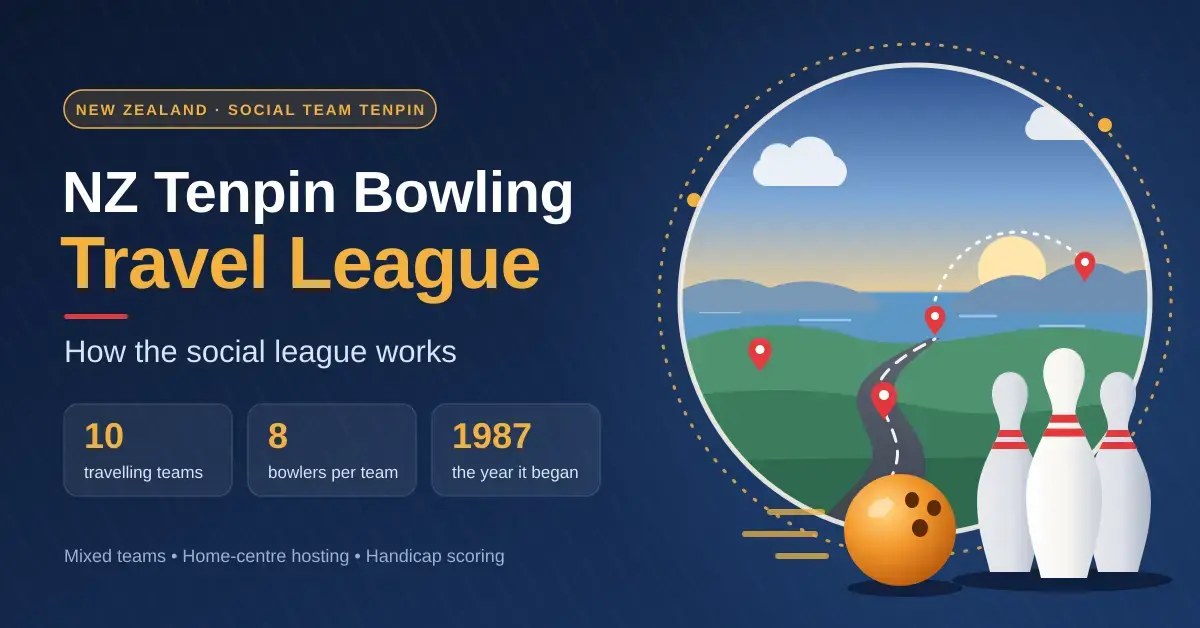
The New Zealand Tenpin Bowling Travel League (NZTBTL) is a long-running social tenpin competition built around ten travelling teams from the lower North Island and the top of the South Island. It has run since 1987, which makes it one of the country’s most enduring organised tenpin leagues.
The NZ Tenpin Bowling Travel League is not a venue or a club you can simply walk into. It is a team-based, travelling competition in which mixed teams of men and women take turns hosting events at their home bowling centres, combining friendly rivalry with road trips and a strong social scene.
This guide explains what the league is, how it is structured, how its travelling and scoring work, which teams take part, where it came from, how a bowler would get involved, and the common misconceptions people have about it.
What is the NZ Tenpin Bowling Travel League?
The NZ Tenpin Bowling Travel League is a social, handicap-based tenpin competition made up of ten teams of eight players each. Rather than meeting at one fixed alley, the league travels: each team takes a turn as host at its home centre on a rotating cycle, so members regularly bowl at different centres around the region.
The word “travel” in the name is the key to its character. The hosting rotation turns each block of competition into a reason to visit another town, which is why the league is as much a social and community activity as a sporting one.
Because the competition is social and handicap-based, it has always valued participation and camaraderie alongside the scores. To follow the on-lane side it helps to understand how ten-pin bowling is played and how scoring works in ten-pin bowling, because the league layers a team and handicap structure on top of the standard game.
Key Facts
- What it is: A social, handicap-based travelling ten-pin bowling league
- Teams: 10
- Players per team: 8 (4 men and 4 women)
- Founded: 1987, in Napier
- Region: Lower North Island and the top of the South Island
- Hosting: Each team hosts in turn, about once every 2.5 years (a 30-month cycle)
- Records kept: Team standings, plus men’s and women’s high game, high series and most strikes
- Official website: sporty.co.nz/nztbtl
How the league works
The league combines a fixed team structure, a travelling host rotation and a season-long points race. The three sections below answer each of those in turn.
Team structure: eight players, four men and four women
Every team fields eight players — four men and four women — which makes the league a mixed, inclusive format by design. The even split is a defining rule rather than a loose guideline, so teams are balanced across both genders rather than being built around a few top bowlers.
Because entry is handicap-based, players of differing ability can bowl in the same team. A handicap adds a set number of pins to a lower-average bowler’s score so that less experienced players can still contribute to a team result, which keeps the competition social rather than elite.
The travelling format and hosting rotation
The host centre changes on a rotation, with each team taking its turn to host roughly once every 2.5 years (a 30-month cycle). Hosting means the home team organises that block of competition at its local centre and looks after the visiting teams, so the duty travels around the whole league over time.
For members, the pay-off is regular road trips to centres they might not otherwise visit, from Wellington and the Kapiti Coast up to Hawke’s Bay and across to the top of the South Island. The travel and hosting are deliberately central to how the league runs.
How scoring and standings work
Team and individual standings are tracked across each season on a handicap-friendly basis. Alongside the overall team results, the league keeps individual records for both men and women, including high game (the best single game), high series (the best combined total across a set of games) and most strikes.
If terms such as high series, strike or spare are unfamiliar, the ten-pin bowling glossary explains them in plain language. Current and historical results are published on the league’s official website.
The ten teams

The league is currently made up of ten teams spread across the lower North Island and the top of the South Island. The names reflect the towns and regions the teams come from:
- Capital City — Wellington (originally the founding Wellington team)
- Harbour City — Wellington
- Petone — Petone, in the Lower Hutt area
- Kapi Mana — Porirua / Mana district
- Kapiti — the Kapiti Coast
- Rose City — Palmerston North
- Wanganui — Whanganui
- Hastings — Hastings, in Hawke’s Bay
- Port View — Hawke’s Bay region
- Motueka — Motueka, at the top of the South Island
The geographic spread is why travel is built into the league. Several teams are clustered around the capital, so bowling in Wellington and its neighbouring centres forms a natural hub, while Motueka adds a South Island destination to the rotation.
The history of the Travel League
The Travel League was founded in 1987 in Napier. It was started by teams from Wellington (led by Ailsa Gill), Hastings (led by Joe McCardell) and Palmerston North (led by Maurie Abrahams), with the Petone Tenpin Bowling Club asked to join so the league had an even number of teams.
In the early days the bowlers played in Napier in an old tin shed until a new bowling centre opened in Hastings. The team names changed as the league grew, and six more teams joined over the following years to reach the present line-up of ten. The league marked 30 years in 2017, with foundation members still bowling at that milestone.
- 1987: League founded in Napier by the Wellington, Hastings and Palmerston North teams, with Petone added to even the numbers. Early games are played in an old tin shed.
- Around 1989: A new bowling centre opens in Hastings, and the Wellington team is renamed Capital City so other Wellington bowlers can join.
- Early 1990s: Palmerston North becomes Rose City. Over the following years six more teams join — Port View, Kapiti, Kapi Mana, Motueka, Wanganui and Harbour City.
- 2017: The league celebrates 30 years, with foundation members still playing and a full roster of ten teams.
- Today: Ten teams of eight (four men, four women) keep travelling and taking turns to host on a rolling cycle.
The years given for the Capital City and Rose City name changes are approximate; the league’s own accounts describe them as happening “two years” and “a couple of years” after the 1987 start rather than on fixed dates.
How does the Travel League compare with a regular centre league?
The biggest difference is that a Travel League team moves around the region, while a standard centre league stays at one alley. A weekly league at your local centre is the usual starting point for most bowlers; the Travel League is a larger, more social commitment layered on top. The table below sets the two side by side.
Travel League vs a Local Centre League
| Feature | NZTBTL Travel League | Typical weekly centre league |
|---|---|---|
| Location | Rotates between members’ home centres across the region | One fixed bowling centre |
| Travel | Regular road trips to the host centre | None — same venue each week |
| Team make-up | Fixed teams of 8 (4 men, 4 women) | Varies — singles, doubles or small teams |
| Scheduling | Blocks of competition on a hosting rotation (~2.5-year cycle to host) | Weekly over a set season |
| Ability mix | Handicap-based, mixed abilities | Often handicap-based; varies by league |
| Main appeal | Social scene, community and travel | Convenient, regular local competition |
| Commitment | Higher — travel and hosting duties | Lower — turn up at your local centre |
How to get involved
The usual route into the Travel League is to start with a weekly league at your local bowling centre first. That is where most players build an average, learn the etiquette and decide whether they want a bigger social commitment; from there, they look at joining or forming a Travel League team as their involvement grows.
You do not need to own a full kit to begin. Many bowlers start with house equipment and hired shoes, and our guide to whether you need your own bowling shoes covers when buying your own gear starts to make sense. For a wider view of the sport locally, see our overview of ten-pin bowling in New Zealand.
Current contacts, fixtures and results for the league are published on its official website at sporty.co.nz/nztbtl, which is the best place to ask about joining a team.
Common mistakes and misconceptions
The most common mistake is treating the Travel League as a place to go bowling. It is a competition, not a venue, so you cannot simply turn up to “the Travel League” — you join a team, and that team bowls at whichever member centre is hosting.
- Thinking it is for elite bowlers only. The handicap system is designed to let players of different standards bowl together, so a high average is not a requirement.
- Assuming you can enter as an individual at any time. The format is built around fixed teams of eight with a set four-men, four-women split, so entry generally happens through a team rather than as a solo sign-up.
- Underestimating the travel. Because hosting rotates around the region and into the top of the South Island, members should expect regular trips, not a weekly session at one local alley.
- Confusing it with lawn bowls. This is ten-pin bowling — played indoors with a ball and ten pins — not the outdoor lawn bowls game, despite the shared word “bowling”.
- Expecting to skip the basics. Most members come through a centre league first; jumping straight into a travelling team without any league experience is unusual.
Who the Travel League is for
The Travel League suits bowlers who already play and want a bigger, more social commitment with a regional community feel. It is a strong fit for people who enjoy the friendships and the road trips as much as the bowling, and for mixed groups who like the balanced four-men, four-women team format.
It is less suited to someone looking for a casual, one-off visit or a weekly session close to home — a regular centre league fills that role far better. For anyone drawn to the community side of the sport, though, the league is a clear example of how tenpin builds long-term friendships across decades.
Sources
Frequently Asked Questions (FAQ)
Is the Travel League a bowling alley I can visit?
No. It is a travelling social competition rather than a venue. Teams take turns hosting at their home centres around the lower North Island and the top of the South Island, so there is no single “Travel League” address to visit.
How are the teams structured?
Each of the ten teams has eight players — four men and four women. That even split makes it a mixed, inclusive format, and the handicap system lets bowlers of differing ability play in the same team.
Do I need to be an expert bowler to join?
No. The league runs on a social, handicap-friendly basis, so players of different standards can compete together. Most people start with a weekly league at their local centre before joining a Travel League team.
How long has it been running?
Since 1987, when it began in Napier. It celebrated 30 years in 2017 and continues today with ten teams.
How do I find out about joining?
Details, contacts and results are published on the league’s official website. The simplest first step is to bowl in a league at your nearest centre and ask locally about teams in your area.
