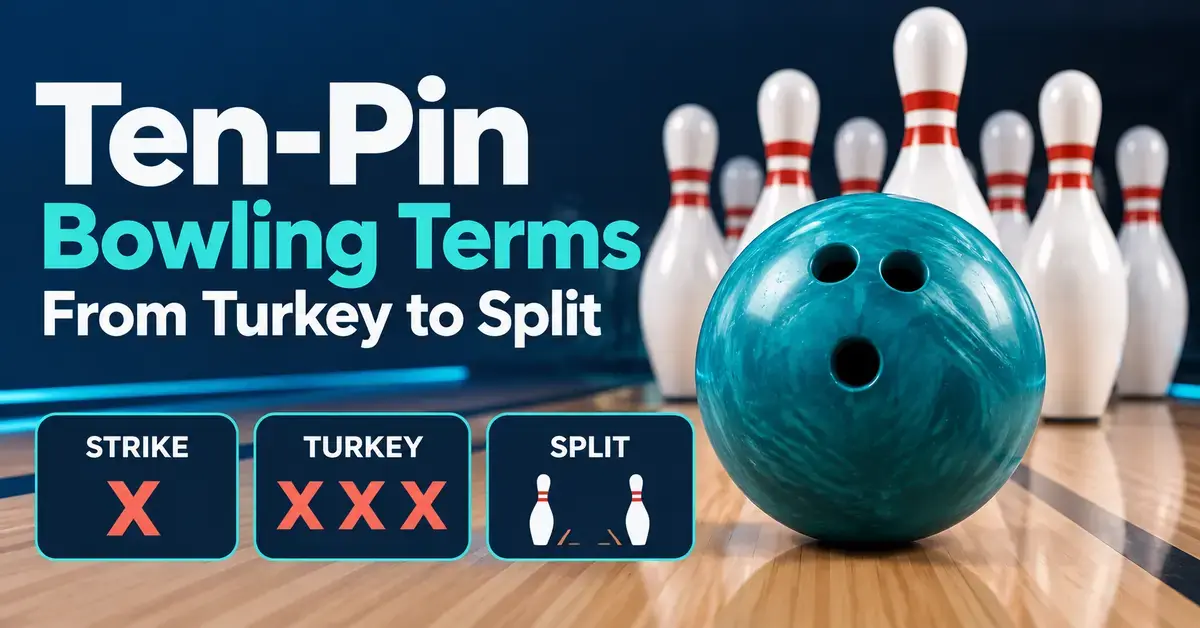
If you have ever heard someone at the lanes shout “turkey!” or groan about leaving a “split” and had no idea what they meant, this ten-pin bowling glossary is for you. Ten-pin bowling has a language all its own, built up over more than a century, and knowing the key terms makes the game easier to follow, easier to score and a lot more fun. Below you will find the most common ten-pin bowling terms explained in plain English, grouped so you can learn them the way they actually come up during a game — from the scoring basics, through the celebrated strike streaks, to the frustrating splits. Every term here belongs to ten-pin bowling specifically; the vocabulary of lawn bowls is different, and we flag that difference near the end so you never mix the two up.
Key Points
- Strike = all ten pins on the first ball; spare = all ten across both balls in a frame.
- Turkey = three strikes in a row; hambone/four-bagger = four; a perfect game (300) needs twelve.
- Split = pins left with a gap and no headpin; a washout keeps the headpin and is easier to convert.
- The pocket is the strike target: 1-3 for right-handers, 1-2 for left-handers.
- Every term here is ten-pin bowling only — lawn bowls uses a different vocabulary.
What is a bowling terms glossary and why does it help?
A bowling terms glossary is simply a plain-language dictionary of the words bowlers use for shots, scores, pin arrangements and equipment. It helps because much of ten-pin’s language is nicknamed slang — a “turkey” is not a bird and “Brooklyn” is not a place you visit. Learning the terms lets you read a scoresheet, understand a coach or league-mate, and describe your own shots accurately.
Ten-pin bowling is played on a wooden or synthetic lane with ten pins arranged in a triangle at the far end. A game is made up of ten frames, and in each frame you normally get two deliveries (throws) to knock down all ten pins. Most of the terms below describe what happens across those two deliveries, or the layout of the pins you are aiming at.
Scoring basics: the terms every bowler uses first
The core scoring terms describe how many pins you knock down and when. Get these four right and you can follow almost any game.
Strike
A strike is knocking down all ten pins with your first delivery in a frame. It is marked on the scoresheet with an “X” and is the single best result you can get in a frame, because it earns bonus points: the value of your next two deliveries is added on top of the ten pins.
Spare
A spare is knocking down all ten pins using both deliveries in a frame — some with the first ball and the rest with the second. It is marked with a forward slash “/”. A spare also earns a bonus: the pins from your next single delivery are added on.
Open frame
An open frame is any frame where you fail to knock down all ten pins in your two deliveries. Because there is no strike or spare, you score only the pins you actually knocked over, with no bonus. Reducing open frames is the fastest way for a beginner to raise their average.
Perfect game (300)
A perfect game is a score of 300, achieved by rolling twelve strikes in a row. The number twelve surprises people because a game has only ten frames, but the tenth frame gives a bowler up to three deliveries when they strike, so twelve strikes are needed to fill the card. A 300 is the highest possible score in ten-pin bowling.
Strike streaks: from double to the “turkey” and beyond
Bowlers give special names to runs of consecutive strikes, and this is where the game’s most colourful slang lives. The key point is simple: every extra strike in a row has its own nickname.
Double
A double is two strikes in a row. Because a strike borrows the next two deliveries as bonus, stringing strikes together is how big scores are built.
Turkey
A turkey is three strikes in a row — the most famous term in bowling. The name is widely said to date from prize-giving traditions in the late 1800s and early 1900s, when a bowler who rolled three straight strikes might win a live turkey, especially around holiday competitions.
Hambone (four-bagger)
A hambone is four strikes in a row. The nickname was coined by ESPN commentator Rob Stone during Professional Bowlers Association telecasts after 2008, when he asked why four strikes had no name of its own the way three did. The same result is also called a four-bagger.
Bagger streaks: five and up
Five or more strikes in a row are usually counted with the word “bagger”: a five-bagger is five in a row, a six-bagger is six, and so on. The term “bagger” comes from the idea of “bagging” strikes one after another. When you reach twelve, you have a perfect game.
Strike Streak Names
| Strikes in a row | Name | Notes |
|---|---|---|
| 2 | Double | Foundation of a big-scoring frame |
| 3 | Turkey | The most famous streak name |
| 4 | Hambone (four-bagger) | Named by commentator Rob Stone |
| 5 | Five-bagger | “Bagger” counts each extra strike |
| 6+ | Six-bagger, and up | Same pattern continues |
| 12 | Perfect game (300) | Highest possible score |
Splits and tricky leaves: from the baby split to the big four
When your first ball leaves pins standing with gaps between them, you are looking at a split — and splits have their own detailed vocabulary. A “leave” simply means whatever pins are left standing after your first delivery.
Split
A split is a leave in which two or more pins remain standing with a gap between them, and the headpin (the front pin) has already been knocked down. Splits are hard to convert into a spare because the ball can usually only reach one group of pins at a time. On many scoresheets a split is circled.
Baby split
A baby split is one of the easier splits to convert, specifically the 2-7 or the 3-10, where the two remaining pins are close enough that a well-placed ball can clip both. Beginners are often encouraged to practise these because they build confidence.
Washout
A washout looks like a split but still includes the headpin standing, for example the 1-2-10. Because the front pin is still up, it is technically classed as a washout rather than a true split, and it is generally easier to convert since you have a pin to drive the others into.
Big four
The big four is the 4-6-7-10 split — two pins on the far left and two on the far right, with a wide empty gap in the middle. It is one of the most difficult leaves in the game and converting it is a rare, crowd-pleasing feat.
Greek church
A Greek church is a spread split with pins on both sides that resembles a church outline, classically the 4-6-7-9-10, with three pins on one side and two on the other. Like the big four, it is a tough leave that is seldom spared.
Sleeper
A sleeper is a pin hidden directly behind another pin, so it is hard to see from the approach — for example the 5-pin sitting behind the headpin, or the 8 behind the 2. The danger is knocking down only the front pin and leaving the hidden one standing.
Aiming and ball-path terms
These terms describe where you want the ball to go and what happens when it arrives. Knowing them helps you talk about accuracy rather than just luck.
The pocket is the ideal target between the headpin and the pin beside it that gives the best chance of a strike. For a right-handed bowler that is the gap between the 1 and 3 pins; for a left-hander it is between the 1 and 2 pins. Hitting the pocket consistently is the single biggest key to scoring.
Brooklyn
A Brooklyn is when the ball crosses over to the “wrong” side of the headpin — a right-hander hitting the 1-2 side instead of the 1-3 side, or the reverse for a left-hander. It can still produce a strike, but because it is not the intended line it is considered lucky. The name comes from old New York bowlers joking about “crossing over” the river to Brooklyn.
Kingpin
The kingpin is the 5-pin, which sits in the centre of the triangle directly behind the headpin. It is called the king because the ball rarely touches it directly; instead other pins must be driven into it, and leaving the 5-pin standing is a common reason an apparently good hit fails to strike.
Tap
A tap is a shot that looks like a perfect pocket hit but still leaves a single pin standing — an unlucky result that feels like it should have struck. Every bowler experiences taps, and they are simply part of the game’s physics rather than a mistake.
Chop (cherry)
A chop, sometimes called a cherry, is knocking down only the front pin of a spare leave while a pin next to or behind it stays standing. It usually means the ball came in slightly off line, and it turns an easy spare into an open frame.
The lane and equipment vocabulary
A few terms describe the playing surface and the ball, and they come up constantly once you start bowling seriously.
Boards and the foul line
The lane surface is divided lengthwise into 39 narrow strips called boards, roughly an inch wide each, and bowlers use board numbers to describe their aim. The foul line is the line separating the run-up (the approach) from the start of the lane; stepping over it counts as a foul and scores zero for that delivery.
Gutter (channel)
The gutter, also called the channel, is the shallow trough running down each side of the lane. A ball that drops into it is a gutter ball and knocks down no pins. New lanes for children often have bumpers fitted to block the gutters.
Lane length and ball weight
A regulation ten-pin lane measures about 60 feet (18.29 m) from the foul line to the centre of the headpin, and is roughly 41.5 inches (105 cm) wide across those 39 boards. A bowling ball can weigh no more than 16 pounds (about 7.26 kg) under United States Bowling Congress specifications, which are the standard followed internationally; house balls at the alley run from around 6 pounds upward so every bowler can find a comfortable weight.
Ten-pin vs lawn bowls: don’t mix the two vocabularies
Ten-pin bowling and lawn bowls are different sports with different words, and confusing their terms is a common trap in New Zealand because both are simply called “bowling” in everyday speech. In ten-pin you roll a ball with finger holes down an indoor lane at pins; in lawn bowls you roll a weighted, biased bowl across an outdoor green toward a small target ball. A “jack”, an “end” and “draw” belong to lawn bowls, while “strike”, “frame” and “turkey” belong to ten-pin. If you are exploring the outdoor code, our guides to lawn bowls in Auckland use that sport’s own vocabulary, whereas everything in this glossary is strictly ten-pin.
Common mistakes when learning bowling terms
The most common mistake is assuming every leave with pins standing is a “split”. If the headpin is still up, it is usually a washout, not a true split — and the two are converted differently. Below are the errors beginners make most often.
- Calling three strikes a “hat trick”. That term comes from other sports; in bowling three in a row is a turkey.
- Confusing a strike and a spare. A strike clears all ten pins on the first ball; a spare needs both deliveries. They earn different bonuses, which changes your score a lot.
- Aiming for the headpin. Hitting the headpin flush usually splits the pins and leaves a difficult leave. Aim for the pocket beside it instead.
- Thinking a Brooklyn is a good shot. It can strike, but it is the wrong line and unreliable, so do not build your aim around it.
- Using lawn bowls words at the ten-pin lane. “Ends”, “jacks” and “draws” will only confuse your team; stick to frames, pins and the pocket.
Where these terms come up in New Zealand
You will hear this vocabulary at any tenpin centre in the country, from casual family games to organised competition. If you want to see the terms in action, our overview of ten-pin bowling in New Zealand explains how the sport is organised, and the New Zealand tenpin travel league shows how league play works if you want to take the game further. Newcomers in the biggest city can also find lanes through our guide to bowling in Auckland. Tenpin Bowling New Zealand is the recognised national body for the sport, and league and tournament play follows the same internationally standard terms and specifications described above.
Sources
Frequently Asked Questions (FAQ)
Why is three strikes in a row called a turkey?
Three strikes in a row is called a turkey because of prize traditions from the late nineteenth and early twentieth centuries, when bowlers who rolled three consecutive strikes in holiday competitions could win a real turkey. The nickname stuck and is now standard around the world.
What is the difference between a split and a washout?
A split is a leave where two or more pins stand with a gap between them and the headpin is already down, which makes it hard to convert. A washout looks similar but still has the headpin standing, so it is generally easier to spare and is not classed as a true split.
What is the pocket in bowling?
The pocket is the ideal target for a strike: the gap between the 1 and 3 pins for a right-handed bowler, or between the 1 and 2 pins for a left-hander. Hitting the pocket consistently gives the best and most repeatable chance of knocking down all ten pins.
How many strikes make a perfect game?
Twelve strikes in a row make a perfect game, which scores 300. A game has ten frames, but the tenth frame allows up to three deliveries after a strike, so twelve strikes are needed to complete a maximum card.
Are ten-pin bowling terms the same as lawn bowls terms?
No. Ten-pin bowling and lawn bowls are separate sports with different vocabularies. Words like strike, frame, spare and turkey are ten-pin terms, while jack, end and draw belong to lawn bowls, so the two sets of terms should not be mixed even though both sports are casually called “bowling”.
