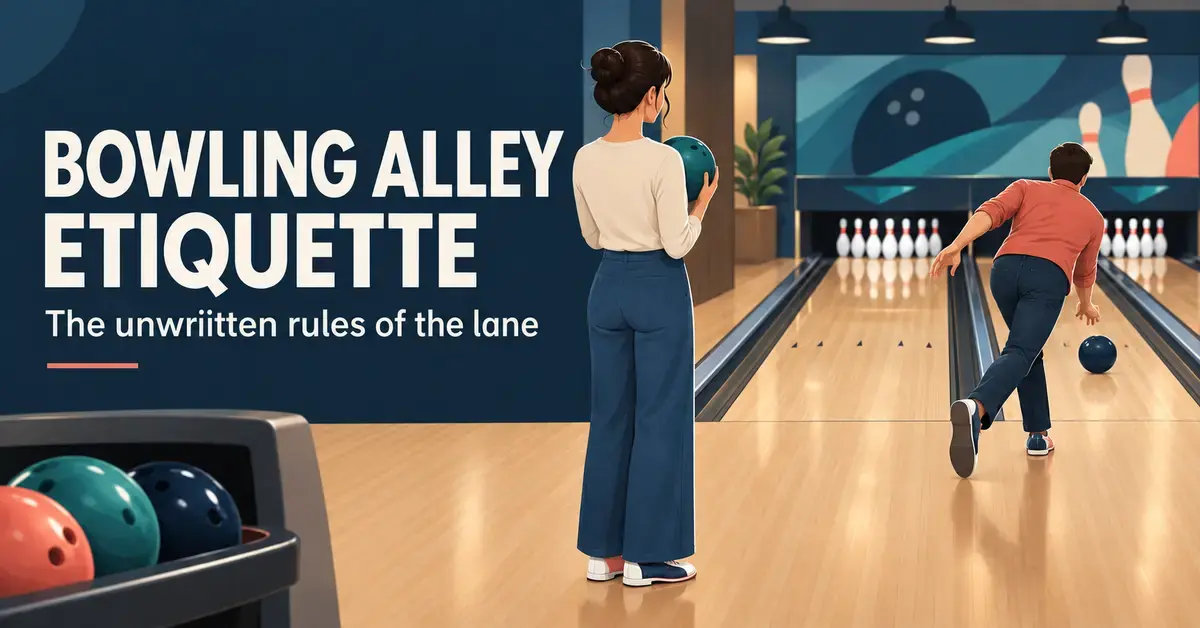
Bowling alley etiquette is the set of shared, mostly unwritten courtesies that keep a busy centre running smoothly and fairly for everyone on the lanes. Ten-pin bowling packs strangers, families and league teams side by side, each taking turns in a small shared space, so a handful of simple habits — waiting your turn, giving way to the bowler on your right, keeping food off the approach — make the difference between a relaxed night out and a frustrating one. This guide explains each of those habits in plain terms, why they exist, and the mistakes newcomers most often make, so you can walk into any New Zealand centre and fit right in.
Key Points
- Lane courtesy is the golden rule: give way to the bowler on your right, and never bowl at the same moment as your neighbour.
- Stay off the approach until it is your turn, then bowl promptly and step back — don’t linger to watch your pins.
- Never cross the foul line: the shot scores zero and the oiled lane beyond it is slippery.
- Bowling shoes only on the approach; change out of them before the cafe, bathroom or outdoors.
- Keep food, drinks and bags behind the approach to avoid slips and trips.
- Don’t touch another bowler’s personal ball without asking, and keep noise and phones out of others’ concentration.
What is bowling alley etiquette, and why does it matter?
Bowling alley etiquette is a code of courtesy that reduces friction between bowlers who share adjacent lanes and equipment. Unlike the scoring rules, it is rarely posted on a wall or enforced by staff — it is passed on by regulars and expected of everyone. It matters for three practical reasons: safety, fairness and pace.
Safety comes first because the far side of the foul line is coated in oil and is genuinely slippery, and the approach area behind it is kept clean and smooth for sliding. Fairness matters because bowling is a game of concentration, and a bowler distracted mid-swing loses a fair shot. Pace matters because a single slow bowler holds up their own lane and, through lane courtesy, the lanes on either side too. Good etiquette is simply the quickest way to make sure everyone gets an equal, uninterrupted go.
Who bowls first? Understanding lane courtesy
The single most important rule is lane courtesy, also called the right-of-way rule: the bowler on your right has priority. If a bowler on the lane immediately to your right is stepping onto the approach at the same time as you, you let them bowl first, then take your turn.
In practice this means a quick glance to your right before you pick up your ball. If someone there is settling into their stance, wait until they have delivered and stepped back off the approach. The generally accepted guidance from the sport’s governing bodies is that when two bowlers are ready at once, the one who stepped up first goes; and if there is any doubt about who was first, the bowler on the right takes precedence.
How many lanes should you give way to?
The traditional courtesy is to check one lane on each side, but many bowlers extend it to give way to bowlers on both immediate lanes. The idea is not to time your shot to the exact second, but to avoid two people bowling shoulder-to-shoulder at the same moment, which is distracting and, when arms are swinging, mildly unsafe. When lanes are quiet, courtesy is effortless; when a centre is packed, a little patience keeps everyone moving.
What if you are unsure whether it is your turn?
When in doubt, pause and gesture for the other bowler to go ahead. A short wave that says “after you” costs nothing and is universally understood. It is far better to hesitate for a moment than to step up at the same time as your neighbour and put both of you off your shot.
Waiting your turn and behaviour on the approach
Stay behind the approach until the bowler currently up has finished. The approach is the wooden or synthetic run-up between the seating and the foul line, and only one person should be on it at a time. Crowding the person ahead of you, standing in their eyeline, or moving into your own stance while they are still delivering are the most common ways new bowlers unsettle others without meaning to.
Be ready when it is your turn. Have your ball chosen and be watching the game so you can step up promptly. At the same time, do not rush: take a normal, steady routine and then step off the approach once your ball is on its way. Lingering at the top of the approach to watch your pins — especially after a strike — blocks the bowler waiting behind you.
Keep celebrations and frustration to your own lane
Enjoy a good shot, but keep the reaction contained to your own space. A cheer is part of the fun; walking into a neighbour’s approach to celebrate, or slamming equipment after a bad frame, spills your moment into someone else’s game. The same applies to coaching a friend — do it from the seating, not from the next lane’s approach.
The foul line: where to stop and why
Never step over the foul line. The foul line is the marked boundary at the start of the lane, and crossing it with any part of your body during or after your delivery is a foul — that shot scores zero even if you knock down all ten pins. Automatic sensors in most modern centres will register it for you.
Beyond the scoring penalty, the reason the rule is taken seriously is safety. The lane surface past the foul line is dressed with oil to protect the wood and shape ball motion, so it is slick underfoot. Stepping onto it risks a fall, and it can also transfer oil back onto the approach, where the next bowler needs clean, consistent footing to slide. Finish your slide behind the line, retrieve your composure, and step back.
Footwear: why bowling shoes are non-negotiable
Bowling shoes are mandatory, and street shoes are not allowed on the approach. Rental shoes are available at the counter of every centre for a small fee, and if you bowl often you can buy your own. They exist for two reasons: their smooth soles let you slide safely into your delivery, and they protect the specially maintained approach from grit, moisture and marks that ordinary shoes drag in.
Change into your bowling shoes before you step near the lanes, and change back into street shoes before you visit the cafe, the bar or the bathroom — walking outside or across wet floors in bowling shoes ruins the slide and can be dangerous when you return to the approach. Wearing socks is expected in rental shoes for hygiene, so bring a pair if you are heading straight from work.
Food, drink and belongings around the lanes
Keep all food, drinks and personal gear behind the approach, never on or beside it. Spilled liquid or dropped food on the approach creates a slip hazard and can stick to the next bowler’s shoes, while bags and jackets left underfoot are a trip risk. Most centres provide a seating area and cup holders exactly for this purpose — use them.
As a rule, eat and drink in the seating or dining area rather than at the top of the approach, and keep your hands clean and dry before you bowl. Greasy or wet hands make the ball hard to control and leave residue on shared house balls and the ball return.
Sharing balls and the ball return
Only pick up your ball when it has fully returned and settled, and keep your fingers clear of the return mechanism. The ball return is the machine that feeds balls back to the rack between the lanes; reaching in while a ball is arriving risks pinched fingers, so wait for it to come to rest.
House-ball etiquette
House balls — the shared balls provided by the centre — are first come, first served, but common sense keeps things civil. If you find a ball that fits, it is courteous not to hoard several at once when the racks are busy, and to return a ball to the general rack rather than leaving it in a neighbouring lane’s return. If you are sharing a lane with another group by arrangement, keep track of which balls each of you is using so nobody is left waiting.
Handling other people’s equipment
Do not touch another bowler’s personal ball without asking. Serious bowlers drill and maintain their own equipment carefully, and a personal ball is not part of the shared house pool. If you like the look of it, ask — most are happy to talk about their gear.
Noise, phones and staying present
Keep noise and distractions to a reasonable level while others are bowling. Conversation and laughter are part of the atmosphere, but shouting across lanes, playing loud music from a phone, or standing in a bowler’s line of sight breaks their concentration. If you need to take a call or reply to messages, step back to the seating area rather than doing it on the approach.
Being present also means watching the flow of your own lane so the game keeps moving. A group where everyone is heads-down on their phones between frames is the usual reason a lane falls behind the ones around it.
Bowling with children and beginners
Groups with children are welcome in almost every centre, and a few courtesies keep it smooth. Ask staff to raise the bumpers (the barriers that block the gutters) for young bowlers rather than improvising, use the lightweight balls and ramps many centres provide, and keep children seated and away from the approach and ball return except when it is their turn. The machinery at the end of the lane and the returning balls are the two hazards to supervise most closely.
With beginners of any age, patience is the whole game. Everyone bowls a gutter ball, and no one minds — the etiquette that matters is not skill but taking your turn promptly, staying off other people’s approaches, and keeping the mood friendly.
League and tournament etiquette in New Zealand
Organised play adds a layer of formality on top of casual courtesy. In a league or tournament, lane courtesy is observed strictly, you are expected to be ready and to bowl at a steady pace, and sportsmanship toward opponents — a handshake or acknowledgement at the start and finish — is standard. Practice balls are usually limited to a set warm-up period, after which every delivery counts.
New Zealand’s competitive scene is administered by Tenpin Bowling New Zealand, the national body affiliated to the International Bowling Federation, and local centres run graded leagues for all abilities. If you are thinking of stepping up from social games, joining a travel or club league is the usual path, and it is where you will absorb the finer points of etiquette from more experienced bowlers. Whether you play in Auckland, Wellington or Christchurch, the courtesies on the lane are the same.
Do's and Don'ts
| Do | Don’t |
|---|---|
| Check the lane on your right and give way | Step up at the same time as your neighbour |
| Be ready and bowl at a steady pace | Linger on the approach after your shot |
| Finish your slide behind the foul line | Cross the foul line onto the oiled lane |
| Wear bowling shoes on the approach only | Walk outside or to the cafe in bowling shoes |
| Keep food, drinks and bags in the seating area | Leave anything on or beside the approach |
| Ask before handling someone’s personal ball | Grab a clearly personal, drilled ball |
| Keep celebrations and noise to your own lane | Shout across lanes or stand in a bowler’s eyeline |
Common bowling etiquette mistakes to avoid
Most etiquette slips come from not knowing the rules rather than rudeness. These are the ones newcomers make most often:
- Bowling at the same time as your neighbour. Forgetting to check the lane on your right is the classic beginner error — a quick glance fixes it every time.
- Lingering on the approach. Watching your ball travel the whole lane, or celebrating a strike from the top of the approach, holds up the bowler behind you.
- Wearing bowling shoes off the approach. Walking to the cafe, outside for a smoke, or into a wet bathroom in your bowling shoes ruins the slide and creates a hazard when you return.
- Crossing the foul line. Stepping over the line loses the frame and puts you on a slippery, oiled surface.
- Leaving food, drinks or bags on the approach. These are slip and trip hazards for you and everyone who bowls after you.
- Using someone else’s personal ball. Grabbing a drilled ball that clearly is not a house ball, without asking, is a quick way to annoy a serious bowler.
- Distracting others. Loud phones, shouting across lanes, or standing in a bowler’s eyeline all break concentration during the shot.
Who these rules are for
Bowling etiquette applies to everyone who steps onto a lane, from a first-time social bowler at a birthday party to a league regular. The good news is that almost all of it reduces to two instincts: give the person on your right their turn, and keep your mess, noise and movement inside your own lane. Learn those two, add bowling shoes and a clean approach, and you already meet the standard expected in any New Zealand centre. Everything else in this guide is simply the detail behind those two ideas.
Sources
Frequently asked questions (FAQ)
Who has the right of way when two people are ready to bowl?
The bowler on the right has priority. If two bowlers on adjacent lanes step up at the same time, the one who was ready first goes, and when there is any doubt about who that was, the bowler on the right bowls first. A quick glance to your right before you pick up your ball is all it takes to observe the rule.
Why can’t I wear my own shoes bowling?
Bowling shoes have smooth, matched soles that let you slide safely into your delivery, and they keep grit and moisture off the carefully maintained approach. Street shoes can catch and cause a fall, and they mark the surface for the next bowler, so every centre requires bowling shoes and hires them at the counter.
What happens if I step over the foul line?
Crossing the foul line is a foul, and that shot scores zero even if you knock down every pin. Beyond the scoring penalty, the lane past the line is coated in oil and is slippery, so stepping over it risks a fall and can carry oil back onto the approach where the next bowler needs clean footing.
Is it rude to celebrate a strike?
No — a cheer for a good shot is part of the fun. The courtesy is simply to keep the celebration in your own lane and to step back off the approach afterwards, rather than lingering at the top or spilling into a neighbour’s space while they are trying to bowl.
Can my kids bowl, and how do I keep it polite?
Yes, children are welcome in almost every centre. Ask staff to raise the bumpers that block the gutters, use the lightweight balls or ramps provided, and keep children seated and clear of the approach and the ball return except on their turn. Supervising them near the returning balls and the pin machinery is the main safety point.
