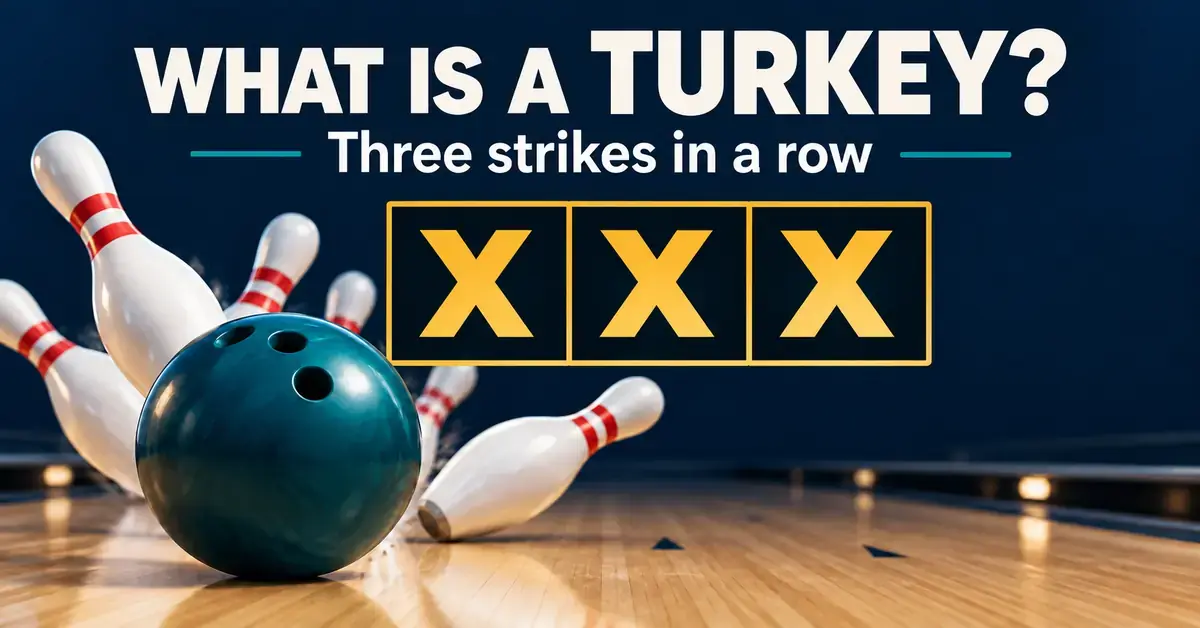
A turkey in bowling is the nickname for three strikes bowled in a row. It is one of the most recognised pieces of ten-pin bowling slang, and hearing it called out is a sign that a bowler is having a strong game. This guide explains exactly what a turkey is, where the odd name comes from, how strikes are scored, and the full set of nicknames bowlers use for longer strings of strikes. Everything here refers to ten-pin bowling, the indoor game played in bowling centres across New Zealand.
What is a turkey in bowling?
A turkey is three consecutive strikes in a single game of ten-pin bowling. A strike means knocking down all ten pins with the first ball of a frame. Do that three frames in a row and you have bowled a turkey. The term is recognised by the sport’s governing bodies, including the United States Bowling Congress and the Professional Bowlers Association, so it is standard vocabulary rather than casual invention.
The three strikes must be back to back. If you strike in the first and second frames, miss in the third, then strike in the fourth, that is not a turkey — the streak was broken. The three strikes can start in any frame, though, so a turkey earned in the eighth, ninth and tenth frames counts exactly the same as one in the opening frames.
Why is three strikes called a turkey?
The name is believed to date back to bowling competitions in the late 1700s and early 1800s, long before the modern game was standardised. The widely accepted explanation is that tournament prizes at the time were often food, and a whole turkey — a valuable item, especially around the Thanksgiving and Christmas holiday season — was awarded to bowlers who managed three strikes in a row.
As striking became more common and prizes changed, the actual turkeys stopped being handed out, but the word stuck. It is worth being clear that this origin story is the popular and repeated account rather than a documented historical fact; the exact beginnings are not recorded. What is certain is that the term has been part of bowling culture for well over a century and remains in everyday use.
Quick Facts
- Turkey: three strikes in a row in one game of ten-pin bowling.
- Sport: ten-pin bowling only — not lawn bowls.
- Recognised by: the United States Bowling Congress and Professional Bowlers Association.
- Likely origin: food prizes at early tournaments, when a whole turkey was awarded for three strikes (popular account, not documented).
- Scoring note: a turkey adds no special bonus; its value comes from normal strike scoring (10 + next two balls).
- Maximum game: twelve strikes in a row = a perfect game of 300.
How are strikes scored, and what is a turkey worth?
Understanding scoring explains why a turkey matters so much. A strike is not simply worth 10 points — it is worth 10 plus the total number of pins you knock down with your next two balls. That bonus is what makes stringing strikes together so powerful.
What a single strike is worth
When you bowl a strike, you score 10 points for that frame plus whatever you knock down on the following two deliveries. For example, if you strike and then knock down 4 and 3 pins on the next two balls, that strike frame is worth 10 + 4 + 3 = 17 points. Because those two follow-up balls also count towards their own frames, the pins effectively get counted twice.
How much a turkey adds
When you bowl three strikes in a row, the first strike frame is worth the maximum 10 + 10 + 10 = 30 points, because the two balls after it are both strikes. This is why a turkey can rapidly lift a score. A full game of nothing but strikes — twelve in a row across the ten frames — produces the maximum possible score of 300, known as a perfect game. Every 30-point frame in that game is built on the same rolling bonus a turkey demonstrates.
If you are new to keeping score, most bowling centres in New Zealand use automatic scoring screens that do the maths for you. You can find plenty of family and league venues through guides such as ten-pin bowling in New Zealand.
Nicknames for longer strings of strikes
A turkey is only one point on a scale of strike-streak nicknames. Bowlers have names for two strikes right up to a perfect game, and knowing them helps you follow league chatter and televised commentary.
Double: two strikes in a row
Two consecutive strikes are called a double. It is the smallest named streak and the building block that leads to a turkey with one more strike.
Four-bagger and the hambone
Four strikes in a row are usually called a four-bagger. Many bowlers also call it a hambone, a term popularised by American sports commentator Rob Stone. From four strikes onward, the general “bagger” system takes over: the number of strikes plus the word bagger.
Five-bagger, six pack and beyond
Five strikes in a row are a five-bagger, sometimes jokingly called a Yahtzee after the dice game’s five-of-a-kind. Six strikes are commonly called a six pack, or a six-bagger, and occasionally a wild turkey. The pattern continues — seven-bagger, eight-bagger, and so on — as the streak grows.
The golden turkey and the perfect game
Nine strikes in a row are sometimes called a golden turkey, because it is effectively three turkeys back to back. Twelve strikes in a single game make a perfect game, scoring 300. Related terms you will hear include the “front nine” (the first nine frames all struck) and “punch out” (finishing a game with consecutive strikes from any frame to the end).
Strike Streaks at a Glance
| Strikes in a row | Common name(s) |
|---|---|
| 2 | Double |
| 3 | Turkey |
| 4 | Four-bagger / Hambone |
| 5 | Five-bagger (jokingly “Yahtzee”) |
| 6 | Six pack / Six-bagger / Wild turkey |
| 7–8 | Seven-bagger / Eight-bagger |
| 9 | Golden turkey |
| 12 (full game) | Perfect game (300) |
Turkey versus other common bowling terms
A turkey is a scoring streak, but it is easy to mix it up with the other pieces of bowling vocabulary you hear at the lanes. Here is how it sits alongside the terms it is most often confused with.
- Strike: all ten pins down with the first ball of a frame. Three of these in a row make a turkey.
- Spare: all ten pins down using both balls of a frame. A spare is not part of a turkey, because a turkey requires first-ball strikes.
- Split: a difficult leave where two or more standing pins have a gap between them, such as the 7–10 split (the two back corner pins), nicknamed “bed posts”.
- Open frame: a frame where you fail to knock down all ten pins with your two balls — the opposite outcome to a strike.
- Clean game: a game with a strike or spare in every frame and no open frames.
If you want a broader grounding in how the sport is played and organised locally, the overview of ten-pin bowling leagues in New Zealand is a useful next read.
Does a turkey exist in lawn bowls?
No — “turkey” is a ten-pin bowling term only and has no meaning in lawn bowls. Lawn bowls is a completely different sport, played on a flat grass or synthetic green where players roll biased bowls towards a small target ball called the jack. There are no pins, no strikes and no frames, so none of the strike-streak nicknames apply.
Because both codes share the word “bowling”, the terminology is often confused. If you are interested in the green-based game instead, New Zealand club guides such as lawn bowls in Auckland and the Howick Bowling Club cover that side of the sport, which uses its own scoring language entirely.
Common mistakes and misconceptions about the turkey
The idea of a turkey is simple, but a few misunderstandings come up regularly among newer bowlers.
- Thinking a turkey is a special bonus. A turkey does not add extra points on its own. Its value comes purely from normal strike scoring — the name is a nickname, not a scoring rule.
- Counting non-consecutive strikes. Three strikes scattered through a game are not a turkey. They must be in three straight frames.
- Assuming a turkey must be in the same game only. Correct — the streak counts within one game; strikes carried across two separate games do not combine.
- Confusing a spare streak with a turkey. Only first-ball strikes count. A run of spares, however impressive, is never a turkey.
- Believing the origin is proven. The turkey-prize story is the accepted explanation, not a verified historical record. Treat it as popular history.
Who cares about turkeys, and how bowlers chase them
Turkeys matter most to recreational and league bowlers, because three strikes in a row is an achievable milestone that noticeably boosts a score without requiring professional skill. For competitive bowlers, longer streaks and the pursuit of a 300 game carry more weight, but the turkey remains the moment casual players celebrate at social outings and birthday sessions.
There is no shortcut to a turkey — it comes from repeatable technique: a consistent approach, a controlled release, and hitting the same target line so the ball enters the “pocket” (the gap between the head pin and the pin beside it) frame after frame. Practice sessions at your local centre are the most reliable way to build that consistency. City guides such as bowling in Auckland and bowling in Wellington list venues where you can practise.
Sources
Frequently Asked Questions (FAQ)
What is a turkey in bowling?
A turkey is three strikes bowled in a row within a single game of ten-pin bowling. A strike is knocking down all ten pins with the first ball of a frame, so a turkey means doing that in three consecutive frames.
Why is it called a turkey?
The most widely repeated explanation is that early bowling tournaments in the late 1700s and 1800s gave away food prizes, and a whole turkey was awarded for three strikes in a row, especially around the holiday season. The prizes stopped but the name stayed. The exact origin is not officially documented.
What do you call four or more strikes in a row?
Four strikes are a four-bagger, also known as a hambone. Five are a five-bagger, six are a six pack, and the pattern of “number plus bagger” continues. Nine in a row are sometimes called a golden turkey, and twelve in one game make a perfect game worth 300.
How many points is a turkey worth?
A turkey has no fixed bonus of its own. Because a strike scores 10 plus your next two balls, the first frame of a turkey is worth the maximum 30 points when both following balls are also strikes. The overall value depends on how the streak continues.
Is a turkey used in lawn bowls?
No. “Turkey” is only a ten-pin bowling term. Lawn bowls is a separate sport played with biased bowls on a green towards a jack, with no pins, strikes or frames, so the term does not apply.
