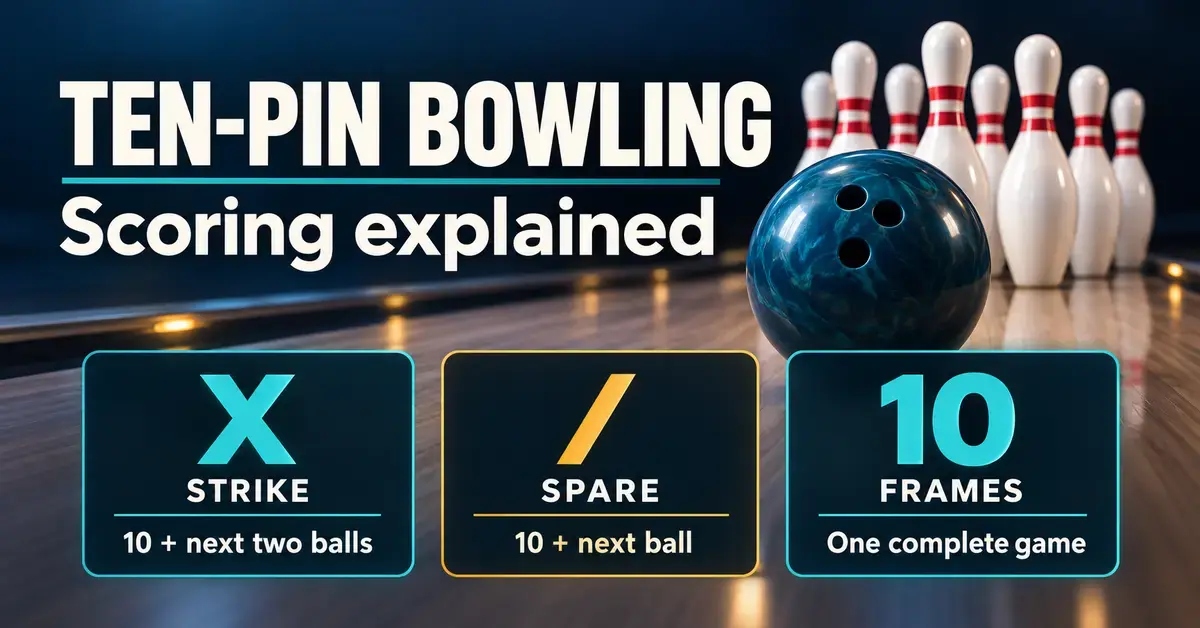
Ten-pin bowling scoring looks baffling the first time you face a sheet full of Xs and slashes, but the system is completely logical once you know what each mark means. The core idea is that the game rewards you for clearing all ten pins quickly: strikes and spares add bonus points taken from the balls you throw next, which is why one strong frame can be worth far more than the ten pins actually standing. This guide explains exactly how every frame is counted, how the special 10th frame works, how a perfect score of 300 is reached, and the mistakes that trip up most newcomers — using nothing but the standard rules used in league and casual play.
Key Points
- Ten frames per game, each with up to two rolls (the 10th frame can have three).
- Open frame = the number of pins knocked down, no bonus.
- Spare (/) = 10 + the pinfall of your next single ball.
- Strike (X) = 10 + the pinfall of your next two balls.
- Maximum score is 300, achieved with 12 consecutive strikes.
- An all-spare game (9 on each first ball) scores 190, showing spares alone build strong scores.
How is a game of ten-pin bowling structured?
A single game of ten-pin bowling is made up of ten frames, and you score each frame separately before adding it to a running total. In the first nine frames you get up to two rolls to knock down all ten pins. If you clear them all with the first ball it is a strike and the frame ends immediately; if you need both balls it is a spare; if some pins are still standing after two balls it is an “open” frame.
The pins are arranged in a triangle of four rows — one pin at the front, then rows of two, three and four — for a total of ten. Because the maximum you can physically knock down in a frame is ten pins, the scoring system layers bonuses on top of that base to reward the harder shots. Understanding the frame is the foundation for everything else; if you are new to the sport in general, our overview of ten-pin bowling in New Zealand sets the wider scene.
How do you score an open frame?
An open frame is scored simply as the number of pins you knock down — there is no bonus. If your first ball takes down six pins and your second ball takes down two, the frame is worth eight points, and you write the digits in the two small boxes at the top of the frame. Any frame where at least one pin remains standing after both rolls is an open frame.
Open frames are where games are lost. Because they carry no bonus, every open frame effectively caps that frame’s value at nine or fewer points, while a strike or spare can pull in extra points from later balls. Cutting down open frames is the single biggest scoring improvement most beginners can make.
How is a strike scored?
A strike is worth 10 points plus the total pinfall of your next two rolls, and it is marked with an X. Because the frame ends the moment you knock all ten pins down with the first ball, you do not throw a second ball in that frame — instead, the two balls you throw in the following frame (or frames) become the bonus.
For example, if you strike and then in the next frame roll a 7 followed by a 2, that first frame scores 10 + 7 + 2 = 19. If you strike and then strike again, you have to wait for the next roll after that to complete the count: two strikes in a row followed by a 5 makes the first frame worth 10 + 10 + 5 = 25. This is why announcers talk about a strike “still working” — its final value is not known until the next two balls have been thrown.
How is a spare scored?
A spare is worth 10 points plus the pinfall of your next single roll, and it is marked with a forward slash (/) in the second box of the frame. You earn a spare when it takes both balls of the frame to clear all ten pins — say a 6 on the first ball and the remaining 4 on the second.
The bonus comes from just one ball, the first roll of your next frame. So a spare followed by a first ball of 8 scores 10 + 8 = 18 for the spare frame. A spare is worth less than a strike on average because it draws its bonus from only one ball instead of two, but it is far more valuable than an open frame and much easier to achieve consistently.
How does the 10th frame work?
The 10th frame is the only frame that can give you three rolls, so that any bonus earned on the final frame can actually be counted. In the first nine frames a strike takes its bonus from later frames, but in the last frame there are no later frames — so the game hands you the extra balls directly.
- Strike on the first ball: you get two more balls. Roll all three as strikes and the frame is worth 30 (10 + 10 + 10).
- Spare across the first two balls: you get one more ball. That third ball’s pinfall is added, so a spare finished with an 8 makes the frame worth 18.
- Open frame: no bonus ball is awarded, and you simply score the pins knocked down over the two rolls.
The extra balls in the 10th frame are strictly for scoring the bonus — they are not a new frame. This is the mechanism that makes a perfect game mathematically possible.
What is the maximum score in ten-pin bowling?
The maximum possible score is 300, known as a perfect game, and it requires 12 strikes in a row. Nine strikes fill the first nine frames, and the 10th frame’s two bonus balls allow the 11th and 12th strikes. Each of the first nine frames scores 30 (10 for the strike plus 10 + 10 from the next two strikes), giving 270, and the 10th frame adds another 30 for a total of 300.
You do not need strikes to score well, though. A game of all spares, each set up with 9 pins on the first ball, scores 190 — because every spare frame is worth 10 + 9 = 19, ten times over. That is a genuinely strong league score, which shows how much spares alone can achieve. Perfect 300 games are rare and are certified by governing bodies; in this country that role belongs to the national federation that also oversees competition and organised league play such as the travel league.
A worked example: scoring three frames step by step
Numbers make the system click faster than rules do. Imagine you bowl the following:
- Frame 1: Strike (X)
- Frame 2: 7 pins, then a spare (7 /)
- Frame 3: 9 pins, then a miss (9 0)
Now count them in order. Frame 1 is a strike, so it is 10 plus the next two balls, which are the 7 and the spare-completing 3 from frame 2: 10 + 7 + 3 = 20. Frame 2 is a spare, so it is 10 plus the next single ball, which is the 9 that opens frame 3: 10 + 9 = 19, bringing the running total to 39. Frame 3 is an open frame worth 9 + 0 = 9, so the running total after three frames is 48. Notice how the strike in frame 1 quietly “reached forward” to grab points from the balls thrown in frame 2 — that forward reach is the heart of bowling scoring.
Reading the score sheet: symbols and notation
Modern bowling centres score automatically on overhead or console screens, but the notation is worth knowing so you can follow the maths and keep score by hand if the system fails. Each frame has small boxes for the individual balls and a larger space below for the running cumulative total.
The same shorthand appears everywhere from your local lanes to televised finals, whether you are bowling at one of the centres in Auckland or in Wellington. The cheat sheet below sums up every mark you will see.
Scoring Cheat Sheet
| Symbol / entry | Meaning | How it is scored |
|---|---|---|
| X | Strike (all 10 on the first ball) | 10 + next two balls |
| / | Spare (all 10 across both balls) | 10 + next one ball |
| Number pair (e.g. 6 2) | Open frame | Total pins knocked down (here 8) |
| – | Miss / gutter (zero pins) | 0 for that ball |
| F | Foul (crossing the line) | 0 for that ball |
| 10th frame X or / | Strike or spare in the final frame | Bonus balls added directly (up to 30 total) |
Traditional scoring versus the World Bowling system
Almost all league and casual play uses traditional scoring — the strike-and-spare bonus system described above — and it remains the global standard used by nearly every commercial centre. It is the system you will meet in New Zealand lanes and the one worth learning first.
You may, however, come across a simplified alternative called the World Bowling (or “current frame”) scoring system, trialled in some international professional events to make the sport easier for spectators to follow. Under it a strike is always worth a flat 30 points regardless of what you roll next, and a spare is worth 10 plus the pinfall of the next single ball. The maximum is still 300, but it is reached with ten consecutive strikes rather than twelve, because each strike is a fixed 30. The two systems can give different mid-game totals, so it is worth checking which one an event uses — but for everyday bowling, traditional scoring is what counts.
How does handicap scoring work in leagues?
Handicap scoring lets bowlers of very different standards compete fairly by adding bonus pins to weaker bowlers’ scores, and it is used by most social and league competitions. Your handicap is worked out from your average, so a beginner and a seasoned bowler can play the same match with a realistic chance of winning.
The common formula is: handicap = (basis score − your average) × a percentage factor. The basis score is a benchmark set by the league (often 200, 210 or 220), your average is drawn from your recent games, and the percentage is usually somewhere between 80% and 90%. For example, with a 200 basis and an 80% factor, a bowler averaging 156 gets (200 − 156) × 0.80 = 35.2, dropped to 35 handicap pins added to every game. Any fraction is truncated, not rounded up. Your “scratch” score is your actual pinfall; your “handicap” score is that total plus the handicap pins — and it is the handicap score that decides most league results.
Common scoring mistakes to avoid
The errors below are the ones that most often confuse newcomers and cost points or cause arguments over the sheet.
- Adding a strike as just 10. A strike is 10 plus the next two balls. Writing it down as a flat 10 is the most common scoring error and undervalues good bowling.
- Counting a spare’s bonus twice. The ball that completes a spare also counts as the first ball of that frame; the bonus is only the next frame’s first ball, not the completing ball itself.
- Filling in a total too early. A strike or spare frame cannot be finalised until the bonus balls are thrown. Leave the running total blank until you can complete the maths.
- Misreading the 10th frame. The extra balls there are bonus rolls, not a new frame — do not add an eleventh frame to the total.
- Chasing strikes and ignoring spares. Consistent spares build a far higher score than occasional strikes mixed with open frames, because every open frame throws away the bonus that spares would have earned.
Sources
- Tenpin Bowling New Zealand (TBNZ) — About / governing body
- United States Bowling Congress (BOWL.com) — alternative scoring system
- BowlersMart — understanding the World Bowling scoring method
- BowlersMart — bowling scoring explained: strikes, spares, frame math
- bowlingball.com — how to calculate your bowling handicap
Frequently Asked Questions (FAQ)
Why can a single frame be worth more than 10 points?
Because strikes and spares add bonus points from balls you throw in later frames. A strike frame can reach 30 points once the next two rolls are counted, even though only ten pins physically stood in that frame.
How many strikes do you need for a perfect 300 game?
Twelve strikes in a row under traditional scoring. Nine fill the first nine frames, and the two bonus balls awarded for a strike in the 10th frame allow the 11th and 12th strikes.
Is a strike or a spare worth more?
A strike is worth more on average because its bonus comes from your next two balls, while a spare’s bonus comes from only your next single ball. Both are far better than an open frame.
What happens if I knock down no pins in a frame?
That frame scores zero for the pins missed, and it counts as an open frame with no bonus. A missed second ball after a first-ball count still scores whatever the first ball knocked down.
Do I have to keep score by hand at a bowling centre?
No. Modern centres calculate scores automatically on the lane screens. Knowing the maths simply lets you follow along, check the totals and keep score manually if the system goes down.
