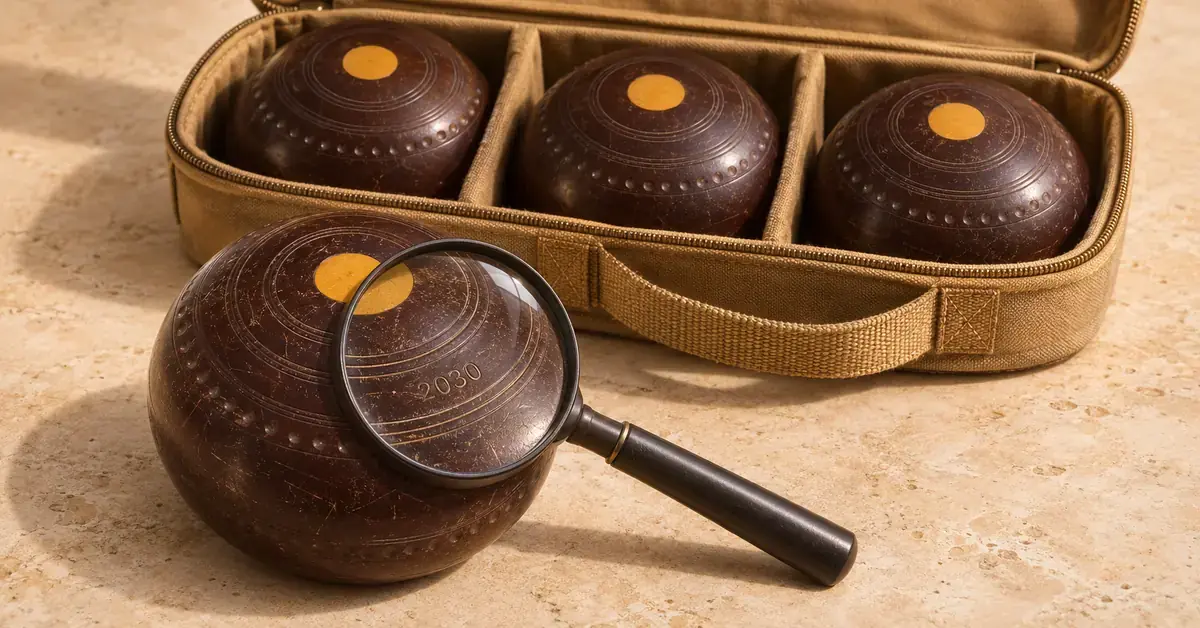
Buying second-hand lawn bowls in NZ can cut the cost of getting started by well over half, but a used set is only a bargain if the bowls are still legal to play with and actually fit your hand. Unlike most sports gear, lawn bowls carry a dated stamp that controls where they can be used, and their all-important bias cannot be changed once they leave the factory. This guide walks through exactly what to check – the date stamp, size and grip, bias and model, physical condition, and whether you are getting a matched set of four – so you can buy with confidence from a club, a private seller or an online marketplace.
Buyer's Checklist
- Date stamp: clear World Bowls stamp, year not yet passed (NZ domestic play needs a 1982-or-later stamp).
- Size: the number matches your hand – finger and thumb just meet around the bowl.
- Grip: rings, dimples or channels feel secure; remember the grip cannot be re-cut.
- Bias and model: identify the exact brand and model; the bias cannot be changed.
- Condition: no cracks; running surface smooth and even; markings legible.
- Matched set of four: same brand, model, size and serial/batch number on all four.
- Price check: budget for re-testing if the stamp has expired.
Why second-hand lawn bowls can be a smart buy
Second-hand bowls are popular because a good set barely wears out in casual play and costs a fraction of a new one. A brand-new set of four from a current model typically runs into the hundreds of dollars, while used sets in good order often sell for a modest two-figure sum. For a beginner who is not yet sure they will stick with the sport, that difference matters.
Bowls are also made to last decades. The material (a dense composite resin) does not perish the way a leather glove or a tennis racquet’s strings do, so a 15-year-old set can still roll true. The catch is that “still rolls” and “still legal and well matched” are not the same thing, which is why the checks below exist. For a full picture of new versus used pricing, see our guide to how much lawn bowls cost in New Zealand.
The date stamp: the first thing to check
Check the date stamp before anything else, because it decides whether the bowls can be used in club and competition play. Every bowl approved for the sport carries a small oval World Bowls stamp (older sets may show an earlier international or national mark). That stamp is what authorises a bowl for use; a set with no recognisable stamp is effectively unusable for anything beyond the back lawn.
What the date stamp means
The two-digit number in the stamp is the year the set is due for re-testing – in practice, its expiry year. Manufacturers set that date roughly ten years after the bowls are made, so a bowl stamped “28” is due for re-testing at the end of 2028. A bowl showing a year that has already passed has not stopped rolling, but it is out of date for stamped competition until it is checked and re-stamped.
Look closely and make sure the year is still clearly legible. A stamp that has worn smooth and cannot be read counts as needing re-testing even if the year itself has not passed.
What New Zealand’s rules require
In New Zealand, Bowls New Zealand sets the requirements for domestic play as the national governing body. For club, centre and national competition, bowls must carry a valid World Bowls stamp, and Bowls New Zealand’s domestic regulations require the stamp to show a 1982 date or later. Very old sets with a pre-1982 national mark may be fine for social roll-ups but are not accepted for domestic competition.
Rules are reviewed from time to time, so if you plan to play competitively it is worth confirming the current requirement with the club or centre you intend to join before you buy. If you are brand new to the sport, a club is the easiest place to get this checked – here is how to join a lawn bowls club and talk to experienced members.
What a re-test and re-stamp involves
Re-testing is done by a World Bowls licensed tester, who checks that each bowl still draws within the allowed bias tolerance and then applies a new stamp with a fresh date. It is not expensive relative to the price of a used set, but it is an added cost and a trip to a tester. If you are buying bowls with an expired stamp, treat re-testing as part of the real price and factor it in when you negotiate.
Check the size and grip fit your hand
Get the size right, because a bowl you cannot hold comfortably will hurt your game far more than a few years on the clock. Lawn bowls are sized by number, and the number relates to the bowl’s diameter: common adult sizes run from 00 (smallest) up to 5, with larger 6 and 7 sizes rarely made today. The number does not describe weight on its own – each size usually comes in a standard (medium) or heavy option.
A simple in-hand test works well. Wrap your middle finger and thumb around the running surface; they should just meet or leave only a small gap. A big overlap means the bowl is too small, and a wide gap means it is too large. You should be able to hold and release it without clenching your fist or flicking your wrist. Grip all four in turn – if your hand tires by the third or fourth, the set will wear you out over a full game.
Grip style (rings, dimples or deeper channels) does not change the diameter, but it changes how secure a size feels, so a textured grip can make a borderline size workable. Because grips and lugs are formed during manufacture, the grip cannot be re-cut later – what you buy is what you get. If you are unsure what suits you, our guide to what size lawn bowls you need covers sizing and grip in detail.
Check the bias and model
The bias is the weighted shaping that makes a bowl curve, and it cannot be changed – so a used set’s bias is whatever the model was built with. Different brands and models curve by different amounts: some draw a narrow line, others a wider arc. There is no single “correct” bias, but a very narrow modern set can be harder for a beginner to control, and a wider-drawing older model is often more forgiving.
Find out the exact brand and model before you buy (it is usually engraved or printed on the bowl next to the stamp and the large and small rings). Knowing the model lets you look up how it draws and whether it suits your green and your experience. If the idea of bias is new to you, read our explainer on bias in lawn bowls first.
One more point on bias and age: a bowl’s running surface slowly flattens with heavy use, and enough wear can push the bias outside the legal tolerance. That is the real reason for periodic re-testing, and it is why a set that has seen years of hard pennant play deserves more scrutiny than a lightly used club set.
Inspect the physical condition
Inspect every bowl in daylight and run your fingertips over the whole surface. You are mainly looking for damage that affects safety or roll, not cosmetic scuffs.
- Cracks and chips: A crack is a dealbreaker – it can grow, affect the roll and even cause a bowl to fail safety checks. Small surface chips at the rings are common and usually harmless, but anything deep should give you pause.
- Flat spots on the running surface: Roll each bowl slowly on a flat surface and watch for a wobble or a hard flat patch, which can signal heavy wear.
- Grip wear: Check that the grip pattern is still defined and not polished smooth, especially on an older set.
- Legible markings: The stamp, size, model and the identifying rings or emblems should all be readable.
- Clean-up: Dirt and grass stains are not a fault – a grimy set often just needs a wash. Our guide on how to clean and care for your lawn bowls shows how to bring them back without damaging the surface.
Make sure it’s a matched set of four
Confirm you are buying four identical bowls, not a mixed handful. Singles, pairs, triples and fours are played with sets, and the four bowls must match in brand, model, size, weight and bias. Mismatched bowls draw different lines, which makes consistent play almost impossible.
The easiest way to verify a true set is the serial or batch number: on a genuine matched set, all four bowls carry the same number. Also check the emblem or colour marking on each bowl – a proper set shares one design. As a legality guide, the four bowls in a tested set are matched to draw within a five-centimetre radius of each other, so wildly different lines are a warning sign. Buying a matched four up front saves the frustration of trying to pair up odd bowls later.
Where to buy second-hand lawn bowls in New Zealand
You have several reliable options in New Zealand, each with trade-offs.
- Bowling clubs: Often the best source. Members upgrade regularly, estates are sold off, and clubs sometimes keep a shelf of used sets or loan bowls for newcomers. You can usually try before you buy and get advice on the spot.
- Trade Me and Facebook Marketplace: The widest choice and the easiest to search by brand and size, but you are relying on photos and the seller’s description. Ask for clear shots of the stamp and serial numbers before you commit.
- Specialist bowls retailers: Some stock professionally checked used or refurbished sets, occasionally with a short warranty or returns window – more expensive than a private sale, but lower risk.
- Club notice boards and word of mouth: A quiet but steady source once you are part of a club community.
Whatever the channel, apply the same checks. A club set you can hold in your hand beats a cheaper online listing you cannot inspect.
How much should you pay?
Used sets in good, in-date condition commonly sell for a modest two-figure price, while a current-model set in near-new order will cost more and a very old or out-of-date set should be cheaper still. Price down for an expired stamp (you will pay for re-testing), visible cracks, a mismatched set or a size that is not quite right for you. Price up for a recent model, a current date stamp and a verified matched four. For the full range of new and used prices alongside club fees and accessories, our dedicated price guide goes into the numbers in depth.
Comparing the main lawn bowls brands
Knowing the brand helps you judge a used set and look up how its models draw. The table below compares the brands you are most likely to see on New Zealand greens. None is objectively “best” – the right set is the one that is legal, well matched and fits your hand. If you are starting out, our guide to the best lawn bowls for beginners explains which model traits are easiest to learn with.
Brand Comparison
| Brand | Origin | Known for | Official site |
|---|---|---|---|
| Henselite | Australia | One of the most common brands on NZ greens; a wide model range from beginner to elite. | henselite.com |
| Thomas Taylor (Taylor Bowls) | Scotland | Long-established maker; sets matched and tested at the factory, identified by a letter in the stamp. | taylorbowls.com |
| Aero | Australia | Modern grips and draw profiles; popular with newer and competitive players. | aerobowls.com |
| Drakes Pride | England | Broad range including value and flatter-green models. | drakespride.com |
| Greenmaster | England | Often found at lower price points on the used market. | greenmaster.co.uk |
Common mistakes when buying used lawn bowls
Avoid these frequent errors and you will dodge most second-hand regrets.
- Ignoring the date stamp: The most common mistake. An expired or unreadable stamp means the set needs re-testing before competition – budget for it or walk away.
- Buying the wrong size to save money: A cheap set that does not fit your hand is a false economy. Comfort beats a bargain every time.
- Assuming four bowls are a set: Always check that serial numbers and markings match. Mismatched bowls draw different lines.
- Buying “to grow into”: Unlike children’s shoes, there is no benefit to an oversized bowl – it only makes control harder.
- Overlooking cracks: A cracked bowl is not a discount, it is a reject.
- Paying new-set money for an old model: Research the model and its age before agreeing a price, especially online.
- Skipping the in-hand test online: If you cannot hold the bowls, at least confirm the exact size and grip and compare them with a set you have tried.
Who second-hand lawn bowls suit
Second-hand bowls suit most new and recreational players, and plenty of established ones too. They are ideal for a beginner testing the sport before committing, a social or barefoot-bowls player who does not need the latest model, and anyone on a budget who is happy to do the checks. They also suit experienced bowlers hunting for a specific discontinued model they already know draws well for them.
A used set is a weaker fit if you want a very specific current narrow-draw model for serious competition, or if you simply do not want the hassle of inspecting and possibly re-testing – in which case a new set with a fresh ten-year stamp may be worth the extra outlay. For everyone else, a carefully chosen second-hand set is one of the best-value entry points into lawn bowls in New Zealand.
Sources
- Taylor Bowls – Frequently Asked Questions (date stamp, grips, matched sets)
- The Sport of Bowls – Bowls Date Stamp history and re-testing
- Bowls Australia – Players urged to check bowls (testing, wear and bias tolerance)
- Bowls Queensland – Stamps on Bowls and Duty of Care
- Bowls World – Lawn Bowls Size Guide
Frequently Asked Questions (FAQ)
Are second-hand lawn bowls worth buying?
Yes, for most players. Bowls are durable and barely wear out in casual play, so a good used set can cost a fraction of a new one and still roll true. The value depends on the checks: a set with a current date stamp, the right size for your hand, no cracks and matching serial numbers is an excellent buy, while an expired or mismatched set is worth far less.
How do I know if used lawn bowls are still legal to play with?
Look for a clear World Bowls stamp with a two-digit year that has not yet passed. In New Zealand, bowls used in club and competition play must carry a valid stamp, and Bowls New Zealand’s domestic regulations require the stamp to date from 1982 or later. If the stamp has expired or is unreadable, the set needs re-testing and re-stamping by a licensed tester before competitive use. Confirm the current requirement with your club if you are unsure.
Do old lawn bowls expire?
They do not stop rolling, but the date stamp expires. The year in the stamp is roughly ten years after manufacture and marks when the set is due for re-testing. An out-of-date set can still be used socially, but for stamped competition it must be re-tested by a World Bowls licensed tester, who checks the bias is still within tolerance and applies a fresh stamp.
How much should I pay for a used set of lawn bowls in NZ?
Used sets in good, in-date condition commonly sell for a modest two-figure price, with recent models costing more and older or out-of-date sets costing less. Reduce your offer for an expired stamp (you will pay for re-testing), cracks, a mismatched set or a size that does not fit you. Check our lawn bowls price guide for the full range of new and used prices.
Can the bias or grip on second-hand bowls be changed?
No. Both the bias (the shaping that makes a bowl curve) and the grip pattern are formed during manufacture and cannot be altered afterwards. That is why it is so important to buy a model whose draw suits you and a size and grip that fit your hand – with a used set, what you see is what you get.
