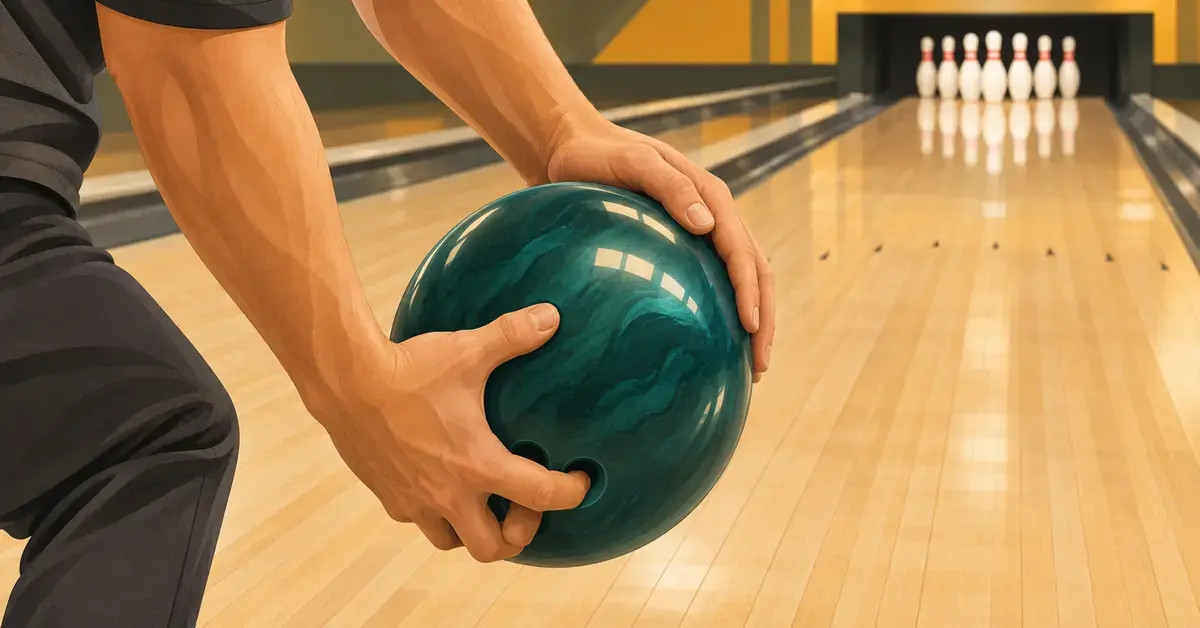
Two-handed bowling is a ten-pin style in which you cradle and swing the ball with both hands and release it without putting your thumb in the ball. The dominant hand’s fingers do the gripping while the non-dominant hand supports the ball through most of the approach, then comes off just before release. That extra support lets you generate far more revolutions on the ball than a traditional one-handed delivery, which is why the style has spread from the professional tour to local lanes. (This is a ten-pin technique, not to be confused with lawn bowls, which is a separate sport.)
Key Points
- What it is: a ten-pin style using both hands and no thumb in the ball, with the fingers of the dominant hand doing the gripping.
- Why bowlers use it: it generates high revs (about 500–700+ RPM) and a strong hook, with ball speeds around 17–22 mph (27–35 km/h).
- Who popularised it: Australian professional Jason Belmonte, who has bowled two-handed since toddlerhood.
- Is it legal: yes, in sanctioned play; the ball is usually drilled with finger holes only and no thumb hole.
- Main trade-offs: harder spare shooting, more physical demand, and the need for a reactive ball drilled for a two-finger grip.
What is two-handed bowling?
Two-handed bowling uses both hands during the approach and swing, with no thumb in the ball. In the most common version you place the middle and ring fingers of your dominant hand in the finger holes, cup the ball against your non-dominant hand, and keep both hands on the ball until the start of the downswing. The non-dominant hand steadies and helps load the ball; it leaves the ball just before the release, so that only the dominant-hand fingers roll it onto the lane.
Because there is no thumb anchoring the ball, your fingers stay under the ball longer at the release. That longer, lower hand position is what produces the heavy forward-and-side rotation — the “rev” — that defines the style. A fluid five-step approach, a low and athletic stance, and keeping the ball close to the body on the downswing all help you stay balanced while carrying the extra weight on one side.
If you are completely new to holding a ball, it helps to first understand the conventional grip before you change it; our guide to how to hold a bowling ball covers the standard thumb-and-two-finger hold that most beginners start with.
How the style generates more hook and revs
The main reason bowlers adopt two hands is revolutions: more revs mean a stronger, more angular hook into the pins. Industry figures put typical two-handers in the range of 500 to 700-plus revolutions per minute (RPM), with ball speeds of about 17 to 22 miles per hour (roughly 27 to 35 km/h). A higher rev rate makes the ball read the oil on the lane more sharply and snap harder on the back end, which is how two-handers get that steep, hooking shot into the pocket.
The non-dominant hand does not add spin after the ball leaves your fingers — physics does not work that way. What the second hand does is let you load and stabilise the ball through the swing without a thumb, so that at the moment of release your fingers can impart more rotation than they could while also gripping with a thumb. The hook itself is still created by the dominant hand coming up through the side of the ball. If you want the underlying mechanics of a hooking shot, our explainer on how to throw a hook in ten-pin bowling covers the one-handed version of the same idea.
Who started two-handed bowling?
Australian professional Jason Belmonte is the player who made two-handed bowling famous, though he did not invent it out of thin air. Belmonte grew up in a small country town in Australia and, as he tells it, first used two hands as a boy simply because he needed both hands to grab a ten-pound bowling ball off the rack. He kept the style into adulthood, and in a 2009 interview with the United States Bowling Congress he said he had been bowling two-handed “since 18 months old” and that bowling one-handed left his thumb, wrist and shoulder sore.
Belmonte joined the Professional Bowlers Association (PBA) Tour and won his first PBA title in Long Island, New York, in 2009 — a breakthrough that helped the style gain respect after years of being dismissed. Other professionals, including Finland’s Osku Palermaa and a later wave of high-rev players, adopted or grew up with two hands, and the style is now a mainstream option rather than a novelty.
Is two-handed bowling legal?
Yes — two-handed bowling is completely legal in sanctioned competition, and so is throwing the ball with two fingers and no thumb. The rules do not require you to use a thumb or to deliver one-handed. In New Zealand, competitive ten-pin is run under Tenpin Bowling New Zealand (TBNZ), so if you intend to bowl in sanctioned events it is worth checking TBNZ’s current equipment specifications before you commit to a particular ball setup.
The one point to get right is how the ball is drilled. Under United States Bowling Congress equipment rules, a thumb hole that you do not use for gripping during your delivery is treated as a balance (weight) hole, and a ball may carry only one such hole. In practice that means most two-handers have their ball drilled with just the finger holes and no thumb hole at all. If you plan to bowl in sanctioned leagues or tournaments, confirm the current specifications with a certified pro shop before you drill, because equipment rules are updated periodically. Getting the fit measured properly matters either way — our guide to getting a bowling ball drilled in New Zealand walks through the process and cost.
The benefits of bowling with two hands
The headline benefit is power: two hands make it easier to generate high revs and a strong hook without the fine thumb control a one-handed power game demands. For many players that translates into better pin carry — the ball hits the pocket with more energy and knocks down more pins on good shots.
- More revs and hook. The no-thumb release makes it easier to get the ball revving, which is the hardest part of the one-handed power game for many beginners.
- No thumb-fit problems. Because the thumb never goes in the ball, you avoid the sizing and swelling issues that plague thumb holes — no re-fitting on a hot day, no thumb blisters.
- Less wrist and thumb strain. Some bowlers find the two-handed release easier on the thumb and wrist than a hard one-handed turn, which is part of why Belmonte stuck with it.
- It can feel natural to start. Beginners who struggle to hook a ball one-handed sometimes find two hands more intuitive, and early scoring can climb quickly.
The drawbacks and common mistakes
The biggest trade-offs are spare shooting, the physical demand on your body, and a real learning curve. None of these makes the style a bad choice, but they are the reasons it is not automatically better than a one-handed game.
- Spares are harder. A high rev rate makes the ball hook a lot, which is great at the pocket but awkward when you need to roll it straight at a single corner pin. Many two-handers have to learn a separate, flatter spare delivery, and some even put a thumb in a plastic spare ball for those shots.
- It is more physically demanding. Carrying the ball with both hands and generating that much rotation asks more of your back, legs and core than a relaxed one-handed swing. Spine tilt and balance need attention, and the style can tire you over a long block.
- You need the right ball. A two-hander’s revs only pay off with equipment that can handle them — typically a reactive ball with a strong core — and a conventional house ball with a thumb hole is not ideal.
- There is a learning curve. Switching from one hand means building new muscle memory and timing, which takes dedicated practice rather than a one-session change.
Common mistakes beginners make include raising the elbow too high at the release, wrapping the ball too far around the body, letting the head drift side to side over the slide, and neglecting the spare game entirely until it costs them scores. Keeping the ball close to the ankle on the downswing and the head steady over the sliding foot fixes most early timing problems.
One-handed vs two-handed: a quick comparison
Neither style is universally “better” — they suit different bodies and goals. The table below compares the two on the attributes beginners most often weigh up, so you can see where each has the edge.
One-Handed vs Two-Handed
| Attribute | One-handed | Two-handed |
|---|---|---|
| Grip | Thumb plus two fingers | Two fingers, no thumb |
| Typical rev rate | Lower to moderate | Higher (about 500–700+ RPM) |
| Hook potential | Moderate to strong with practice | Strong, angular hook more easily |
| Spare shooting | Easier to roll straight | Harder; often needs a separate delivery |
| Physical demand | Lower; relaxed swing | Higher on back, legs and core |
| Thumb fit issues | Possible (swelling, blisters) | None — no thumb in the ball |
| Learning curve | Familiar, widely coached | Steeper; new timing and balance |
Equipment: what gear suits a two-hander
A two-hander’s ball is drilled with finger holes only and tends to be a strong reactive model. Because the style thrives on revs, players usually choose a reactive resin ball with an aggressive core that can grip the lane and hook hard, rather than a plastic or basic urethane ball; our guide to the different types of bowling balls explains the difference between plastic, urethane and reactive coverstocks if those terms are new to you. Heavier balls — commonly around 6.8 to 7.3 kilograms (15 to 16 pounds) — help with pin carry, though you should never use more weight than you can swing in control. If you are unsure what to start with, our guide to choosing a bowling ball weight explains how to find a comfortable load.
The fit is just as important as the ball. Without a thumb, the whole release runs through two fingers, so fingertip drilling and a comfortable, secure finger fit matter a great deal. This is a job for a certified pro shop rather than guesswork. Standard bowling shoes are fine — the style changes your swing and release, not your footwear — though the usual advice about a smooth slide still applies.
Should you try two-handed bowling?
Two-handed bowling suits you if you enjoy a big hook, struggle to rev the ball one-handed, or find a thumb hole uncomfortable — and if you are willing to practise the spare game. If your priority is the simplest path to consistent accuracy, or you want the least physical demand, a one-handed delivery is still the easier default for most casual players. There is no rule that says you must commit to one style forever; plenty of bowlers try both and keep whichever feels more natural.
In New Zealand, the best way to find out is to try it at an indoor centre before you spend anything on gear. Many centres hire balls and shoes, and clubs are used to beginners experimenting, so you can test the two-handed release with a house ball before committing to a drilled ball of your own. If you catch the bug and want to bowl competitively, a local league is the natural next step, and TBNZ-affiliated clubs can point you to coaching. Whichever style you choose, start light, keep your approach relaxed, and give the spare game as much attention as the strike ball.
Sources
- Bowling.com — Bowler Types / Play Styles: Two-Hander (mechanics, rev rate and equipment)
- Bowling.com — What ball speed and rev rate do two-hander bowlers typically have?
- United States Bowling Congress — USBC modifies rule on bowling ball gripping holes (thumb-hole and balance-hole rule)
- United States Bowling Congress — Jason Belmonte: The Interview (origin and PBA career)
Frequently Asked Questions (FAQ)
How do you grip the ball for two-handed bowling?
You put only the middle and ring fingers of your dominant hand in the finger holes — no thumb — and cradle the side and underside of the ball with your non-dominant hand. Most players use a fingertip drilling (the fingers insert to the first knuckle) rather than a conventional grip, because it lets the fingers come out cleanly and impart revs at the release. Because everything runs through two fingers, it is worth having the fit measured at a certified pro shop.
Can you bowl two-handed if you are left-handed?
Yes. The style works the same for either hand — a left-handed two-hander simply mirrors a right-hander, releasing from the left side so the ball hooks from left to right into the pocket. Your dominant hand does the gripping and your non-dominant hand supports the ball, whichever way round that is. Several well-known two-handers play left-handed, so being a lefty is no barrier.
How do you shoot spares with two hands?
Because the two-handed release hooks so much, most players flatten out their delivery for single-pin spares rather than throwing their big hook across the lane. The common approach is to move your feet, square up to the target and release the ball straighter; many two-handers also carry a plastic spare ball — some put a thumb in it — to roll it dead straight at corner pins. Practising this straight shot is as important as the strike ball.
Is two-handed bowling harder for beginners?
It depends on what you find difficult. Some beginners find two hands more natural than learning a one-handed hook, and early scores can rise quickly. The catch is spare shooting — a big hook makes straight shots at corner pins awkward — and the style asks more of your back and legs, so it takes practice to become consistent.
Do I need a special ball to bowl two-handed?
To get started you can use a house ball and simply leave your thumb out, but to bowl seriously you will want a ball drilled with finger holes only and no thumb hole. Most two-handers use a reactive resin ball with a strong core to take advantage of their high revs, fitted at a certified pro shop.
