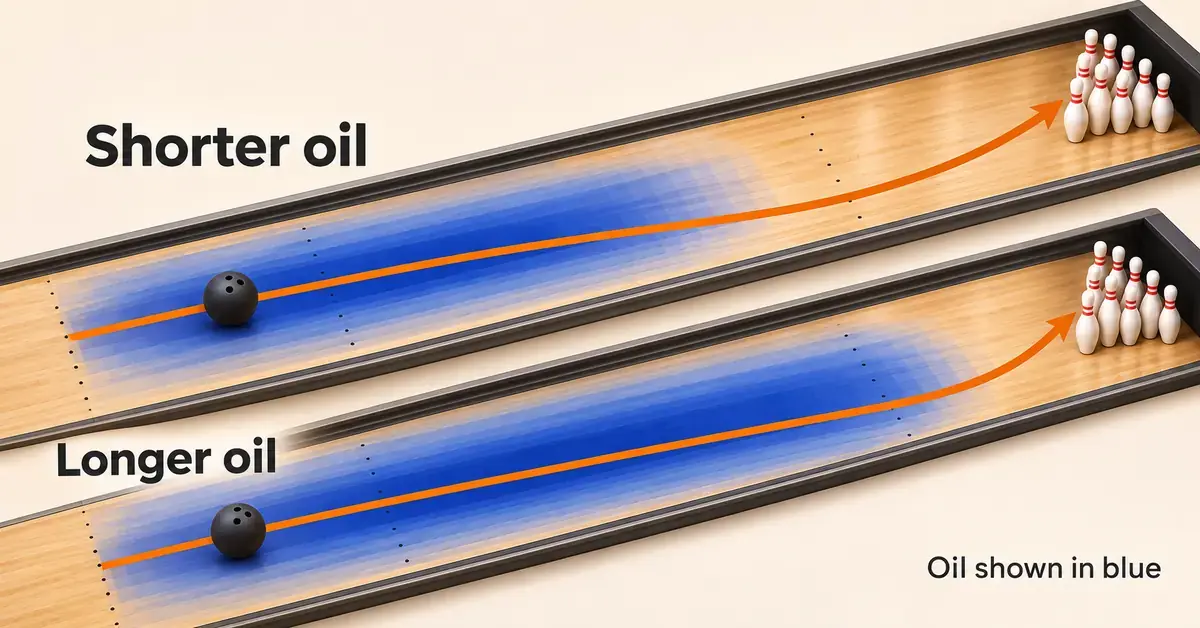
Bowling lane oil patterns are the invisible layer of conditioner spread across a ten-pin lane, and they are the main reason the same ball hooks hard one day and skids straight the next. You cannot see the oil with the naked eye, but it decides exactly where your ball slides, where it grips and where it turns toward the pins. This guide explains what an oil pattern is, the three things that define every pattern, and why your ball hooks differently from lane to lane — in plain English, so you can walk into any New Zealand centre knowing what is really going on under your ball.
One thing first: this is a ten-pin bowling topic only. Lawn bowls has no oil at all — a lawn bowl curves because of a built-in weight called bias in lawn bowls, which is a completely different sport with its own rules. Everything below is about ten-pin.
Key Points
- Oil patterns are an invisible layer of conditioner on a ten-pin lane; you cannot see them, but they decide where your ball skids, hooks and rolls.
- Every pattern is defined by three things: length (how far the oil goes), volume (how much there is), and ratio (centre boards versus the edges).
- A house shot loads oil in the middle and leaves the edges dry, which steers the ball back toward the pocket — that is why casual lanes feel forgiving.
- Sport patterns are flat (an oil ratio of 3:1 or less), so a small miss means a missed pocket.
- The rule of 31 (pattern length in feet minus 31) estimates the board your ball should leave the oil on.
- Plastic rental balls barely react to oil; reactive-resin balls hook hard once they reach dry boards.
What is a bowling lane oil pattern?
A bowling lane oil pattern is a measured layer of lane conditioner (often just called “oil”) that a machine applies to the front part of the lane before play. It is not spread evenly. The machine lays down different amounts of oil on different boards and down different distances, and that deliberate layout is the “pattern”.
Lanes are oiled for two reasons:
- To protect the surface. A bowling ball is heavy and travels fast, so the oil acts as a buffer that stops the ball wearing down the wood or synthetic lane.
- To control how the ball moves. Modern reactive balls grip a dry surface almost instantly. Without any oil, a hooking ball would veer sideways long before it reached the pins. The oil gives the ball a slick runway first, then lets it grab once the oil runs out.
Lanes come in two surfaces, synthetic or older timber, and a synthetic surface tends to let the ball travel a little further before it grips than wood does. Either way, the oil pattern on top is what you are really playing.
Why does lane oil make your ball hook differently?
Your ball hooks differently because it meets oil and dry boards in different places depending on the pattern. A ball only hooks where it can grip the lane, and it can only grip where there is little or no oil. Change where the oil sits and you change where — and how much — the ball turns.
The three phases: skid, hook and roll
As a ball travels down the lane it goes through three stages:
- Skid. In the heavily oiled front section the ball slides with very little grip, holding a fairly straight line.
- Hook. Further down, the oil thins out. The ball starts to grip the boards, catches, and begins to turn toward the pins.
- Roll. When the oil runs out completely, the ball gains full traction, stops sliding and rolls forward into the pocket.
More oil down the lane means a longer skid and a later, sharper hook. Less oil means the ball grips sooner and hooks earlier. That is the whole secret: the oil decides where “skid” ends and “hook” begins.
Boards, the breakpoint and the pocket
A ten-pin lane is about 60 feet (around 18.3 metres) from the foul line to the head pin, and it is roughly 42 inches wide, divided into 39 narrow boards. Board 20 is the centre. The “pocket” is the gap you aim for — between the 1 and 3 pins for right-handers, or the 1 and 2 pins for left-handers.
The spot furthest from the pocket where the ball finishes skidding and starts turning back is called the breakpoint. Reading where your ball reaches its breakpoint, and on which board, is the heart of lane play. If you want to make the ball turn on purpose, start with the basics of how to throw a hook in ten-pin bowling before worrying about patterns.
The three things that define every oil pattern
Every oil pattern comes down to three measurements: length, volume and ratio. Get your head around these and almost any pattern makes sense.
Length: how far the oil goes
Pattern length is the distance in feet that the oil is applied from the foul line, and it is probably the single most useful number to know. The shorter the oil, the more dry lane the ball has to hook across; the longer the oil, the less room it has to turn.
Lane conditioning specialist Kegel illustrates this well: on a 34-foot pattern a modern ball spends more than 26 feet on dry backend and tends to hook so much that bowlers move to an outside line, while a 44-foot pattern leaves only about 16 feet of dry lane, so the ball has far less time to hook toward the pocket. In the middle range, around 37–40 feet, the lane surface itself often matters more than length.
Volume: how much oil
Volume is the total amount of oil on the lane, usually measured in millilitres. More oil generally means more skid and a later hook; less oil means an earlier, stronger grip.
Volume on its own is a poor guide, though, because it does not tell you where the oil sits. Kegel gives a neat example: at one 2005 world event the short pattern held about 20.76 millilitres and the long pattern about 20.02 millilitres — almost identical totals — yet the short pattern hooked far more because of how the oil was spread, not how much there was.
Ratio: centre versus the edges
Ratio compares how much oil sits in the middle of the lane against the outside boards. A high ratio means lots of oil in the centre and little on the edges; a low (flat) ratio means the oil is spread evenly across the width.
This one number explains most of why a lane feels easy or hard. As Bowling This Month notes, an official Sport condition is defined by an oil ratio of 3:1 or less, while a normal house shot sits well above 3:1. The flatter the ratio, the less the lane helps you.
House shots versus sport patterns
The pattern you meet at a casual night out is almost always a “house shot”, and it is built to be forgiving. A house shot loads most of the oil in the middle boards and leaves the outside boards dry. That creates a wide margin for error, often called built-in forgiveness:
- Miss slightly to the outside (toward the gutter) and the dry boards grip the ball and send it back toward the pocket.
- Miss to the inside and the heavy centre oil holds the ball up so it does not hook too early.
A sport pattern (the kind used in tournaments) is the opposite. The oil is laid flat from edge to edge, so there is no friendly dry edge to steer the ball home. Miss your target by a board or two and you simply miss the pocket. The comparison below sums up the difference.
Oil Pattern Comparison
| Feature | House shot (recreational / league) | Sport pattern (tournament) |
|---|---|---|
| Oil ratio (centre to edge) | Higher than 3:1 (often very high) | 3:1 or less (flat) |
| Margin for error | Wide — built-in forgiveness | Very small |
| How a miss behaves | Dry edges push the ball back to the pocket | The ball goes where you send it |
| Who plays it | Casual bowlers and most social leagues | Competitive tournaments and events |
Short, medium and long oil: how pattern length changes your line
Patterns are loosely grouped by length, and each group pushes you to play the lane a different way. Exact cut-offs vary between sources, but a common grouping is:
- Short patterns (about 36 feet and under). Oil stops early, leaving a lot of dry lane. The ball hooks a long way, so bowlers often play nearer the outside with more speed or a ball that reacts less. Breakpoints sit closer to the gutter.
- Medium patterns (about 37–42 feet). The all-rounder range found on most house shots. Breakpoints usually fall around boards 8–12, and the lane surface often decides the best line.
- Long patterns (about 42 feet and longer). Oil stretches far down the lane, so the ball skids most of the way and has little room to hook. Bowlers play straighter and keep their breakpoint closer to the pocket, around boards 13–16.
The practical takeaway: a short pattern makes your ball hook more, a long pattern makes it hook less, and the same ball and the same throw can look like two different balls depending on which one you are on.
What is the rule of 31 in bowling?
The rule of 31 is a quick way to estimate where your ball should leave the oil. Take the pattern length in feet and subtract 31; the answer is roughly the board your ball should exit the pattern on as it heads for the breakpoint.
For example, on a 40-foot pattern, 40 minus 31 gives board 9, so you aim to have the ball reach its breakpoint around the 9 board. On a 37-foot pattern it points to board 6; on a 43-foot pattern, board 12.
Treat it as a starting point, not a law — as the USBC puts it, nothing is definite, but it is a good guideline. It assumes a fairly typical hooking ball and style, and our advice is to trust it least on very long patterns, where a normal hook can struggle to reach the pocket from that far out. Use it to get close, then watch what your ball actually does and adjust.
PBA animal patterns and other named patterns
Tournament organisers publish named patterns so everyone competes on the same oil. The best known are the PBA “animal” patterns, each named for how it behaves and defined mainly by its length. Published lengths are revised from time to time, so it is most useful to group them by how much lane they leave the ball to work with:
- Wolf — one of the shortest patterns, leaving a lot of dry lane, so the ball hooks a lot.
- Cheetah — a short pattern played out near the gutter.
- Viper — a medium-short pattern.
- Bear — a flat, medium-length pattern with little edge-to-edge help, which makes it one of the harder tests.
- Scorpion — a longer pattern that rewards playing more inside.
- Shark — a long pattern that forces bowlers deep into the middle of the lane.
- Badger — among the longest patterns, where you play very straight with the breakpoint near the pocket.
You will almost never meet these on a social outing, but they are a useful illustration of how changing the oil — mainly its length — completely changes how a lane must be played.
How do you read and adjust to an oil pattern?
You read a pattern by watching your ball, not the lane. Since you cannot see the oil, the ball’s reaction is your information. A few practical steps for anyone past the casual stage:
- Watch the breakpoint. Note where the ball stops sliding and starts turning. If it hooks too early, there is less oil (or shorter oil) than you thought; if it skids past the pocket, there is more.
- Move your feet, not just your aim. If the ball hooks too much, move left (for a right-hander) and play straighter through more oil; if it does not hook enough, move right toward the drier boards.
- Match your ball to the oil. On heavy or long oil you need more grip; on dry or short oil you need less. Knowing the difference between plastic, urethane and reactive bowling balls is the single biggest lever here.
- Mind your ball surface. A dull or clean ball grips oil differently from a shiny one, which is why regular maintenance matters; see how to clean a bowling ball to keep its reaction consistent.
- Get the weight right first. None of this helps if the ball is too heavy to throw smoothly, so sort out your bowling ball weight before you chase lane play.
Common mistakes beginners make with oil patterns
Most early frustration with “why is my ball doing that?” comes down to a handful of avoidable errors:
- Expecting a house (rental) ball to hook. Plastic house balls barely react to oil, so they roll fairly straight no matter the pattern. If you want to see a real hook, you need a reactive ball.
- Blaming your throw for a change in the lane. Oil breaks down as games go on — balls carry it down the lane and wear it off the main line. The same shot that struck early can miss later; that is the pattern changing, not you.
- Only changing your aim. Adjusting where you look while standing in the same spot rarely fixes a hook problem. Moving your feet across the approach changes the whole angle through the oil.
- Ignoring ball surface. A ball that has not been cleaned, or one with the wrong finish for the oil, will react unpredictably however well you throw it.
- Assuming every lane is the same. Even two house shots at different centres can play differently. Read your ball each time rather than copying last week’s line.
Oil patterns at New Zealand bowling centres
If you catch the bug and move toward competition, that is when sport patterns, named shots and the rule of 31 start to matter. Competitive ten-pin in New Zealand is organised by Tenpin Bowling New Zealand, and league and tournament play is where you will first meet flatter, less forgiving oil.
Sources
Frequently Asked Questions (FAQ)
Can you see the oil on a bowling lane?
No. Lane oil is applied in a thin, clear layer and is practically invisible from where you stand. You can sometimes spot a faint sheen under the right light, but you read the pattern by watching how your ball reacts, not by looking at the lane.
How much oil is on a bowling lane?
Only a small amount, and the exact volume varies by pattern. Lane specialist Kegel reported that two 2005 WTBA patterns held about 20.76 and 20.02 millilitres of conditioner — almost identical totals that still played very differently, because the total volume matters far less than where the oil is placed.
Do bowling alleys clean their balls?
Many do. Centres often wipe down house balls and some run them through a cleaning machine between sessions, but it is not guaranteed on a busy casual night. If you use your own ball, regular cleaning matters far more, because oil builds up on the surface and changes how the ball grips the lane.
Do bowling alleys re-oil the lanes?
Yes. Centres strip the old oil and lay a fresh pattern regularly, using an automated lane machine so every lane starts with the same conditions.
