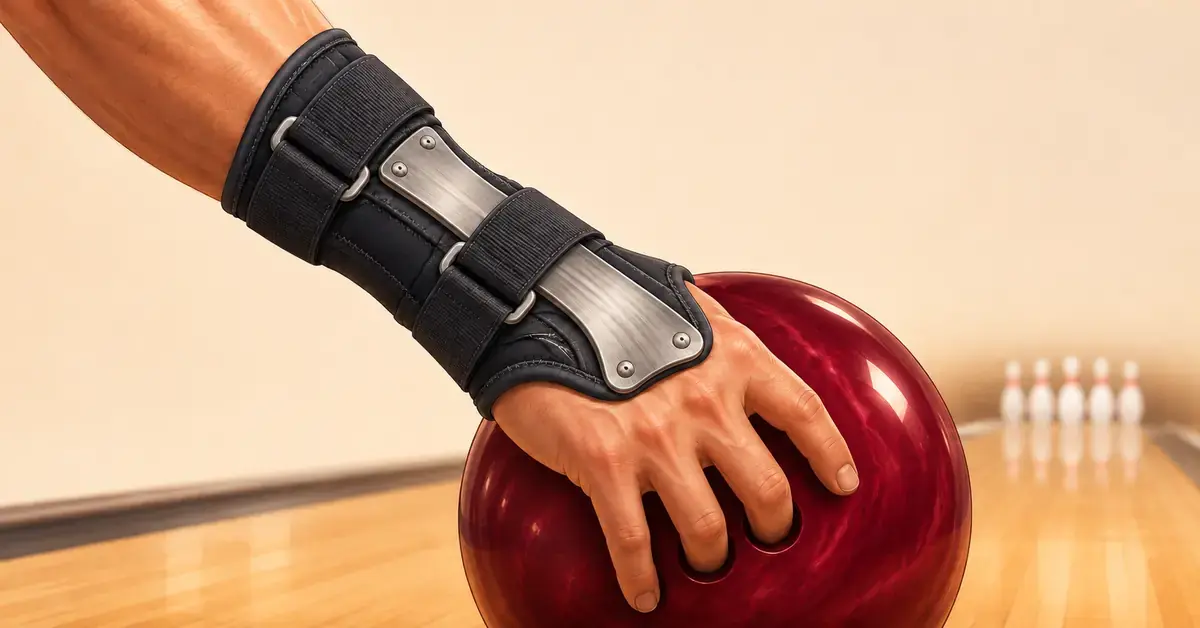
A bowling wrist support is a strap, cuff or metal-framed brace that holds your wrist in a fixed position through the swing and release, so your hand does not collapse backwards at the bottom of the swing. In ten-pin bowling it is used to keep a consistent release and, with some models, to help the ball hook; off the lane it is sometimes worn to protect a sore or recovering wrist. Most beginners do not need one, but there are a few clear situations where a support earns its place.
Key Points
- A bowling wrist support holds your wrist firm through the release so your hand does not collapse backwards under the weight of the ball.
- Its main benefit is consistency — a repeatable release — not a sudden jump in score or an instant hook.
- Most beginners do not need one; it helps most when your wrist tires over a game, when you already rev the ball, or in long league blocks.
- Types range from simple neoprene wraps to adjustable metal positioners, plus restrictors that limit over-rotation.
- Fit and the correct hand (right or left) matter more than the brand; a loose brace does nothing.
- A support is not a treatment for injury — see a GP or physiotherapist for wrist pain that is persistent, sharp or worsening.
What a bowling wrist support actually does
A bowling wrist support does one core job: it stops your wrist from bending backwards as the weight of the ball pulls on it at the bottom of your swing. Holding your wrist firm or slightly “cupped” through the release takes real forearm and wrist strength, and most bowlers tire or lose that position as a game goes on. A support takes over that work, so your hand arrives at the ball the same way on frame one and frame thirty.
That consistency is the real benefit. When your wrist is in the same position every time, your release is more repeatable, which usually means tighter accuracy and a steadier ball reaction rather than a sudden jump in score. Manufacturers such as Storm describe supports as devices that stabilise the wrist during the release; that stabilising effect is well agreed on, even if the bigger performance claims are not.
It is worth being clear about what a support does not do. It will not fix your timing, footwork or aim, and it will not turn a straight ball into a big hook on its own. Many positioners are marketed as “hook” devices, but the honest version is that they hold your hand in a strong position so you can generate rotation more easily — they prevent your wrist collapsing rather than spinning the ball for you. If your fundamentals are off, a brace will simply make a flawed release more repeatable.
Wrist positions: the thing a support is really controlling
To understand supports, it helps to know the wrist positions they lock in. In ten-pin bowling the wrist can roll into several positions during the release, and each changes how much the ball revs (spins) and hooks.
Cupped wrist
A cupped wrist is bent forward, with the back of the hand curling toward the forearm. This is the strongest position: it tends to produce the highest rev rate and the sharpest hook because the fingers stay under and behind the ball longer. It is also the hardest to hold, which is why strong-revving players are the most common buyers of firm positioners that lock a cup in place.
Firm or straight wrist
A firm, broadly straight wrist — hand roughly in line with the forearm — gives moderate power and a medium, predictable roll. This is a sensible target for most developing bowlers, and it is the position most adjustable supports are set to out of the box. Keeping it firm (not floppy, not forced) lets the energy of the swing transfer into the ball efficiently.
Broken or relaxed wrist
A broken wrist is bent backwards, with the hand falling behind the ball. It is the weakest release: the ball skids longer and revs less, so it hooks the least. A backwards-bending wrist under load is also where a lot of wrist strain comes from. This is the collapse a support is designed to prevent — though a relaxed wrist is a legitimate, deliberate choice for a straighter spare shot. Understanding these positions matters more than the gear: it ties directly into how you hold a bowling ball and into learning to throw a hook in ten-pin bowling.
The main types of bowling wrist support
Supports fall into a few clear groups, from a simple elastic cuff up to an adjustable metal brace. The right one depends on whether you want comfort, a locked position, or a training aid.
Comparison
| Type | What it does | Adjustable position? | Best for |
|---|---|---|---|
| Neoprene / cloth wrap | Light support and warmth; takes some load off the wrist | No | Casual bowlers; mild soreness |
| Fabric support with bar | Resists backward bending while staying fairly soft | Limited | League bowlers wanting comfort plus help |
| Metal wrist positioner | Locks an exact cup and side angle through the release | Yes (cup + lateral) | Strong-revving and competitive players |
| Wrist restrictor | Limits wrist rotation to stop over-rotation (training aid) | Varies | Grooving a cleaner, controlled release |
Simple neoprene or cloth wraps are the entry level: an elastic or neoprene cuff with a Velcro strap. They add light support and warmth and take some load off the wrist, but they do not firmly lock a position. They suit casual bowlers, people with mild soreness, and anyone who just wants a bit of reassurance.
Fabric supports with a built-in bar sit a step up. They add a semi-rigid insert or metal stay under the wrist to resist backward bending while staying fairly soft and comfortable. They are a good middle ground for league bowlers who want help holding position without a full metal frame.
Metal wrist positioners are the serious devices — a lightweight aluminium frame with adjustable cup (forward/back tilt) and lateral (side) settings, held on with multiple straps. The Brunswick Bionic positioner, for example, offers several wrist cup and lateral positions so you can dial in and repeat an exact wrist angle. They give the most control and are favoured by stronger-revving and competitive players, at the cost of comfort, bulk and price.
Wrist restrictors do the opposite job. Instead of helping you cup the wrist, a restrictor such as the Turbo Wrist Restrictor limits how far the wrist can rotate or break, which is used as a training aid to stop over-rotation and groove a cleaner release. It is about control, not extra hook — and note that this kind of device is sold as a training aid: the Turbo Wrist Restrictor is described by its retailer as a “training device not intended for league or competition.”
Do you actually need one?
Most beginners do not need a wrist support, and buying one too early can hide problems you would be better off fixing. The clearest reason to get one is a specific, repeatable need rather than a general feeling that it might help.
Who tends to benefit
- Bowlers whose wrist tires over a game. If your first few frames look good and your release falls apart later, a support holds the position your muscles can no longer maintain.
- Players chasing a consistent hook. If you already rev the ball and want to repeat an exact cupped position, an adjustable positioner makes that far easier.
- League and tournament bowlers. Over long blocks, the repeatability a support gives can matter more than any single big shot, which is why they are common once people start bowling in a ten-pin league.
- Anyone managing mild, known wrist niggles who has been cleared to keep playing and just wants support and warmth.
Who can usually skip it
- New and casual bowlers. Learning a firm wrist naturally builds the strength and feel you need. Lean on a brace too soon and you may never develop it.
- Bowlers using the wrong ball. A lot of “wrist weakness” is really a ball that is too heavy. Sorting out your bowling ball weight often removes the problem a support was meant to mask.
- Two-handed players. The two-handed bowling style supports the wrist with the off hand through the swing, so a brace is far less common — and can get in the way.
Wrist pain while bowling: support, rest or a professional?
If your wrist hurts while or after bowling, a brace is not automatically the fix, and it can be the wrong one. Bowling wrist pain is often a repetitive-strain problem — the twisting and loading of the wrist through the release can irritate the tendons, a form of tendonitis. Reaching for a support to push through pain can let an overuse injury get worse.
A sensible order of response is: first, rule out the easy causes — a ball that is too heavy, a poor grip, or drilling that does not fit your hand. Second, rest and let mild soreness settle. A support may help a known, minor niggle once you have been cleared to keep playing. But persistent, sharp or worsening pain — or numbness and tingling, which can point to nerve issues rather than a tired tendon — is a reason to stop and see a GP, physiotherapist or hand therapist for a diagnosis before you keep loading the joint. A brace treats a symptom; a professional finds the cause.
How to choose and fit a bowling wrist support
Getting the right fit matters more than the brand, and it is where most buyers go wrong. A few points to check before you spend:
- Buy for the correct hand. Bowling positioners are hand-specific — a right-hand model will not work on a left hand. Check “right” or “left” before you order.
- Get the size right. Fit is the most common complaint with metal positioners; a loose brace wobbles and does nothing useful. Use the maker’s sizing chart and measure your wrist. Reviewers of popular models often suggest sizing up when you are between sizes, as the fit can run snug.
- Match the device to your goal. Want comfort and warmth? A neoprene wrap is enough. Want to lock an exact cupped angle? You need an adjustable metal positioner. Want to stop over-rotating? That is a restrictor.
- Watch the finger shelf. Some positioners have a shelf under the fingers to add roll. If you have shorter fingers, make sure it does not overhang and interfere with a clean fingertip release.
- Mind the grip connection. A support only helps if your grip and ball fit are sound to begin with, so it works best alongside a properly drilled bowling ball rather than as a patch for a bad fit.
- Don’t rely on it full-time. Leaning on a support for every shot can stop you building natural wrist strength; many coaches suggest using it where it helps and still practising without it.
What they cost in New Zealand. Pricing is worth a reality check. In our experience, dedicated bowling positioners are hard to find on NZ shop shelves and usually have to be ordered through importers or overseas retailers, which adds shipping and lifts the price. A simple neoprene or cloth wrap is the cheapest option, a fabric support with a built-in bar sits a little higher, and an adjustable metal positioner is the most expensive by some margin. For plain wrist soreness off the lane, a general adjustable wrist support from a NZ pharmacy is far cheaper — fine for warmth and light support, but not designed for a bowling release.
A note on lawn bowls (a different code)
Everything above is about ten-pin bowling. Lawn bowls is a separate sport with its own equipment, and “wrist support” means something different there. Lawn bowls has no equivalent wrist positioner for a ten-pin-style release; where a bowler cannot deliver the bowl normally — through injury, disability or reduced grip and mobility — the recognised aid is a bowling arm, a device that cradles and releases the bowl so the player does not have to bend down or grip hard. These are governed by Bowls New Zealand, which approves specific bowling arms for domestic play, and which aids are permitted can vary by competition. If you have arrived here for the green rather than the lane, the lawn bowls delivery technique is the better starting point, and the two codes should not be mixed up.
Health disclaimer
This article is general information about bowling equipment, not medical advice, and a wrist support is not a treatment for an injury.
Sources
- Storm Bowling — The Benefits of Wrist Supports in Bowling
- United States Bowling Congress (bowl.com) — Mastering the Hook (wrist positions and release)
- Bowling.com — Storm Xtra-Hook Wrist Support (features and sizing)
- Bowling.com — Brunswick Bionic Wrist Positioner (adjustable cup and lateral settings)
- Bowling.com — Turbo Wrist Restrictor (restrictor training aid)
- Bowling This Month — Keeping Bowling Hands and Wrists Healthy
- Bowls New Zealand — The Sniper Arm (a lawn bowls delivery arm)
Frequently Asked Questions (FAQ)
How many hours a day should I wear a wrist support or splint?
There is no single number, and it depends on why you are wearing it. A bowling positioner is worn only while you bowl and taken off afterwards. A medical wrist splint for a diagnosed condition should be worn exactly as the health professional who fitted it advises — follow their guidance rather than a general rule, as wearing a splint too much can let the surrounding muscles weaken.
When should I not wear a wrist brace?
Do not use a bowling support to push through pain you have not had checked, and do not keep wearing a brace that causes new numbness, tingling, swelling or increased pain. A support that masks a problem lets you keep loading an injured wrist, which makes things worse rather than better.
Are wrist supports allowed in ten-pin leagues and tournaments?
Everyday wrist positioners and supports are commonly worn in ten-pin league play. What is allowed, though, depends on the competition: sanctioned events set their own equipment rules, so if you bowl in a ranked or sanctioned competition it is worth checking the equipment regulations of the governing body — in New Zealand that is Tenpin Bowling New Zealand, and internationally the United States Bowling Congress. Note too that some products are sold as training aids only: the Turbo Wrist Restrictor, for example, is described by its retailer as a “training device not intended for league or competition.”
Can I use the same support for bowling and for everyday wrist pain?
Not really — they are built for different jobs. A bowling positioner is shaped to control your wrist angle through a release and is hand-specific; a pharmacy wrist support is designed for rest, warmth and light immobilisation. A general support can give mild help while bowling casually, but it will not control your release, and a bowling positioner is not a substitute for a medical splint.
