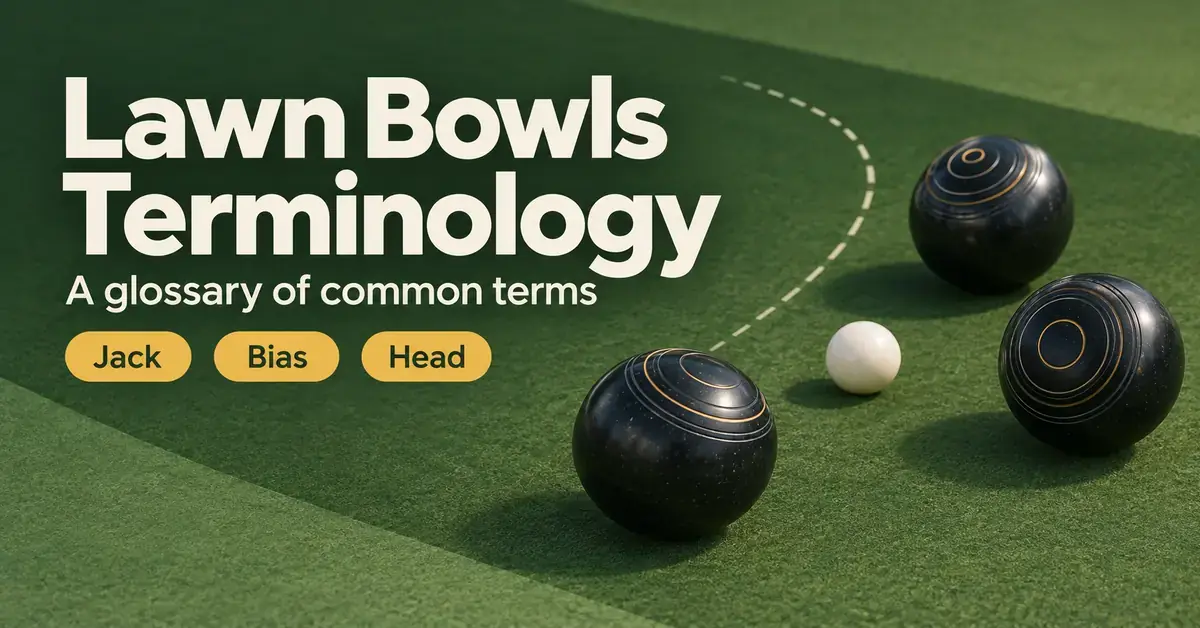
Lawn bowls has a language all of its own. Walk onto a New Zealand green for the first time and you will hear players talk about the jack, the head, a toucher or a dead end — words that mean little until someone explains them. This glossary gathers the most common lawn bowls terms into plain English, groups them the way they come up during a game, and backs the definitions with the official Laws of the Sport used in New Zealand. It covers lawn bowls only (the outdoor game played with biased bowls on a flat green), not ten-pin bowling, which has an entirely separate vocabulary.
Use it as a quick reference before your first roll-up, or dip into a single section when a word trips you up. Each term is defined once, in the section where it naturally belongs, and technical words are explained the first time they appear.
Key Terms at a Glance
- Jack — the small unbiased target ball every player aims at.
- Bias — the built-in weighting that curves a bowl in an arc.
- Head — the jack plus all the bowls resting around it.
- End — one full round of play; a game is made up of many ends.
- Shot — the bowl nearest the jack, and the word for each point scored.
- Draw — the standard shot: roll to finish as close to the jack as possible.
- Toucher — a bowl that touches the jack and stays live, even in the ditch.
- Skip — the team captain who bowls last and calls the shots.
The green and the equipment
Before any shot makes sense, it helps to know the playing surface and the gear. These are the objects and spaces you will hear named constantly.
Green — The large, level, closely mown grass (or synthetic) surface a club plays on. A single green is divided into several parallel playing lanes.
Rink — One of those playing lanes: the marked rectangular strip of the green used for a single game. Under the World Bowls Laws of the Sport, an outdoor rink is between 4.3 and 5.8 metres wide. “Rink” is also used for a team of four players (a “fours” side).
Ditch — The shallow trench that runs around the edge of the green, just past the playing surface. Bowls and the jack can end up in the ditch, which has special consequences explained under “toucher” and “dead bowl”.
Bank — The raised face just beyond the ditch that marks the boundary of the green. Distance markers on the bank help players judge length.
Mat — The rectangular mat a player stands on to deliver the jack and every bowl for an end. A standard mat is 600 mm long and 360 mm wide, and at least one foot must be on or above it at the moment of delivery.
Jack (or kitty) — The small, white or yellow, unbiased ball that is the target for the whole end. Outdoor competition jacks measure 63–64 mm across and weigh roughly 225–285 grams. After it is rolled and centred, the jack must come to rest at least 23 metres from the mat line for the end to be valid.
Bowl (or wood) — The larger, slightly flattened ball each player rolls. “Wood” is a traditional nickname, even though modern bowls are made of a hard composite plastic.
Bias — The most important idea in the sport. Each bowl is deliberately shaped so that one side is weighted differently, which makes it curve in an arc as it slows down rather than travel straight. The smaller of the two rings stamped on a bowl marks the bias side, and the bowl curves towards that side at the end of its run.
The structure of a game: ends, heads and scoring
Lawn bowls is scored in short rounds rather than one continuous flow. These terms describe how play is organised and how points are counted.
End — One complete round of play: the jack is set, then every player delivers all of their bowls in one direction. When the score is agreed, the next end is played back in the opposite direction.
Head — The jack together with all the bowls that have come to rest in play around it. “Reading the head” means judging which bowls are where and what shot to play next.
Shot — Two meanings. The bowl currently nearest the jack is “holding shot”, and each point scored is also called a shot. If your team has three bowls closer to the jack than any opponent’s, you score three shots.
Toucher — A bowl that touches the jack on its way through. A toucher stays alive (“live”) even if it later rolls into the ditch, so it is marked with a chalk cross to identify it.
Resting toucher — A toucher that finishes still touching the jack. It usually counts as an excellent shot because it sits right on the target.
Dead bowl — A bowl that finishes off the rink, or in the ditch without being a toucher. It is removed and does not count.
Jack high (or bowl high) — A bowl whose nearest edge is level, sideways, with the jack. It tells you the bowl has the right length even if it is off to one side.
Dead end — An end that does not count and must be replayed, usually because the jack has been driven off the side of the rink (out of bounds). No score is recorded.
Burnt end — An end declared void because the head was disturbed before it settled — for example a stray bowl from the next rink runs through it. Like a dead end, it is replayed with no score.
Measure — When two bowls look equally close to the jack, an official or the players use a measuring tape or callipers to decide which is nearer, and therefore who scores.
Shots and delivery
Most bowls terminology describes the kind of shot a player is trying to play. Knowing these words lets you follow a skip’s instructions and describe your own delivery.
Weight — The amount of pace or force put on a bowl. “Too much weight” means it went too far; “light” means it fell short.
Draw — The core shot of lawn bowls: a bowl rolled with just enough weight to curve gently and stop as close to the jack as possible, without disturbing anything.
Line — The starting direction, or aiming line, a player chooses so that the bias curves the bowl back onto the target. Picking the correct line and weight together is the whole skill of the draw.
Forehand and backhand — The two sides on which a bowl can be delivered. For a right-handed player, the forehand curves in from the right and the backhand curves in from the left; either can reach the same target depending on which way the bias is turned.
Yard-on (or running shot) — A bowl played with a little more weight than a draw — roughly a yard past the jack — to nudge the jack or an opponent’s bowl while keeping some control.
Trail — A weighted draw that catches the jack and carries (“trails”) it to a new position, ideally closer to your own back bowls.
Drive (or fire) — The most forceful shot, played almost flat out to smash the head, remove an opponent’s bowl, or knock the jack into the ditch. It sacrifices accuracy for power.
Wick (or rub) — When a bowl glances off another bowl and changes course, often deliberately, to reach the jack.
Block (or blocker) — A bowl deliberately left short and to one side to sit in the path an opponent would use for a driving or running shot.
Wrong bias — Delivering a bowl with the bias turned the wrong way, so it curves away from the target instead of towards it. A common and frustrating beginner error.
Narrow and wide — A “narrow” bowl was aimed too straight and finishes on the jack’s near side; a “wide” bowl was given too much line and swings past on the far side.
Back bowl — A bowl resting behind the jack. Good players like a back bowl as insurance in case the jack is later moved backwards.
Players and roles on a team
In pairs, triples and fours, each position has a name and a job. These terms tell you who plays when and who is in charge.
Lead — The player who delivers first each end. In many formats the lead also rolls the jack and sets the mat.
Second — In triples and fours, the player who bowls immediately after the lead. The second often keeps the scorecard.
Third (or vice-skip) — In a four, the player who bowls third. The third is the skip’s deputy, agrees the count at the head and often measures close shots.
Skip — The team captain, who bowls last and directs strategy from the head, telling teammates which shot to play.
Marker — In singles, a neutral helper who centres the jack, marks touchers with chalk, and answers players’ questions about the head. The marker does not play.
Umpire — The official who measures disputed shots and rules on the laws when players cannot agree.
Reading the green: line, length and speed
Two greens rarely play the same, so bowlers talk constantly about how the surface is behaving. These terms describe the judgement behind every shot.
Length — How far a bowl travels. Judging length (weight) is half of a good draw; judging line is the other half.
Green speed (or pace) — How fast a green runs, measured in seconds — the time a bowl takes to travel a standard distance. A “fast” green (higher seconds) needs less weight; a “slow” or “heavy” green needs more.
Hand — Short for the forehand or backhand path being used. A skip may ask a player to “change hands” to find a cleaner route to the jack.
Roll-up — An informal, non-competitive practice game, and the usual way new members are introduced to the game at clubs around the country, from lawn bowls in Auckland to the Canterbury lawn bowls scene.
Common mistakes beginners make with bowls terminology
Getting the words right matters as much as getting the shots right, because a skip’s instructions are useless if you misread them. These are the mix-ups newcomers make most often.
- Confusing “shot” meanings. “We’re holding shot” means you have the nearest bowl right now; “we scored three shots” means three points. Same word, different sense.
- Mixing up dead end and dead bowl. A dead end is the whole round replayed because the jack went out; a dead bowl is a single bowl removed for finishing off the rink.
- Assuming a toucher in the ditch is lost. A bowl marked as a toucher stays live in the ditch and can still win the end — an untouched bowl in the ditch is dead.
- Playing the wrong bias. Beginners often deliver with the rings facing the wrong way, sending the bowl curving off the rink. Always check the small rings point towards your intended finish.
- Treating “weight” and “line” as one thing. A poor bowl is usually wrong on one or the other; naming which helps you correct the next delivery.
How lawn bowls terms differ from ten-pin bowling
Lawn bowls and ten-pin bowling share the word “bowling” but almost none of their vocabulary. In lawn bowls you roll a biased bowl across grass towards a jack and score by proximity; there is no “strike”, “spare”, “frame”, “gutter” or “pin”. Those belong to ten-pin bowling in New Zealand, where you knock down pins in an indoor lane. If a term here — jack, head, end, skip — sounds unfamiliar from the ten-pin game, that is because it comes from the outdoor code. Keeping the two glossaries separate avoids the most common source of confusion for newcomers who have only ever bowled indoors.
How to start using the language
The fastest way to learn bowls terminology is to hear it in context. Most clubs run free come-and-try sessions where an experienced member walks you through the head, the mat and the bias in real time. Clubs such as the Howick Bowling Club welcome beginners, and regional guides for centres from bowling in Wellington onwards can point you to a green near you. Bring flat-soled shoes, borrow a set of bowls, and within an end or two the words in this glossary will start to feel natural.
Quick Facts
| Feature | Official detail (World Bowls / outdoor game) |
|---|---|
| Jack diameter | 63–67 mm (outdoor competition jacks 63–64 mm) |
| Jack weight (outdoor) | Approx. 225–285 grams |
| Minimum jack distance | At least 23 m from the mat line after delivery |
| Mat size | 600 mm long × 360 mm wide |
| Rink width (outdoor) | Between 4.3 m and 5.8 m |
| Bowl colour marking | Small rings mark the bias side the bowl curves towards |
| Green speed | Measured in seconds — the time a bowl takes over a set distance |
Sources
Frequently asked questions (FAQ)
What is the difference between a toucher and a dead bowl in lawn bowls?
A toucher is a bowl that touches the jack during its delivery; it is marked with chalk and stays live even if it ends up in the ditch. A dead bowl is one that finishes outside the rink boundary, or in the ditch without having touched the jack, and it is removed from play and does not count.
What does bias mean in lawn bowls?
Bias is the built-in weighting that makes a bowl curve in an arc as it slows, instead of rolling straight. The small rings stamped on one side mark the bias side, and the bowl curves towards that side at the end of its run, which is why players aim out to the side and let the bowl draw back to the jack.
How far does the jack have to travel to be valid?
Under the World Bowls Laws of the Sport, once the jack is delivered and centred it must come to rest at least 23 metres from the mat line, measured along the centre of the rink. If it stops short of that distance, it is re-rolled or repositioned so the end can be played fairly.
What is the difference between a dead end and a burnt end?
A dead end usually happens when the jack is driven off the side of the rink and out of bounds, so the end is void and replayed with no score. A burnt end is void because the head was disturbed before it settled — for instance by a bowl from another rink — and it is likewise replayed with no score recorded.
What do the team positions lead, second, third and skip do?
The lead bowls first and often sets the jack and mat; the second bowls next and commonly keeps score; the third (or vice-skip) is the skip’s deputy who agrees the count and measures close shots; and the skip bowls last and directs the team’s tactics from the head.
