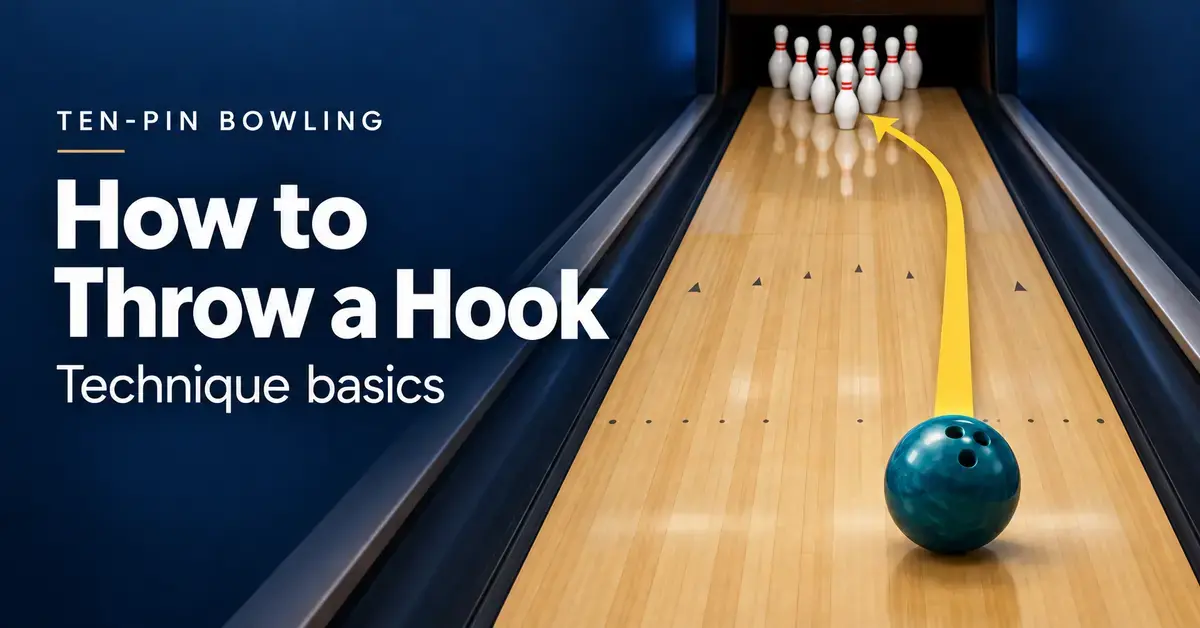
A hook is the curving path a ball takes as it travels down a ten-pin lane, breaking sideways toward the pins near the end of its roll. Learning to throw one is the single biggest step most players take from casual scores into the 150s, 180s and beyond, because a hooking ball enters the pins at an angle that knocks down far more of them than a straight shot. This guide explains what a hook is, the grip and ball that make it possible, and a step-by-step release you can practise on any lane in New Zealand — in plain language, with every technical term explained the first time it appears.
What is a hook in ten-pin bowling?
A hook is a ball that rolls fairly straight for the first two-thirds of the lane, then curves — or “hooks” — sideways into the pins. The curve is created by the spin, or rotation, you put on the ball at the moment you let go of it, combined with a ball surface that can grip the timber and oil of the lane. For a right-handed player the ball starts out toward the right side of the lane and hooks back to the left into the pins; for a left-hander it mirrors, starting left and hooking right.
The target is the “pocket”: the gap between the head pin (the 1 pin) and the pin just behind it on your strong side. For right-handers the pocket is between the 1 and 3 pins; for left-handers it is between the 1 and 2 pins. Hitting the pocket at an angle, rather than head-on, is what produces consistent strikes.
Why a hooking ball knocks down more pins than a straight one
A hook carries more pins because of the angle at which it strikes and the energy it keeps in reserve. A ball rolled dead straight hits the pocket almost front-on and tends to deflect off the pins, often leaving corner pins standing. A hooking ball arrives at the pocket from the side, driving through the pins in a chain reaction and keeping the head pin, 3 pin (or 2 pin), 5 pin and corner pin all in play.
The curve also means the ball is still “revving” — turning over — as it reaches the pins, so it transfers more energy into them instead of skidding through. That extra pin action is why nearly every competitive ten-pin player hooks the ball to some degree.
Key Points
- A hook curves into the pocket — the 1-3 gap for right-handers, 1-2 for left-handers — hitting the pins at an angle that carries far more of them than a straight ball.
- The curve is made at the release, not by twisting the ball early: thumb exits first, fingers lift and gently turn.
- A fingertip grip is essential; a conventional rental-ball grip barely hooks.
- Reactive resin coverstocks hook the most, urethane less, plastic least.
- Aim at the arrows (about 4.5 m out), not the pins (about 18 m out), and adjust your feet rather than your aim.
- Control beats power: a small repeatable hook out-scores a big wild one.
The equipment that makes a hook possible
You cannot hook a ball with the wrong equipment, no matter how good your release is. Two things matter most: how the ball is drilled to fit your hand, and what the ball’s outer surface (the “coverstock”) is made of.
Fingertip grip versus the house-ball (conventional) grip
A fingertip grip is the key that unlocks the hook. In a fingertip grip your middle and ring fingers go into the ball only as far as the first knuckle, while your thumb goes all the way in. This lets your fingers stay in the ball a split second after your thumb leaves, so they can lift and turn the ball on the way out.
Most rental “house” balls use a conventional grip, where the fingers go in to the second knuckle. That grip is easy to hold but gives almost no leverage to spin the ball, so it is very hard to hook a conventional-drilled house ball cleanly. Serious learners visit a pro shop to have a ball drilled to a fingertip grip that matches their hand span exactly.
Coverstock: plastic, urethane and reactive resin
The coverstock is the outer shell of the ball, and it decides how much the ball can grip the lane. Lanes are coated with a thin layer of oil, and a ball can only hook once it reaches the drier back end of the lane where there is less oil. The three main coverstock types, from least to most grip, are plastic (also called polyester), urethane, and reactive resin. Reactive resin, introduced in the early 1990s, grips the lane the hardest and produces the sharpest, strongest hook, which is why it dominates modern play.
Core, RG and differential — in one paragraph
Inside a hooking ball is a weighted, shaped “core” that influences how the ball rolls. Two numbers describe it. RG (radius of gyration) measures how quickly the ball starts to roll: a lower RG rolls earlier, a higher RG skids longer before hooking. Differential measures how much the ball “flares” — how strongly it wants to change direction — with a higher differential producing more hook potential. You do not need to memorise these as a beginner; a pro-shop fitter will match them to your style, but it helps to know the words when you shop.
Comparison
| Coverstock | Hook potential | Best suited to | Typical user |
|---|---|---|---|
| Plastic / polyester | Lowest — rolls almost straight | Spare shooting; dry lanes | Beginners and spare balls |
| Urethane | Moderate, smooth and controllable | Drier or shorter oil patterns | Players wanting predictability |
| Reactive resin | Highest — sharp, strong hook | Oiled lanes; angling into the pocket | Regular and competitive bowlers |
How to throw a hook: step by step
The hook is created almost entirely at the release, in the last moment before the ball leaves your hand. Work through these steps slowly at first; speed and power come later.
1. Set-up and hand position
Start with your hand behind and slightly under the ball, palm facing you, fingers relaxed. Keep your grip pressure light — squeezing the ball is the fastest way to kill a hook, because tense fingers cannot turn. Line your body up so your sliding foot will finish near the middle of the approach.
2. The pendulum swing
Let the ball swing back and forward like a pendulum, powered by its own weight rather than by muscling it with your arm. A relaxed, straight swing keeps the ball on line and puts your hand in the right place at the bottom of the swing, where the release happens. Your arm should stay loose from the shoulder down.
3. The release: thumb first, then fingers
This is the heart of the hook. As the ball reaches the bottom of the swing next to your ankle, let your thumb slide out of the ball first. Your middle and ring fingers stay in a fraction longer, and as the thumb clears you lift up and through the ball with those two fingers. That lift is what starts the ball turning.
4. Rotation and follow-through
As your fingers lift, turn your hand gently to the side — for a right-hander, rotate counter-clockwise, like turning a doorknob to the left or shaking someone’s hand; for a left-hander, rotate clockwise. Think of coming from behind the ball to the side of it, a smooth “unrolling” motion, not a violent twist at the wrist. Finish with your arm following through upward toward your target, as if reaching up to a high shelf. The combination of lift and gentle turn gives the ball the side-rotation that makes it hook.
Where to aim: the arrows, not the pins
Aim at the arrows on the lane, not at the pins. The seven triangular arrows are set into the lane about 4.5 metres (roughly 15 feet) past the foul line, while the pins are about 18 metres (60 feet) away. Your eyes track a nearer target far more accurately, so good players pick an arrow to roll the ball over and trust the hook to finish the job into the pocket.
A common right-handed starting line is to stand slightly left of centre and roll the ball out over the second arrow from the right, letting it hook back into the 1-3 pocket. Left-handers mirror this over the second arrow from the left toward the 1-2 pocket. Adjust your feet, not your aim: if the ball hooks too early or too late, move your starting position a board or two left or right and keep aiming at the same arrow.
Rev rate, ball speed and axis rotation, explained simply
Three linked ideas describe how much a ball hooks. Rev rate is how many times the ball rotates on its way down the lane — more revolutions generally mean a stronger hook. Axis rotation (sometimes called side rotation) is how much of that spin is turned to the side rather than rolling straight forward; more side rotation means a sharper break toward the pins. Ball speed is simply how fast you throw it, and it works against hook: throw too hard and the ball skids past the pocket before it can turn.
The goal for most players is balance, not maximum spin. A medium, repeatable speed with controlled rotation gives a predictable hook you can aim with, which scores far better than a huge but wild curve.
Common mistakes beginners make
Most failed hooks come from a handful of repeatable errors. Fixing these will do more for your game than adding power.
- Squeezing the ball. Tight grip pressure locks your fingers so they cannot turn the ball. Hold it as lightly as you can while staying in control.
- Turning the whole hand too early or too hard. “Cranking” your wrist at the top of the swing or spinning the ball violently produces an inconsistent, weak roll. The turn is a gentle side motion at the bottom of the swing.
- Letting the thumb stay in. If the thumb does not exit first, the fingers cannot lift and the ball rolls straight. Slightly loosen the thumb hole fit if it grabs.
- Throwing too fast. Excess speed skids the ball through the oil and past the pocket. Ease off and let the ball rev.
- Aiming at the pins. Staring 18 metres down-lane wrecks accuracy; use the arrows.
- Using a conventional house ball. Expecting a big hook from a second-knuckle rental grip sets you up to fail. A fingertip drill changes everything.
- Ignoring the lane oil. The same throw hooks differently on a freshly oiled lane than on a dry one; expect to adjust your line through a session.
How much hook do you actually need?
You need only as much hook as you can control and repeat. Beginners often chase the dramatic sweeping curves they see from professionals, but a modest, reliable hook that reaches the pocket the same way every time will out-score a big unpredictable one. Start by grooving a small, consistent hook, then increase revs and rotation gradually as your timing improves. Many strong recreational players win on a controlled few-board hook rather than a spectacular one.
Getting started with the hook in New Zealand
The fastest way to learn is on a real lane with a ball that fits you. Most centres offer coaching or at least a pro-shop counter where staff can measure your hand and drill a fingertip grip. If you are exploring the sport, our overview of ten-pin bowling in New Zealand covers the basics of the game and where it is played, and our regional guides list venues in the main centres — for example bowling in Auckland, bowling in Wellington and bowling in Christchurch. Once your hook is repeatable, playing regularly is what builds it, and joining organised play such as the NZ ten-pin bowling travel league gives you varied lane conditions that sharpen your adjustments faster than open bowling alone.
Sources
Frequently Asked Questions (FAQ)
Can you hook a rental house ball?
You can put a little turn on a house ball, but a big, clean hook is very hard because most house balls use a conventional grip with the fingers inserted to the second knuckle, which gives almost no leverage to spin the ball. A ball drilled to a fingertip grip — fingers in only to the first knuckle — makes hooking far easier, which is why regular players buy and drill their own.
Which way does the ball hook for a right-hander?
For a right-hander the ball hooks from right to left, starting toward the right side of the lane and curving back into the pocket between the 1 and 3 pins. This happens because a right-hander rotates the hand counter-clockwise at release. A left-hander is the mirror image: the ball hooks left to right into the 1-2 pocket.
Why does my ball go straight instead of hooking?
The most common causes are gripping the ball too tightly, keeping the thumb in the ball at release so the fingers cannot lift, throwing too fast so the ball skids past the pocket, or using a conventional-grip house ball. Loosen your grip, let the thumb exit first, ease off the speed, and if you are serious, get a fingertip-drilled ball with a reactive coverstock.
Should I aim at the pins or the arrows?
Aim at the arrows. They sit about 4.5 metres past the foul line, far closer than the pins about 18 metres away, and your eyes track a near target much more accurately. Pick an arrow to roll the ball over and let the hook carry it into the pocket, adjusting your foot position rather than your aim if the ball misses.
How long does it take to learn to hook a bowling ball?
Most people can start putting a small, repeatable hook on the ball within a few focused sessions once they use a fingertip grip and release the thumb first. Building a strong, controlled hook that holds up across different lane conditions takes months of regular practice, so treat it as a gradual skill rather than a single trick to master in one visit.
