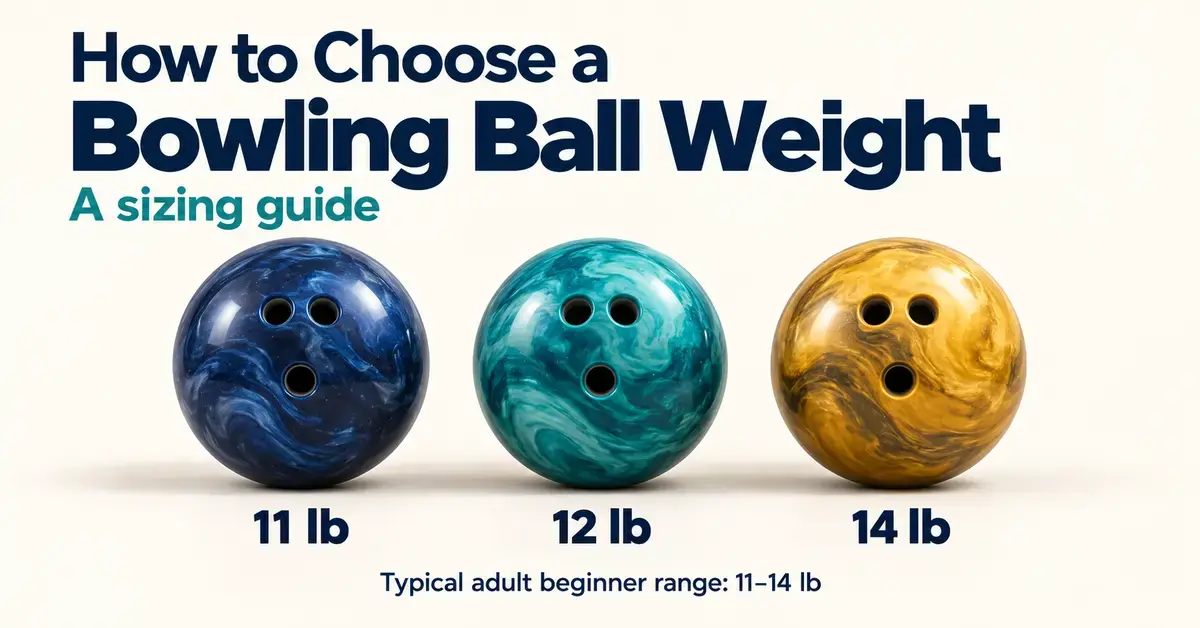
Choosing a bowling ball weight comes down to one idea: pick the heaviest ball you can swing smoothly without straining, up to the legal maximum of 16 pounds (7.26 kg). For most adult beginners that lands somewhere between 11 and 14 pounds, but the right number depends on your body weight, hand strength, technique and whether you are grabbing a house ball off the rack or buying one drilled to fit your hand. This guide walks through each of those factors, gives you a weight chart you can use straight away, and clears up the myths that lead new bowlers to pick a ball that is too heavy.
Key Points
- Rule of thumb: pick a ball around 10% of your body weight, up to the 16 lb (7.26 kg) legal maximum.
- Typical beginner range: 11–14 lb (5.0–6.4 kg) for adults; many skilled bowlers prefer 15 lb over 16 lb for accuracy.
- All balls are the same size: weight changes the internal density, not the diameter — a lighter ball is not a smaller ball.
- House ball vs. drilled ball: go lighter with a loose house ball; a fitted, drilled ball lets you control a pound or two more.
- Comfort wins: if the swing pulls your arm or your forearm aches by the tenth frame, drop 1–2 lb.
What “bowling ball weight” actually means
Bowling ball weight is simply how heavy the ball is, measured in pounds (lb) even in metric New Zealand, because the sport’s manufacturing and rules come from the United States. Ten-pin balls run from about 6 lb (2.7 kg) up to a maximum of 16 lb (7.26 kg). The United States Bowling Congress (USBC), whose equipment rules the whole sport follows, sets the maximum at 16.00 pounds and specifies no minimum weight at all.
Here is the point that surprises almost every beginner: every regulation ball is the same size, whatever it weighs. A 6 lb ball and a 16 lb ball have the same diameter — a circumference between 26.704 and 27.002 inches (roughly 21.6 cm across). Manufacturers change the density of the material inside the ball, not its outside dimensions. So “choosing a weight” is never about finding a ball that fits your hand better; a lighter ball is not smaller. It is purely about how much mass your arm can control through a full, relaxed swing.
What weight bowling ball should I use? The 10% rule
The quickest starting point is the 10% rule: choose a ball that weighs about 10% of your body weight, up to the 16 lb cap. A 120 lb (54 kg) bowler starts around 12 lb, and a 150 lb (68 kg) bowler around 14–15 lb rather than automatically reaching for 16.
Treat this as a starting estimate, not a law. The 10% figure assumes average hand and arm strength and a reasonably good swing. If you have a smaller frame, a shoulder or wrist niggle, or you have not thrown a ball in years, start a pound or two lighter. If you play sport regularly and have strong hands, you might comfortably go a pound heavier. The best ball weight is the one that lets your arm swing like a relaxed pendulum — not one that drags your shoulder forward or forces you to muscle the ball down the lane.
Weight Guide
| Bowler | Body weight | Suggested ball weight |
|---|---|---|
| Young child (5–7) | Under 27 kg (60 lb) | 6–8 lb (2.7–3.6 kg) |
| Child (8–12) | 27–41 kg (60–90 lb) | 8–10 lb (3.6–4.5 kg) |
| Teen / light adult | 41–59 kg (90–130 lb) | 10–12 lb (4.5–5.4 kg) |
| Average adult | 59–73 kg (130–160 lb) | 13–15 lb (5.9–6.8 kg) |
| Heavier / stronger adult | 73 kg+ (160 lb+) | Up to 16 lb (7.26 kg) maximum |
Bowling ball weight chart by body weight
The weight guide above turns the 10% rule into a practical range for adults and older teens. A few notes on how to read it:
- Ranges, not single numbers. Where a row shows 13–15 lb, start at the lighter end for your first few games and move up only if the ball feels too light to roll consistently.
- 16 lb is a ceiling, not a target. You do not “graduate” to 16 lb by being an adult. Plenty of skilled bowlers, including many touring professionals, throw 15 lb because it is easier to repeat accurately over a long session.
- Comfort overrides the chart. If a weight strains your wrist or elbow, drop down immediately — no chart matters more than avoiding injury.
Choosing a bowling ball weight for kids and juniors
For children, the simplest rule is roughly one pound per year of age: a 7-year-old starts with a 7 lb ball, a 10-year-old with a 10 lb ball. An alternative that works well for smaller or larger children is one pound for every 10 pounds (4.5 kg) of body weight, so an 84 lb (38 kg) child suits an 8 lb ball.
Use these as ceilings rather than goals. A child who cannot swing the ball without hopping forward or dropping it early needs to go lighter — control and a safe, repeatable throw matter far more than power at this stage. Most bowling centres stock house balls down to 6 lb (2.7 kg), and many have ramps for very young children so they can push the ball rather than swing it. Younger juniors also benefit from balls with smaller, shallower finger holes, which some centres label separately on the racks.
House balls versus your own drilled ball
How you choose weight changes depending on whether you use a shared house ball or a personal ball drilled to fit your hand — and the difference is bigger than most beginners realise.
House balls (the ones on the racks)
House balls have generic finger and thumb holes spaced for an “average” hand. Because the fit is loose, you grip harder to stop the ball slipping off early, and that extra squeezing tires your hand fast. With a house ball, err on the lighter side of your range — the poor fit makes a heavy ball feel heavier still.
Your own drilled ball
A ball drilled to your hand by a pro-shop fitter sits on your fingers securely with a relaxed grip, so your swing does the work instead of your knuckles. A good fit often lets you handle one or even two pounds more than you could with a house ball of the same weight. This is why the standard advice is to spend time throwing house balls first, settle on a weight you can control across a couple of full games, and only then buy and drill a ball — usually at, or one pound above, your comfortable house-ball weight.
How to test whether a weight is right for you
You do not need equipment or maths to check a ball — you need a few honest test throws. Work through these checks before committing to a weight:
- The lift test. Pick the ball up with two hands. If it feels awkward or heavy just to hold at your waist, it is too heavy to swing repeatedly.
- The pendulum test. Hold the ball at your side and let it swing gently back and forth. It should move freely without pulling your shoulder or making you lean. If your arm feels dragged, drop 1–2 lb.
- The full-game test. Throw a full game or two. The right weight still feels controllable in the tenth frame; the wrong weight shows up as a sore forearm, a wandering ball, or a swing that gets shorter as you tire.
- The accuracy test. The ball should go roughly where you aim. If you cannot steer it and it drifts into the gutter, it is heavier than your control allows.
Fatigue and pain are the clearest signals of all. A ball that feels fine on the first throw but aches by the fifth is too heavy for the length of a real game.
Does a heavier ball knock down more pins?
A heavier ball carries slightly more energy, but that advantage vanishes the moment it costs you accuracy or speed. Pins fall from a combination of ball speed, roll and — above all — hitting the right spot (the “pocket” between the head pin and the pin beside it). A 16 lb ball thrown slowly and off-target knocks down fewer pins than a well-aimed 13 lb ball rolled with a smooth, repeatable swing.
For beginners, control beats mass every time. A lighter ball you can throw the same way shot after shot builds the timing and accuracy that actually raise your score. You can always move up in weight later as your technique and strength improve.
Common mistakes when choosing ball weight
Most weight problems come from a handful of predictable errors:
- Grabbing 16 lb because it is “the real weight.” The maximum is a legal limit, not a recommendation. Starting too heavy is the single most common beginner mistake and the fastest route to a sore arm.
- Choosing by ball size. All balls are the same size, so a heavier ball is not a “bigger” ball. Pick on weight and grip fit, never on how large it looks.
- Ignoring the finger holes. A house ball with holes too wide forces a hard grip that makes any weight feel heavier and can strain your thumb. Try several balls to find holes that fit snugly but come off cleanly.
- Testing with one throw. A weight that feels fine once can be exhausting over three games. Judge weight across a full session, not a single ball.
- Buying a drilled ball before finding your weight. A custom ball is only worth it once you know the weight you can control — get that right with house balls first.
- Pushing through pain. Wrist, elbow and shoulder soreness means the ball is too heavy. Dropping a pound is not a step backwards; it protects the joints you need for every future game.
A quick note on lawn bowls (a different sport, different sizing)
Because New Zealand plays both codes, it is worth being clear: everything above is about ten-pin bowling. Lawn bowls are not chosen by weight in the same way. A lawn bowl is picked mainly by size — a number from about 000 (smallest) up to 5 — that matches the span of your hand, because you must grip and release it cleanly. Lawn bowls weigh far less than ten-pin balls (roughly 1.1–1.6 kg) and carry a built-in bias that curves their path, which ten-pin balls do not have from the factory. If you are buying lawn bowls, the fit test is to wrap your fingers and thumb around the bowl until the tips almost meet, and to choose a grip pattern that feels secure — not to apply the 10% rule from ten-pin.
Where to bowl and get fitted in New Zealand
The easiest way to settle on a weight is to try a range of house balls at a local centre before you spend anything. Start with our overview of ten-pin bowling in New Zealand for how the sport is organised here, then find a venue near you through our city guides for bowling in Auckland, Wellington and Christchurch. Most centres have a pro shop or staff who can help you test weights and, when you are ready, drill a ball to fit. If you want to keep playing regularly, joining a league — including the social travel league — is a good way to get consistent lane time and feedback on your equipment.
Sources
- United States Bowling Congress (USBC) — Equipment Specifications and Certifications Manual
- Bowling.com — What weight bowling ball should I use? (10% rule and weight chart)
- Bowlingball.com BowlVersity — How to Choose the Right Bowling Ball Weight
- AMF — Ball Weight Guide: What Weight Bowling Ball Should I Use?
- Bowls World — Lawn Bowls Size Guide (lawn bowls sizing reference)
Frequently Asked Questions (FAQ)
What is the most common bowling ball weight for adults?
Most adult beginners settle between 11 and 14 pounds, and many experienced bowlers, including professionals, use 15 pounds because it is easier to throw accurately over a long session than the 16-pound maximum. The best weight is the heaviest one you can swing smoothly without strain, not the highest number available.
Is a 16-pound bowling ball too heavy for a beginner?
For most beginners, yes. Sixteen pounds is the legal maximum, not a recommended starting point, and starting too heavy is the most common cause of a sore arm and an inconsistent swing. Begin around 10% of your body weight, get comfortable, and move up only if a lighter ball feels too easy to control.
Are lighter bowling balls smaller than heavier ones?
No. Every regulation ten-pin ball has the same diameter regardless of weight — about 21.6 cm across, with a circumference between 26.7 and 27 inches. Manufacturers change the density of the material inside the ball, not its outside size, so a 6-pound ball and a 16-pound ball look identical.
How do I pick a bowling ball weight for my child?
A simple guide is roughly one pound per year of age, so a 7-year-old starts around 7 pounds and a 10-year-old around 10 pounds; alternatively, use one pound for every 10 pounds of body weight. Treat these as ceilings — if the child cannot swing the ball comfortably or keeps dropping it, go lighter and focus on control.
Can I use a heavier ball once I have my own ball drilled to fit?
Often yes. A ball drilled to your hand sits securely with a relaxed grip, so your swing does the work instead of your fingers, and many bowlers can handle one or two pounds more than they could with a loose house ball. Even so, confirm the weight feels controllable across a full game before committing to a drill.
