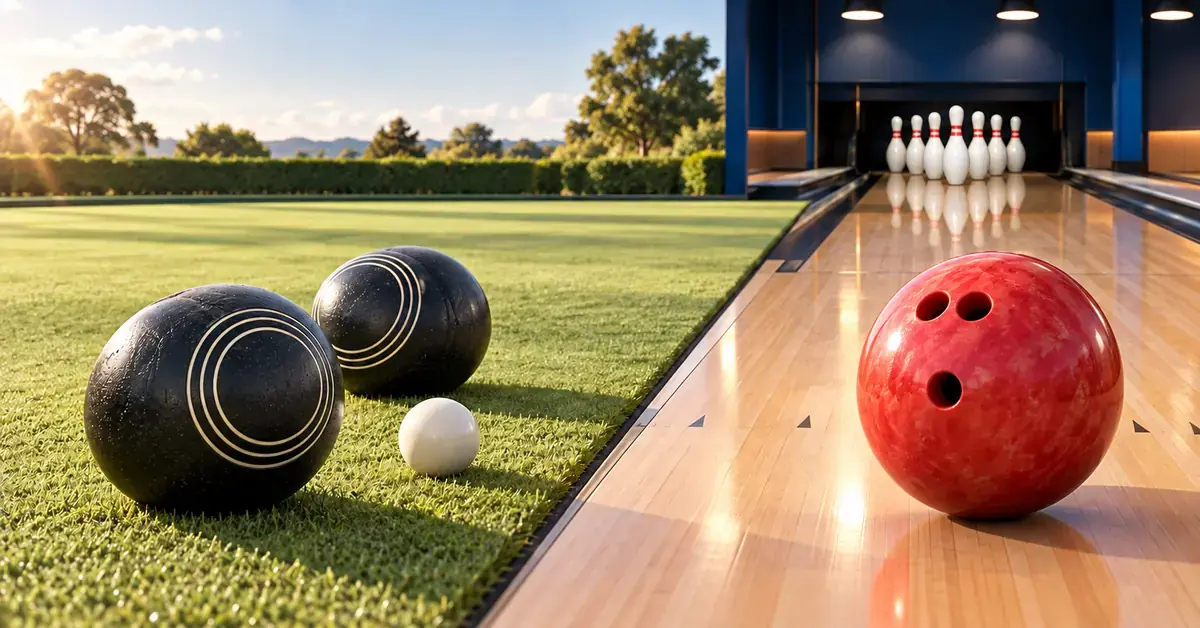
Both sports share the word “bowling”, but lawn bowls and ten-pin bowling are two completely different games. Lawn bowls is an outdoor sport played on a large flat grass or synthetic green, where you roll a weighted, curving bowl towards a small target ball. Ten-pin bowling is an indoor lane game where you roll a drilled ball at ten pins to knock them down. This guide compares them side by side — the rules, the gear, where and when you play, what each costs and how they feel — so you can decide which one to try first. The short answer: pick ten-pin for a casual, all-weather night out, and lawn bowls for a social outdoor club sport you can grow into for decades.
Key Points
- Two different sports: lawn bowls is outdoors on a flat green with curved, biased bowls; ten-pin is indoors on a lane with ten pins.
- Season: ten-pin runs all year indoors; lawn bowls is mainly a warm-weather outdoor game.
- Cost model: ten-pin is pay-per-game; lawn bowls is an annual club membership.
- Gear: both let you start with nothing — ten-pin centres hire everything, and most bowls clubs lend bowls and shoes to beginners.
- Best for: ten-pin for a casual, flexible night out; lawn bowls for a social club sport you can grow into for years.
What is lawn bowls?
Lawn bowls is a precision sport played outdoors on a flat, closely mown green. Your aim is to roll your bowls so they finish as close as possible to a small white target ball called the jack. The green is divided into playing lanes called rinks, and a match is made up of “ends” — everyone bowls towards the jack at one end, the closest bowls score, then play turns around and heads back the other way.
The defining feature of the game is that the bowls are not round. Each bowl is shaped with more weight on one side, called the bias, so it travels in a curved path and hooks in towards the jack at the end of its run. Learning to read that curve, and how fast the green is running, is the heart of the skill. If you want the full walkthrough, see our guide on how to play lawn bowls.
In New Zealand the sport is run by Bowls New Zealand, which oversees around 465 clubs and more than 40,000 playing members, making it one of the country’s larger participation sports. It is traditionally a summer game, with the main outdoor season running roughly from spring to early autumn.
What is ten-pin bowling?
Ten-pin bowling is an indoor lane sport where you roll a ball down a smooth timber or synthetic lane to knock over ten pins arranged in a triangle at the far end. You get two deliveries per turn to clear all ten. Knocking them all down with the first ball is a strike; clearing them across both balls is a spare. A game is ten “frames”, and a flawless game of twelve strikes in a row scores the maximum of 300.
The lane is about 60 feet (18.3 m) from the foul line to the head pin, with a gutter on each side to catch balls that stray. A separate approach area in front of the foul line gives you room to take your run-up. Hidden from view, a coat of oil is applied to the lane in a set pattern, which affects how much the ball slides and curves — one reason scores vary so much. For the complete breakdown, read our ten-pin bowling rules.
The sport is governed in this country by Tenpin Bowling New Zealand (TBNZ). Because it is played in climate-controlled centres, it runs all year round, day or night, which makes it easy to try on a whim.
How does the equipment compare?
The gear is where the two codes differ most, and it shapes everything about how they play. The table below sets the two side by side.
Comparison
| Feature | Lawn Bowls | Ten-Pin Bowling |
|---|---|---|
| Setting | Outdoor flat green, divided into rinks | Indoor lane with gutters and an approach |
| Season | Mainly warmer months (some indoor greens) | All year, climate-controlled |
| Object | Roll biased bowls closest to the jack | Knock down ten pins with a rolled ball |
| Ball/bowl | Biased (curves); max 1.59 kg; sizes ~00-7 | Symmetrical, drilled; max 16 lb (7.26 kg) |
| Target | Small white jack | Ten pins (~15 in tall, ~3 lb 8 oz each) |
| Scoring | Shots counted each end; closest bowls score | 10 frames; strikes and spares; max 300 |
| How you join in | Join a local club (annual membership) | Book a lane and pay per game |
| Governing body (NZ) | Bowls New Zealand | Tenpin Bowling New Zealand (TBNZ) |
| Best suited to | Ongoing club and community play | Flexible, casual outings |
Lawn bowls equipment
A lawn bowl is made of hard composite material and is weighted on one side to create the bias. Bowls must not weigh more than 1.59 kg and sit within a diameter range of roughly 112 to 134 mm. Sizes run from about 00 (smallest) up to 7 (largest), and most adults use something in the size 2 to 4 range depending on hand size and grip. Each bowl carries a World Bowls validation stamp and a date stamp confirming it meets the specifications. Beyond the bowls themselves you mainly need flat-soled shoes to protect the green; many clubs lend bowls and shoes to newcomers.
Ten-pin bowling equipment
A ten-pin ball is a solid sphere drilled with finger holes, with a maximum weight of 16 pounds (7.26 kg) and no minimum. Rental “house” balls at a centre typically run from about 6 to 16 pounds so there is a weight for everyone, from children to adults. The pins are around 15 inches tall and weigh about 3 lb 8 oz each. The great advantage for a first-timer is that you need to own nothing at all: the centre provides the ball, the lane and hire shoes, and sets the pins automatically.
Where and when do you play each one?
Setting and season are the clearest practical difference. Ten-pin bowling is indoors and available all year, so rain, wind or a cold night makes no difference — you simply book a lane. New Zealand has dedicated centres in most main towns and cities; our guide to the best bowling alleys in New Zealand maps out the larger venues.
Lawn bowls is an outdoor green sport tied to the weather and the seasons. The traditional pennant and club season runs through the warmer months, and play can be called off in heavy rain or high wind. Some regions also offer indoor or covered greens that stretch the playing window. Lawn bowls is firmly club-based: you join a local club, which gives you access to the green, coaching and a ready-made social calendar — a different model from simply turning up and paying per game. If the indoor-versus-outdoor question interests you, we also compare indoor bowls vs lawn bowls, which are themselves two separate games.
Which is easier to learn?
Both are easy to start and hard to master, but they reward different things. Ten-pin bowling gives instant gratification — you will knock some pins down on your very first ball, and a lane with bumpers lets young children score straight away. The depth comes later, in learning to curve the ball (a hook), to pick up tricky spares and to read the oil pattern.
Lawn bowls has a gentler physical start but a steeper early learning curve, because the bias means your bowl never travels in a straight line. New players often take a few sessions to judge how wide to aim and how much weight to put behind the bowl. The upside is that it is a thinking game of angles and tactics that keeps developing for years, which is a big part of its lasting appeal.
How physically demanding is each sport?
Both are low-impact and genuinely open to almost any age or fitness level, which is unusual among sports. That said, the demands differ.
- Lawn bowls: involves a controlled crouch and a smooth forward delivery, plus a fair amount of gentle walking up and down the rink across a match that can last a couple of hours. It is easy on the joints and famously welcoming to older players, while still being played competitively at a high level.
- Ten-pin bowling: uses a short run-up and the swing of a weighted ball, which asks a little more of the wrist, arm and lower back in one motion, especially with a heavier ball over several games. Choosing a sensible ball weight makes it comfortable for most people.
Neither sport requires running, speed or contact, which is why both attract such a wide range of ages and abilities.
What does it cost to try each?
The cost structures are quite different, and this often decides which you start with.
Ten-pin bowling is pay-as-you-go. You pay per person per game, usually with hire shoes included, so a casual night costs a set amount with no commitment. Our guide to how much ten-pin bowling costs in NZ breaks down the typical game, family-pack and off-peak prices.
Lawn bowls is cheaper per hour once you are a member but works on an annual subscription. Many clubs offer low-cost or even free introductory sessions, and barefoot bowls (a relaxed, casual version) is often charged per person like a social outing. If you take it up, you will eventually want your own set of bowls; see our guide to how much lawn bowls cost in New Zealand for new versus second-hand prices. As a rough rule: ten-pin costs less to try once, while lawn bowls costs less over a full season of regular play.
Which is more social, and who does each suit?
Both are sociable, but in different ways. Ten-pin bowling suits spontaneous groups — friends, families, birthdays, work events and date nights — because you can book a lane for an hour and leave. Many centres pair the lanes with a bar, arcade and food, so it doubles as an entertainment venue.
Lawn bowls suits people who want a regular club community and a sport to belong to. The club model builds friendships over a season, with social roll-ups, competitions and events off the green. It also has a thriving casual entry point in barefoot bowls, which many people try at a social function before joining properly. In short: choose ten-pin for a flexible one-off outing, and lawn bowls for an ongoing club hobby — and if you want to put down roots, our guides on how to join a lawn bowls club and how to join a ten-pin bowling league walk through the first steps for each.
Common mistakes and misconceptions
A few assumptions trip up beginners when they compare the two sports:
- Thinking they are the same game: they share only the name. The equipment, scoring, venue and governing bodies are entirely separate, so skills do not transfer directly from one to the other.
- Expecting a lawn bowl to roll straight: the bias is deliberate. New players often aim straight at the jack and watch the bowl curve away; you have to aim off to one side and let it hook back.
- Assuming lawn bowls is only for retirees: it is popular with older players, but it is played competitively by all ages, and barefoot bowls draws a young, casual crowd.
- Grabbing the heaviest ten-pin ball: a ball that is too heavy wrecks your accuracy and tires your arm. Pick a weight you can swing smoothly and control.
- Turning up to a green in the wrong shoes: lawn bowls requires flat, smooth soles to protect the surface — normal sports shoes with a heel or deep tread are not allowed on the green.
- Thinking you must buy gear first: you don’t. Ten-pin centres hire everything, and most bowls clubs lend bowls and shoes to newcomers for the first few visits.
So which should you try?
Try ten-pin bowling first if you want something immediate, indoors and flexible — a fun hour you can book tonight with friends or family, whatever the weather, with nothing to buy. Try lawn bowls if you are drawn to the outdoors, enjoy a tactical game of angles, and like the idea of joining a club and a community you can be part of for years. Many New Zealanders happily do both: ten-pin for a casual night out and lawn bowls as a warm-weather club sport. The best way to decide is simply to try each once — book a lane at a local centre, and ask a nearby club about a free come-and-try or barefoot bowls session.
Sources
- World Bowls — laws of the sport and bowl specifications
- Bowls New Zealand — national governing body (clubs and membership figures)
- Tenpin Bowling New Zealand (TBNZ) — national governing body
- United States Bowling Congress (USBC) — equipment and lane specifications
- Olympics.com — lawn bowls rules and bowl dimensions
Frequently Asked Questions (FAQ)
Are lawn bowls and ten-pin bowling the same sport?
No. They share only the word “bowling”. Lawn bowls is an outdoor sport that uses curved, biased bowls rolled towards a small target jack on a flat green. Ten-pin bowling is an indoor lane game where you roll a drilled ball to knock down ten pins. The equipment, rules, scoring and governing bodies are all different.
Why does a lawn bowl curve but a ten-pin ball does not have to?
A lawn bowl is deliberately weighted more on one side, called the bias, which makes it follow a curved path and hook in towards the jack. A ten-pin ball is symmetrical and can be rolled straight; experienced players choose to curve it (a hook) using spin and the lane’s oil, but a beginner can roll it straight down the lane.
Which is cheaper to try, lawn bowls or ten-pin bowling?
Ten-pin bowling is cheaper for a one-off visit because you pay per game with shoes usually included. Lawn bowls works on an annual club membership, so it is cheaper per hour if you play often, and many clubs offer free or low-cost introductory and barefoot bowls sessions to get started.
Which sport is better for older players?
Both are low-impact and open to all ages, but lawn bowls is especially popular with older players because the movement is gentle on the joints and the game is as much about tactics as physical effort. Ten-pin bowling is also accessible, though choosing a lighter ball helps keep it comfortable.
Do I need to buy my own equipment to start either one?
No. Ten-pin centres provide the ball and lane and hire out shoes, so you can turn up with nothing. Most lawn bowls clubs lend bowls and flat-soled shoes to newcomers for the first few sessions, so you only need your own set once you decide to keep playing.
