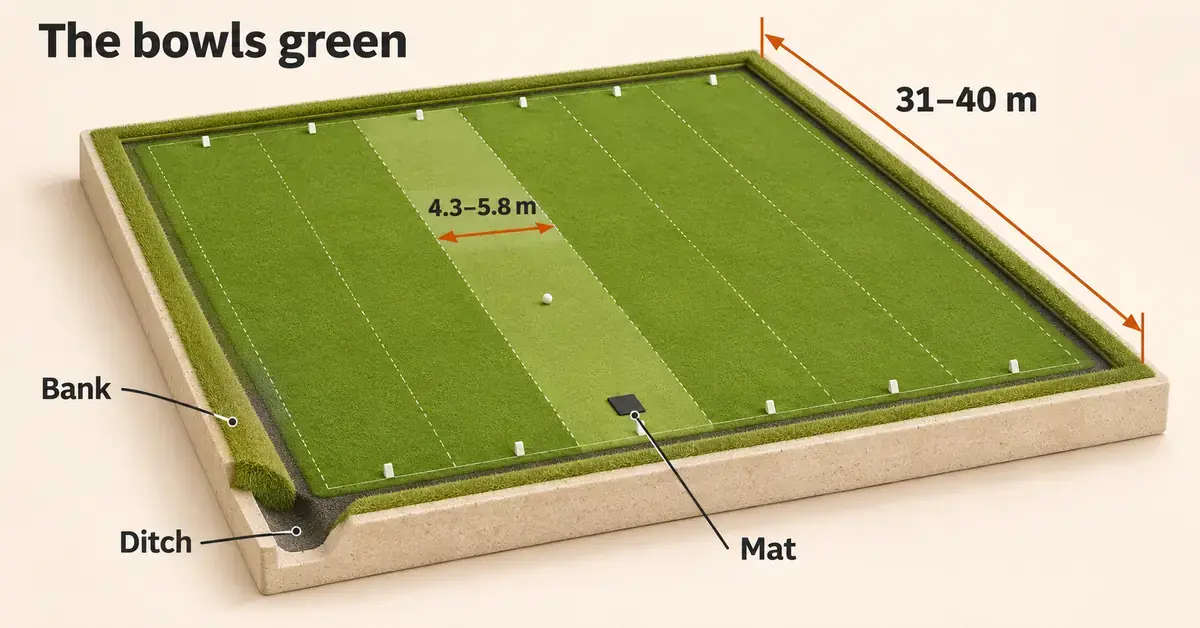
A full-size lawn bowls green is a square or rectangle measuring between 31 and 40 metres in the direction of play, surrounded by a shallow ditch and a raised bank, and divided into playing lanes called rinks that are each 4.3 to 5.8 metres wide outdoors. Those few numbers decide almost everything about how a game feels, yet most players never see them written down. This guide sets out the official lawn bowls green dimensions and the sizes of the rink, the ditch, the bank, the mat and the jack, explains why each one matters, and flags the one figure New Zealand sets differently from the world standard.
All the measurements below come from the World Bowls Laws of the Sport of Bowls (Crystal Mark Fourth Edition), the rulebook used for the flat-green outdoor and indoor game played across New Zealand. If you are new to the sport, it helps to read these alongside the basic lawn bowls rules so the field of play and the flow of a game make sense together.
Quick Facts
- Green length (direction of play): 31 to 40 metres, square or rectangular
- Rink width (outdoor): 4.3 to 5.8 metres
- Rink width (indoor): 4.6 to 5.8 metres
- Rinks per full-size green: usually six
- Ditch: 200 to 380 mm wide, 50 to 200 mm deep
- Bank height: at least 230 mm above the green
- Mat: 600 mm long x 360 mm wide
- Minimum legal jack distance: 23 metres from the mat line
- New Zealand domestic variation: minimum rink width 3.6 metres
What are the official dimensions of a lawn bowls green?
A lawn bowls green must be either square or rectangular, with the length in the direction of play set between 31 and 40 metres. That single rule is the headline measurement: everything else is built around it. Most clubs lay out a square green close to the upper end of the range, often around 37 to 40 metres a side, because a square green lets the club rotate the direction of play to spread wear evenly across the turf.
Green shape, length and surface
The playing surface can be natural vegetation (fine-leaved grass cut very short) or an approved synthetic carpet laid over a firm base. Both are legal under the laws, and in New Zealand you will find all three types in common use: traditional cotula and bent-grass greens, and modern synthetic surfaces that drain fast and play through the winter. The surface type changes how far a bowl travels and how much it curves, but it does not change the green’s required size.
How the green is divided into rinks
The green is split lengthwise into narrow lanes called rinks, and each separate game is played up and down one rink. An outdoor rink must be between 4.3 and 5.8 metres wide; an indoor rink must be between 4.6 and 5.8 metres wide. Wherever possible, every rink on a green is set to the same width so the games play alike.
The laws do not fix how many rinks a green has – that depends on the green’s width divided by the chosen rink width. A full-size outdoor green is usually marked out as six rinks (sometimes seven), which is why a busy club green can run six games side by side at once. Rinks are numbered in order, with the number shown on the bank at each end.
Key Measurements
| Feature | Measurement | Law |
|---|---|---|
| Green length (direction of play) | 31-40 m, square or rectangular | 46 |
| Rink width (outdoor) | 4.3-5.8 m | 49.1 |
| Rink width (indoor) | 4.6-5.8 m | 49.1 |
| Ditch width | 200-380 mm | 47.2 |
| Ditch depth | 50-200 mm | 47.2 |
| Bank height above green | at least 230 mm | 48.2 |
| Boundary peg from side ditch | 600 mm outdoor / 460 mm indoor | 49.6 |
| Distance markers from end ditch | 2 m and 25 m | 49.12 |
| Mat | 600 mm long x 360 mm wide | 50 |
| Jack (outdoor grass green) | 63-64 mm, 225-285 g | 51.2 |
| Jack (synthetic / indoor) | 63-67 mm, 382-453 g | 51.3 |
| Minimum legal jack distance | 23 m from the mat line | 10.1.3 |
How big are the ditch and the bank?
The ditch is the shallow trough that surrounds the whole green, and it is part of the field of play, not just a border. Under the laws the ditch must be between 200 and 380 millimetres wide and between 50 and 200 millimetres deep. It has to have a holding surface – sand, fine shingle or a soft synthetic – that will not damage a bowl or the jack when they drop in.
Why the ditch size matters
The ditch depth and width are not trivia. A bowl or jack that has touched something and falls into the front ditch can still count, and a jack knocked into the ditch can stay live, so the trough has to be shallow enough that a bowl settling in it is easy to see and measure. A ditch that is too deep or too narrow makes close ends awkward to judge.
The bank behind the ditch
Beyond the outer edge of the ditch sits the bank – the raised face that stops bowls. The top of the bank must be at least 230 millimetres above the surface of the green. Its face must be vertical (a right angle to the green) or sloped back by no more than 35 degrees, and it must be made of, or covered with, a material that will not damage a bowl or jack that runs into it. A bowl that reaches the bank after play has started is generally dead, so the bank also defines the far limit of a legal shot.
Rink markings: boundary pegs, distance markers and the centre line
The width of each rink is marked by boundary pegs, and the length is marked by distance pegs on the side banks. These markings tell players where the rink ends and where to legally place the mat and jack.
Boundary pegs
White or brightly coloured boundary pegs mark the four corners of each rink. For an outside rink, the pegs must sit at least 600 millimetres from the side ditch for outdoor play and at least 460 millimetres from the side ditch for indoor play, which keeps the outermost rink clear of the edge. Any bowl that finishes completely over the boundary line between the pegs is out of play and is removed for that end.
Distance markers and the centre line
Markers on the side banks show distances of 2 metres and 25 metres from each end ditch. The 2-metre mark is where the mat line can sit at the nearest; the 25-metre mark relates to the far end. Many greens also carry a centre line marked along the surface of the rink, starting 2 metres from each end ditch, which helps players deliver the jack and mat straight down the middle. Understanding where the centre line runs makes it easier to picture the bias in lawn bowls curving a bowl out and back to the jack.
What size is the mat, and where does it go?
The mat is a fixed size: 600 millimetres long and 360 millimetres wide (roughly 24 by 14 inches). It is the same mat whether you play singles or fours, indoors or out. The player delivering stands on it, and at the moment of delivery at least part of one foot must be on or above the mat – a rule that stops players from creeping forward down the rink.
Placing the mat correctly
Before the first bowl of an end, the player to play first places the mat along the centre line of the rink. The mat line (the front edge) must be at least 2 metres from the rear ditch and at least 25 metres from the front ditch. Within that band the player can set the mat wherever they like, which is a genuine tactical choice: moving the mat changes the length of every shot that end. Getting the mat placement wrong is one of the most common beginner mistakes, and it is separate from the skill of using a measure to settle a close end – for that, see how to measure a close end.
Jack size and the distances that decide a legal end
The jack is the small target ball, and its size depends on the surface. On an outdoor natural (grass) green the jack must measure between 63 and 64 millimetres across and weigh between 225 and 285 grams. On synthetic outdoor greens and indoor greens the jack must measure between 63 and 67 millimetres across and weigh much more – between 382 and 453 grams – so that it rolls properly on a faster, firmer surface. The jack must be a solid sphere and either white or yellow.
How far the jack must travel
After the jack is delivered and centred, it must come to rest at least 23 metres from the mat line, measured in a straight line from the centre of the mat line to the nearest point of the jack. A jack that stops short of 23 metres, finishes in the ditch, or runs outside the rink is improperly delivered and the other player resets the mat and re-delivers it. If the jack comes to rest closer than 2 metres from the front ditch, it is pulled back and centred exactly 2 metres from the front ditch.
When the jack becomes dead during play
During the end a bowl can knock the jack about. If a bowl in play drives the jack to less than 20 metres from the mat line (or off the rink, or into a hollow in the bank face), the jack is dead and the end is normally replayed. These distance rules are why the length of the green and the position of the mat matter so much – they set the window in which a legal head can form.
How are New Zealand’s green dimensions different?
New Zealand follows the World Bowls laws, with one notable local variation on rink width. The Laws allow Member National Authorities to set their own minimum rink width for domestic play, and Bowls New Zealand uses that power. Under the Bowls New Zealand Domestic Regulations, the minimum width of a rink for domestic play is 3.6 metres and the maximum is 5.8 metres – so a narrower rink than the 4.3-metre world minimum is legal at club level here.
That matters because many older New Zealand greens were built when rinks were narrower, and the 3.6-metre floor lets those greens stay in legal use. The regulations also confirm that domestic boundary pegs must be 13 to 25 millimetres wide and that boundary threads are not used for domestic play. The green length (31-40 metres), the ditch, the bank, the mat and the 23-metre jack distance are unchanged – New Zealand does not adopt the laws’ optional shorter 21-metre jack distance.
Indoor versus outdoor: what changes?
The green length is the same indoors and out, but three things differ. Indoor rinks must be slightly wider at the minimum (4.6 metres rather than 4.3), the heavier synthetic-surface jack is used, and the boundary pegs sit closer to the side (460 millimetres rather than 600). Indoor greens are almost always synthetic, which plays faster and more predictably than grass. If you are weighing up where to play over winter, the differences between the two settings are covered in our comparison of indoor bowls and the outdoor game.
Common mistakes and misconceptions about green dimensions
A few ideas trip up new bowlers and spectators again and again.
- Confusing the green with the rink. The green is the whole playing area; the rink is the single lane you play on. People often quote the rink width (around 5 metres) as the size of the “green”, which is wrong by a factor of seven or eight.
- Assuming every green has six rinks. Six is common, but the number depends on the green’s width and the rink width chosen – some greens have five or seven.
- Thinking the jack sits at a fixed spot. The jack can be anywhere from 23 metres out to about 2 metres from the front ditch, so the length of the “head” changes end to end.
- Believing there is a minimum distance a bowl must travel. There is a minimum legal distance for the jack, but a delivered bowl is simply short if it stops early – it is not dead for being short.
- Treating the ditch as out of bounds. A touched bowl or jack in the front ditch can still count; the ditch is part of play, not a gutter.
Why the dimensions shape how the game plays
Green and rink size are not just paperwork – they set the character of the sport. A longer green or a jack pushed to 30-plus metres rewards a heavy, controlled draw; a short jack near the front ditch makes for a tight, crowded head. The rink width governs how much room a bowl has to swing out on its bias and curve back, which is why a bowler who knows the exact width can picture their line. Matching the right equipment to the surface matters too, so it is worth checking what size lawn bowls you need for the green you play on. Learn the measurements once and the strategy of mat placement, jack length and line selection all start to make sense.
Sources
Frequently Asked Questions (FAQ)
How big is a lawn bowls green?
A lawn bowls green is square or rectangular and measures between 31 and 40 metres in the direction of play. It is surrounded by a ditch 200-380 mm wide and a bank at least 230 mm high. Most full-size greens are close to 37-40 metres a side and divided into about six rinks.
How wide is a bowls rink?
Under the World Bowls laws an outdoor rink is between 4.3 and 5.8 metres wide, and an indoor rink is between 4.6 and 5.8 metres wide. For domestic play in New Zealand, Bowls New Zealand sets a lower minimum of 3.6 metres, so narrower club rinks are legal here.
How far does the jack have to be bowled?
After it is delivered and centred, the jack must come to rest at least 23 metres from the mat line to be legal. If it stops short of that, or ends up in the ditch or off the rink, it is improperly delivered and re-bowled. A jack that comes to rest within 2 metres of the front ditch is moved back to exactly 2 metres from it.
What size is the mat in lawn bowls?
The mat is 600 millimetres long and 360 millimetres wide, the same for every format and surface. Its front edge (the mat line) must be placed on the centre line at least 2 metres from the rear ditch and at least 25 metres from the front ditch.
Are indoor bowls rinks the same size as outdoor ones?
The green length is the same, but indoor rinks have a slightly higher minimum width (4.6 metres rather than 4.3), the boundary pegs sit closer to the side ditch (460 mm rather than 600 mm), and a heavier synthetic-surface jack of 63-67 mm and 382-453 grams is used instead of the lighter grass-green jack.
