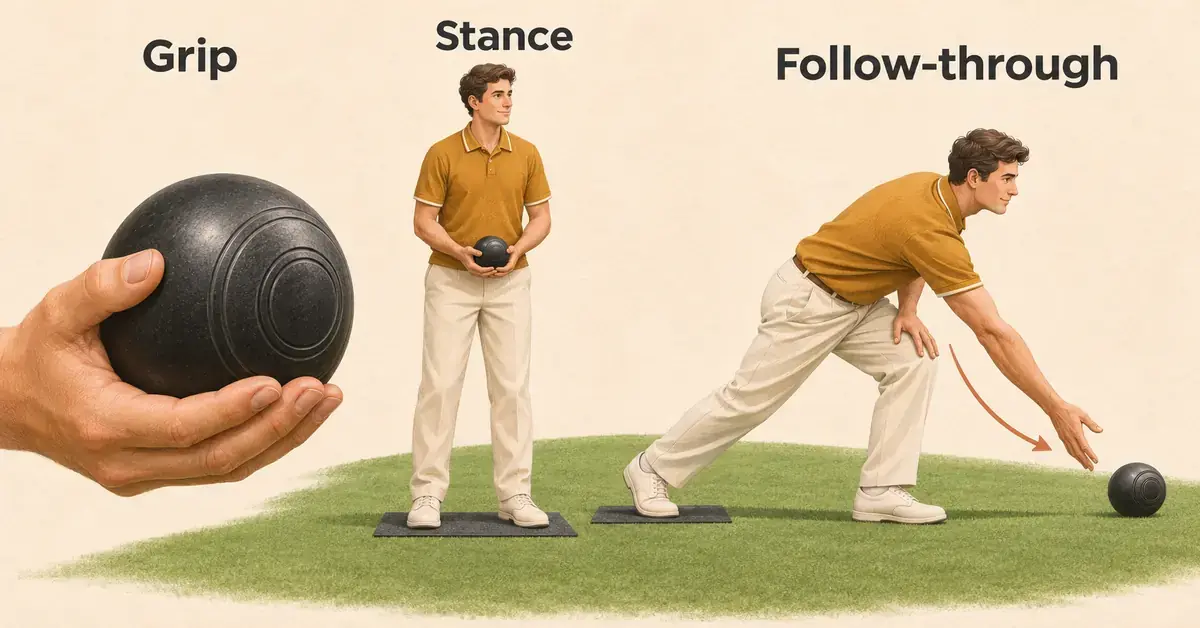
The lawn bowls delivery is the single action that sends your bowl down the green, and getting it right matters more than any other skill in the game. Good lawn bowls delivery technique has four linked parts: how you hold the bowl (grip), how you set up on the mat (stance), how you swing and step, and how your arm follows the bowl after it leaves your hand (follow-through). Do those four things the same way every time and your bowls start finishing where you want them. This guide breaks the delivery into clear stages, explains the one rule that governs your feet on the mat, and covers the mistakes that trip up most beginners in New Zealand clubs.
What is the delivery in lawn bowls?
The delivery is the complete movement of putting a bowl onto the green, from your stance on the mat to the moment your hand follows through along the aiming line. Because a bowl is weighted on one side (its bias), it travels in a curve rather than a straight line, so the delivery has to send it off on the correct line at the correct speed to curve back and finish near the jack (the small white or yellow target ball). Everything else in the sport — the draw and the other lawn bowls shots, tactics, team play — depends on a repeatable delivery underneath it.
Coaches in New Zealand and elsewhere teach the delivery as a routine rather than a single throw. Bentleigh Bowls Club’s coaching notes, for example, list five constants of a consistent delivery: a clear intended line, balance and stability, controlled momentum, a smooth release, and consistent repetition. The goal is not power or style — it is doing the same thing on every bowl so the only thing that changes is the shot you have chosen to play. If you are completely new to the sport, it helps to read a plain-English guide on how to play lawn bowls first, then use this article to refine the physical technique.
How do you grip a lawn bowl?
A lawn bowls grip should feel comfortable and secure without squeezing, because the bowl has to roll cleanly off your fingers rather than be thrown. The most important points coaches agree on are simple: keep your little finger off the bowl, because it tends to cause the bowl to wobble on release, and let your middle finger be the last point of contact as the bowl leaves your hand. If you grip too hard the bowl will not release smoothly, and a wobble on delivery costs you both line and length.
The right grip also depends on the bowl fitting your hand, so if you are unsure, check the right size of lawn bowls for your hand before you worry about technique. There are three common grips.
The claw grip
The claw grip spreads the fingers across the bottom of the running surface with the thumb resting higher up the side of the bowl, leaving a small gap between the palm and the bowl. It gives good control of the release and is widely taught as a starting grip. Because the thumb sits reasonably high, it suits bowlers who want a firm, controlled feel.
The cradle grip
The cradle grip sits the bowl deeper in the palm with the fingers fairly close together and the thumb lower down the side than in the claw. It is the most relaxed of the grips and is often chosen for larger bowls or heavier, slower greens, where a little more support helps. Many beginners find it the easiest grip to start with.
The fingertip grip
The fingertip grip is a variation of the claw in which the bowl rests lower, out on the fingers, with the palm clear of the wood. It gives a sensitive, delicate release and is often preferred on fast greens, where very little effort is needed to send the bowl its full distance. It takes more practice to control than the cradle.
No single grip is “correct.” Try each one, keep your little finger off the bowl, and settle on whichever lets you release smoothly and repeatably.
What is the correct stance on the mat?
Your stance is how you stand on the mat before you deliver, and its job is to point your body along your intended line and keep you balanced. Face the direction you want the bowl to start travelling, with your feet together or slightly apart and your weight evenly balanced. There is no single compulsory posture — an upright (standing) stance and a crouched (athletic) stance are both legal and widely used, so choose the one you can hold steadily and repeat.
- Upright stance: you stand nearly straight, bending as you begin the swing. It is easy on the back and simple to repeat, which is why many beginners and older bowlers use it.
- Crouch (athletic) stance: you start bent at the knees and hips, closer to the ground. It can give a lower, more stable release but demands more leg strength and flexibility.
Whichever you choose, your non-bowling hand can rest on your leading knee or thigh to steady you, and your eyes should be fixed on your aiming point out on the green, not on the jack. Decide your shot and your line before you step onto the mat, so your stance is already set up for the delivery you intend to play.
Where should your feet point?
Point your feet along your intended line of delivery, not at the jack. Because the bowl curves, the line it starts on is to one side of the jack — out to the right on a right-hander’s forehand and out to the left on the backhand. Set your feet so that a straight step forward travels along that starting line. Aligning your feet, shoulders and eyes to the same line is one of the quickest ways to make your deliveries more consistent.
The foot-fault rule
You must have a foot on or above the mat at the moment you deliver, or you commit a foot-fault. The Laws of the Sport of Bowls (Crystal Mark Fourth Edition, the current World Bowls rules) state it precisely: before delivery you must be standing on the mat with all or part of at least one foot on the mat, and at the moment you deliver the jack or a bowl you must have all or part of one foot on or above the mat. Wheelchair bowlers substitute a wheel for the foot. Break this and, under Law 8, an umpire warns you the first time and can have later offending bowls stopped and declared dead. The regulation mat itself is 600 mm long and 360 mm wide, which gives you plenty of room to set your feet. For the wider context, see our guide to the basic rules of lawn bowls.
The backswing, step and release
The swing and step are where line and length are actually created, so they need to be smooth and in the right order. Think of your bowling arm as a pendulum hanging from the shoulder: it swings straight back and straight forward along your intended line, close to the side of your body. Keep the swing relaxed — a longer, slower green or a longer jack needs a longer backswing and follow-through, while a short jack needs less.
The order matters. Bend and begin the backswing first, then step. Starting the step before the swing is the classic cause of “dumping” the bowl — dropping it heavily onto the green so it bounces and loses line. Work through the movement like this:
- Bend and start the backswing. Keep your head still and your shoulders square to the line.
- Step forward along the line. A normal walking step is ideal — not a lunge. Right-handers usually step with the left foot on the forehand and the right foot on the backhand.
- Transfer your weight onto the front foot as the arm swings through.
- Release the bowl just in front of your leading foot, letting it roll off your fingers with the middle finger last.
- Stay low through the release rather than standing up, which pulls the bowl off line.
Keeping your head still and your eyes on the aiming point throughout is one of the most important habits in the whole delivery, because any head movement during the swing shifts your line.
What does a good follow-through look like?
The follow-through is the continuation of your arm along the aiming line after the bowl has gone, and it is the proof that the rest of the delivery was sound. Your hand should follow the bowl out along the intended line, fingers extending toward the target, while you stay low and balanced. Keeping the delivery arm low — rather than lifting it up after release — protects both your balance and your line.
A reliable test of balance is the “hold-finish” drill: deliver the bowl slowly and freeze in your finishing position. If you can hold it steady for about two seconds without wobbling or stepping to recover, your stance, step and release are working together. If you fall forward, sideways, or have to catch yourself, something earlier in the delivery is off balance.
Delivery checklist
- Choose your shot, hand (forehand or backhand) and line before you step on the mat.
- Set your feet on the mat pointing along the intended line, not at the jack.
- Settle into a comfortable, balanced stance — upright or crouched.
- Take a relaxed grip; keep your little finger off the bowl.
- Fix your eyes on your aiming point and keep your head still.
- Bend and begin a smooth pendulum backswing before you step.
- Step forward along the line with a normal walking stride.
- Transfer your weight onto the front foot and stay low.
- Release the bowl just in front of your leading foot, middle finger last.
- Follow through along the line and check a foot was on or above the mat.
Aiming: line and weight
Every delivery is a combination of line (the direction you send the bowl) and weight (how hard you roll it), and you have to get both right for the bowl to finish near the jack. Line decides which side of the jack the bowl curves back from; weight decides how far it travels.
Forehand and backhand
You can play any shot on one of two lines: the forehand or the backhand. For a right-handed bowler, the forehand sends the bowl out to the right of centre so it curves back to the left toward the jack; the backhand sends it out to the left so it curves back to the right. Left-handers are the mirror image. Being able to deliver on both hands lets you choose the better line for the shot and the state of the head (the jack and the bowls gathered around it).
Why the bowl curves
The bowl curves because of its bias — the shape that makes it lean and fall toward one side as it slows down. Understanding bias in lawn bowls explains why you aim to one side of the jack rather than straight at it: you are allowing for the curve the bowl will take as it loses speed.
Green speed and how wide to aim
How far to one side you aim depends mostly on the speed of the green, which is measured by the time in seconds a bowl takes to reach the jack. Bowls manufacturer Henselite describes a slow green as one where the bowl takes about 10 to 14 seconds and needs to be rolled in only a slight curve, and a fast green as one taking roughly 14 to 19 seconds, where the bowl has to be rolled in a much wider curve to allow for the extra time the bias has to act. In practice that means the faster the green, the wider you aim; the slower the green, the narrower. New Zealand clubs play on both grass and synthetic greens, and speeds vary from green to green, so judge the pace with a trial end or two rather than assuming.
Controlling weight
Weight is controlled mainly by the length of your backswing and the pace of your step, not by muscling the bowl. A longer, smoother swing sends the bowl further; a shorter swing sends it less far. The aim is to control the momentum so the bowl travels the required length and comes to rest at the jack — too much weight runs the bowl through the head, too little leaves it short.
Common delivery mistakes
Most delivery faults come from a handful of repeatable habits, and fixing them is faster than changing your whole action. Watch for these:
- Gripping too hard. A tense grip stops the bowl releasing cleanly and often causes a wobble. Relax the hand and keep the little finger off the bowl.
- Stepping before you swing. This “dumps” the bowl onto the green so it bounces and loses line. Always begin the backswing first, then step.
- Standing up through the release. Rising too early lifts the arm and pulls the bowl off line. Stay low until the bowl is well on its way.
- Moving your head. Any head movement during the swing shifts your aim. Keep your eyes fixed on the aiming point.
- Aiming at the jack. Because the bowl curves, aiming straight at the jack sends it narrow. Aim along the line the bowl needs to start on.
- Inconsistent step length. A lunge one bowl and a shuffle the next changes your weight. Use a natural, repeatable walking step.
- Letting the little finger creep up the side. This is a frequent cause of wobble; keep it clear of the bowl.
How to practise your delivery
You improve a delivery by repeating it deliberately, not just by playing games. A few simple drills used by coaches work well:
- Hold-finish drill: deliver slowly and freeze in your finishing position for about two seconds to test balance.
- Grouping drill: draw four bowls to a jack on the same hand and try to group them as tightly as possible, then repeat on the other hand. This builds consistency of line and weight.
- Film yourself: record your delivery from the front and the side. The front view shows whether the bowl leaves your hand straight; the side view shows your balance and whether you stay low.
The fastest way to iron out faults is a few sessions with a qualified coach. Bowls New Zealand runs a national coaching pathway — Foundation, Development and Performance courses — and most clubs have coaches who help new members with exactly these fundamentals. If you are not yet a member, our guide to joining a lawn bowls club explains how to get started and where coaching usually fits in.
Sources
Frequently Asked Questions (FAQ)
Which stance should a beginner use, upright or crouched?
Start with whichever you can hold steadily and repeat. Many beginners and older bowlers prefer the upright stance because it is easy on the back and simple to balance, while the crouch can give a lower, more stable release if you have the leg strength and flexibility for it. Neither is more “correct” — consistency matters far more than the posture you choose.
Do I step with the same foot as my bowling hand?
Usually the opposite foot. Right-handers most often step forward with the left foot on the forehand and with the right foot on the backhand, so the stepping foot is clear of the swinging arm. Left-handers mirror this. The step should be a natural walking stride taken along your intended line, not a lunge.
Can left-handed bowlers use the same delivery technique?
Yes — the technique is identical, simply mirrored. A left-hander’s forehand sends the bowl out to the left of centre and it curves back to the right, the reverse of a right-hander. Grip, stance, swing, release and follow-through are all the same principles.
Why does my bowl wobble when it leaves my hand?
A wobble almost always comes from the grip or the release. Check that your little finger is off the bowl, that you are not squeezing too hard, and that the bowl rolls off your fingers with the middle finger as the last point of contact. Standing up or snatching at the release can also cause it.
How long does it take to develop a consistent delivery?
Most beginners can groove a reliable basic delivery within a few focused practice sessions, but refining line and weight control takes ongoing practice over a season. Short, regular practice with a clear routine improves you faster than occasional long sessions, and a coach can shorten the process considerably.
