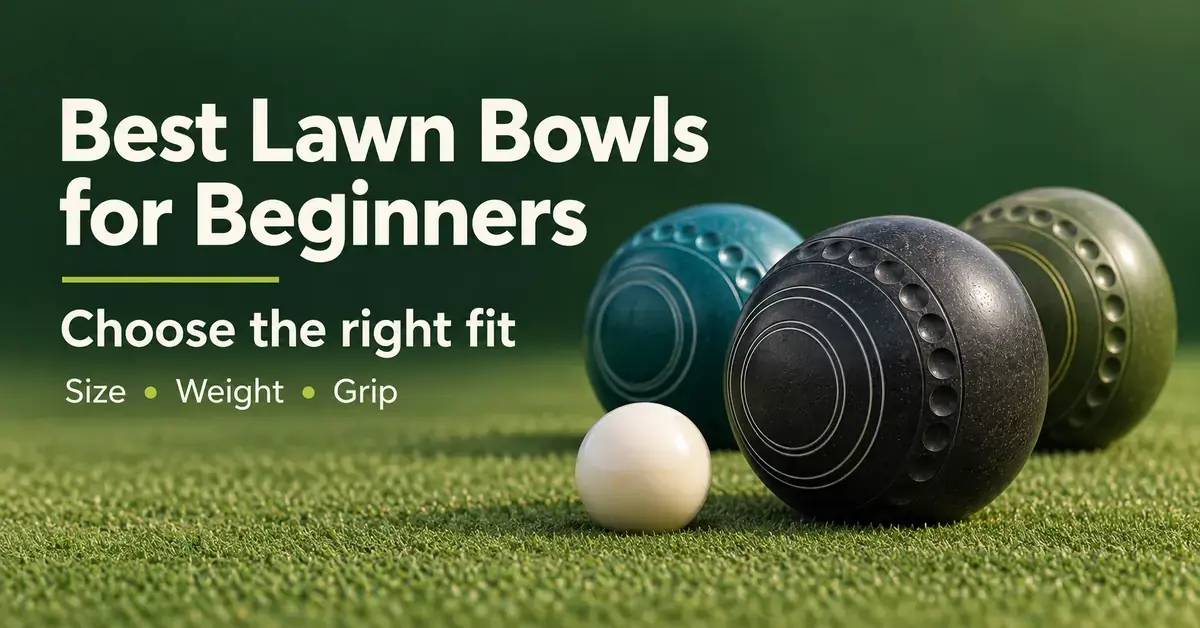
Choosing your first set of lawn bowls comes down to one thing above all else: fit. Unlike most sports gear, a bowl is not picked by your height, strength or budget first — it is picked to match the size of your hand and the way you deliver it. Get the size, weight and grip right and the bowl will feel like part of your arm; get them wrong and you will fight the equipment every time you play. This guide explains exactly what to look for, in plain terms, so you can walk into a club or a shop knowing what matters and what is just marketing.
One important thing to know before you spend anything: in New Zealand you almost certainly do not need to buy bowls to start. Most clubs lend a set for your first sessions, so the smartest move is to try several sizes on the green before you commit. Read this guide, then borrow before you buy.
Key Points
- Fit first: choose a bowl by your hand size, never by your height, age or strength.
- Size test: with the bowl in your hand, your middle finger and thumb tips should just touch over the top — sizes run 00 (smallest) to 5 (largest).
- Weight: standard/medium weight is the safe default for beginners; heavy weight adds hand fatigue.
- Grip: a dimple or gripper pattern holds better than a plain bowl on wet NZ greens.
- Bias: start with a mid-bias model — it is the most predictable while you learn.
- Don’t rush to buy: clubs lend bowls; borrow and try several sizes before purchasing.
- Second-hand is fine: just check all four bowls match (same model and serial number) and mind the date stamp only if you plan to compete.
What are lawn bowls, exactly?
A lawn bowl is not a round ball. It is a hard, slightly flattened sphere that is weighted more on one side so it curves — or “draws” — as it slows down. That built-in curve is called the bias, and it is what makes the sport a game of judgement rather than brute force. You roll your bowls toward a smaller white or yellow target ball called the jack, and the player or team whose bowls finish closest to the jack scores.
Bowls are bought and played as a matched set of four (a “full set”), though singles and pairs formats mean you may only use two at a time. Modern bowls are made from a dense composite resin, not the timber (traditionally lignum vitae) used a century ago. When you choose a set, the four properties that actually matter are size, weight, grip and bias — covered one by one below.
If you are completely new to the sport and want to find somewhere to try it, the lists of lawn bowls clubs around Auckland and bowls clubs in Canterbury are good starting points. Note that lawn bowls is a different code from ten-pin bowling in New Zealand — the equipment, venues and rules do not overlap, so make sure any “bowls” advice you read is about the outdoor grass game.
How is bowl size measured, and what size should a beginner choose?
Bowl size is the single most important choice, and it is decided by your hand — not your height, age or strength. The size number simply refers to the diameter of the bowl.
How lawn bowl sizes work
Lawn bowls run from size 00 (the smallest) up to size 5 (the largest), with sizes 0, 1, 2, 3 and 4 in between. Most adults end up somewhere in the middle of that range. A bigger number means a physically larger bowl with a wider diameter; it does not make the bowl “better” or give it more power. The only goal is a diameter your hand can hold and release comfortably.
The finger-and-thumb test
The classic way to check size takes seconds. Hold the bowl in your bowling hand, wrap your fingers around one side and your thumb around the other, and bring their tips toward each other over the top of the bowl:
- Correct size: the tips of your middle finger and thumb just touch, or leave only a small gap.
- Too small: your fingers overlap noticeably — the bowl will feel fiddly and be hard to control.
- Too big: there is a wide gap and you have to stretch — you will drop it or “flick” your wrist to release it.
Back this up with a swing test: with the bowl in your grip, mimic your delivery stance and swing your arm gently by your side. The bowl should feel secure without you clenching your fist or straining your wrist, and it should leave your hand smoothly. If you have to snap your wrist to let it go, drop down a size.
Typical starting sizes for women and men
These are averages, not rules — always test rather than assume:
- Women: commonly sizes 0 to 3, most often 1 or 2.
- Men: commonly sizes 2 to 4, most often 3.
Because grip strength and hand size vary widely, plenty of players sit outside these ranges, and that is completely normal.
Do heavier or lighter bowls matter for beginners?
Weight is a secondary choice, and for a beginner it is far less important than getting the size right. Bowls are not chosen by weight the way you would pick up a heavier or lighter dumbbell for strength — in general, a larger size simply weighs a little more than a smaller one.
That said, most sizes are offered in two weight options: a standard (or medium) weight and a heavy weight. Heavy bowls can help on faster or windier greens, but they place more load on your hand and wrist over a long game. If you are new, or if the size that fits you is already at the top of your comfortable range, a standard-weight bowl is the safer default because it reduces hand fatigue across an afternoon of ends.
What grip should a beginner choose?
Grip refers to the pattern cut or moulded into the surface of the bowl to help you hold it securely. It is a comfort decision, not a performance one, so there is no “best” grip — only the one that feels most secure in your hand. The common options are:
- Plain bowls: a smooth surface with only the manufacturer’s rings. Traditional, but harder to hold in the wet.
- Dimple grip: a pattern of small indentations across the running surface — the most popular all-round choice, and forgiving for beginners.
- Ring or gripper grip: deeper rings machined into the bowl, giving extra purchase in damp conditions or for players with less grip strength.
If your hands sweat or you play in dew or drizzle — common on New Zealand greens — a dimple or gripper pattern is worth choosing over plain.
Understanding bias: why beginners should start mid-bias
Bias is the amount a bowl curves as it slows, and every legal bowl has some — you cannot buy a “straight” bowl. World Bowls sets a minimum bias that all approved bowls must meet, so the real question is how much a given model curves:
- Wide (or heavy) bias: a broad, gradual curve. Useful on slow, heavy greens where a bowl needs to swing a long way to reach the jack.
- Narrow (or tight) bias: a straighter run with a sharper finishing curve. Suited to fast greens.
For a beginner the answer is simple: choose a mid-bias model. It behaves predictably across the range of green speeds you will encounter while learning, so you spend your energy grooving a consistent delivery rather than compensating for an extreme curve. You can specialise later once you know the greens you play on most.
What does the World Bowls stamp and date mean?
Every set of approved bowls carries a World Bowls stamp, and understanding it matters most when you are buying second-hand. The stamp records the bowl’s size, its bias mark, a serial number and a date.
- The date stamp lasts ten years. World Bowls requires bowls to be re-tested and re-stamped at least once every ten years — or sooner if the stamp becomes illegible. Testing was standardised in April 2002 (with a set test surface, release chute and a 9-metre test distance), which is why bowls made from 2002 onward carry a clear date.
- A matched set of four is required for competition. To play in events sanctioned by World Bowls or a national body, all four of your bowls must be the same model with the same serial number and a valid (in-date) stamp. Mixing models or brands is not allowed in competition.
- Casual and social play is different. For club roll-ups, coaching and “have a go” sessions in New Zealand, an expired date stamp is usually irrelevant — the bowls still roll perfectly well. The stamp only becomes a barrier when you enter graded competition.
So if you find a cheap second-hand set with an old date, it is fine for learning; just budget for a re-test if you later want to compete.
New versus second-hand bowls — and should you buy at all yet?
The honest answer for most beginners in New Zealand is: not yet. Clubs provide bowls you can borrow to get started, and the only thing you genuinely need to bring is a pair of flat-soled shoes to protect the green. Bowls New Zealand and its regional bodies run free “Have a Go” sessions and beginner coaching precisely so you can try different sizes and makes before spending anything.
When you are ready to buy, here is roughly what to expect in the NZ market:
- New sets: a top-tier new set can run up to around NZ$900, though many club-level sets cost considerably less. New bowls come with a fresh ten-year stamp and let you pick the exact size, grip and bias.
- Second-hand sets: often the smart first purchase. Individual bowls commonly sell from about NZ$30, with complete sets frequently in the NZ$95–$240 range on marketplaces such as Trade Me and through specialist retailers.
If you buy used, check that all four bowls share the same size, model and serial number, that the running surface is free of deep chips or cracks, and — if competition is a goal — that the date stamp is either in-date or cheap to renew. Many clubs, including established ones such as Howick Bowling Club, can point new members toward reputable second-hand sets or advise on sizing.
Lawn bowls brands compared
Four manufacturers dominate the sport worldwide — often called the “Big Four” — and all of them make bowls that are entirely suitable for beginners. The table below compares them on verifiable facts rather than opinion; there is no single “best” brand, only the model that fits your hand and your green. All four are sold through New Zealand stockists.
Brand Comparison
| Brand | Origin | Known for | Beginner-friendly to note | Official site |
|---|---|---|---|---|
| Taylor | Scotland (established 1796) | The oldest maker; precision engineering, many championship models | Taylor Ace (mid-bias) | taylorbowls.com |
| Drakes Pride | Liverpool, England | Value and range; a staple in club play | Drakes Pride Professional / Pro 50 | drakespride.co.uk |
| Henselite | Australia | One of the oldest names; consistency and long-running models | Classic and Tiger ranges | henselite.com |
| Aero | Australia (founded 2012) | High manufacturing consistency; large model range, popular across NZ and Australia | Groove and Turbo Pro ranges | aerobowls.com |
Popular entry-level models bowlers are often steered toward include the Drakes Pride Professional and Pro 50, and the Taylor Ace — all mid-bias designs that suit a developing delivery. Rather than chasing a specific model name, take your fitted size and grip preference to a stockist or coach and try what they have in that size.
Common mistakes beginners make when choosing bowls
Most first-time buyers go wrong in a handful of predictable ways. Avoiding these will save you money and frustration:
- Buying before borrowing. The biggest mistake is spending money before you have tried several sizes on a real green. Borrow from a club first.
- Choosing size by height or strength. Size follows your hand, full stop. A tall player with small hands may need a smaller bowl than a shorter player with large hands.
- Going one size too big. A bowl you have to stretch around will slip on release. When in doubt between two sizes, the smaller, more secure one usually wins.
- Picking an extreme bias. A very wide- or narrow-biased model makes learning harder. Start mid-bias.
- Buying a mismatched second-hand set. Four bowls that are not the same model and serial number cannot be used together in competition — check before you pay.
- Ignoring the grip in wet conditions. A plain bowl can be hard to hold on a dewy morning; a dimple or gripper pattern is more forgiving.
- Assuming heavier is better. Heavy-weight bowls tire your hand over a long game with little benefit for a beginner.
Who suits which bowls, and when to upgrade
If you are just starting, aim for a mid-bias bowl in the size that passes the finger-and-thumb and swing tests, in a standard weight, with a dimple grip — that combination suits the widest range of new players and NZ green conditions. Social and club players rarely need anything more.
Consider upgrading or specialising only once you play regularly and know your home greens: at that point you might move to a bias better matched to those greens, or to a heavier bowl if you have built the delivery to control it. Buying a competition-legal, in-date matched set is worth doing when you decide to enter graded events — not before.
Sources
- Bowls World — Lawn Bowls Size Guide
- Henselite — A Beginner’s Guide to Lawn Bowls Sizes, Weights and Bias
- The Sport of Bowls — Bowls Date Stamp
- The Sport of Bowls — Re-Testing Lawn Bowls
- Bowls Auckland — What You Need to Play Bowls
- Bowls Tahunanui — Getting Started FAQs
- Aero Bowls — About Aero
- Taylor Bowls — Frequently Asked Questions
Frequently Asked Questions (FAQ)
What size lawn bowl should a beginner buy?
Buy the size that fits your hand, not your body. Use the finger-and-thumb test: hold the bowl and bring your middle finger and thumb over the top so their tips just touch. Women commonly land on sizes 1 to 2 and men on size 3, but always test before deciding.
Do I need to buy my own bowls to start playing?
No. Most New Zealand clubs lend bowls to newcomers, and “Have a Go” days and beginner coaching let you try different sizes for free. All you need to bring is flat-soled shoes. Borrowing first lets you learn what fits before you spend anything.
Are second-hand lawn bowls a good idea for beginners?
Yes, they are often the smartest first purchase. Complete used sets frequently sell for about NZ$95 to $240. Just check that all four bowls are the same model and serial number, look for cracks or deep chips, and note the date stamp if you plan to compete later.
What does the date stamp on a lawn bowl mean?
The World Bowls date stamp is valid for ten years and must be renewed for the bowls to be legal in sanctioned competition. For casual, social and club roll-up play the date generally does not matter — out-of-date bowls still roll perfectly well, so an old stamp should not put you off a good second-hand set.
What is bias and does it matter for a beginner?
Bias is the built-in curve every lawn bowl makes as it slows down; you cannot buy a straight bowl. It matters, but beginners should keep it simple by choosing a mid-bias model, which behaves predictably across different green speeds while you develop a consistent delivery.
