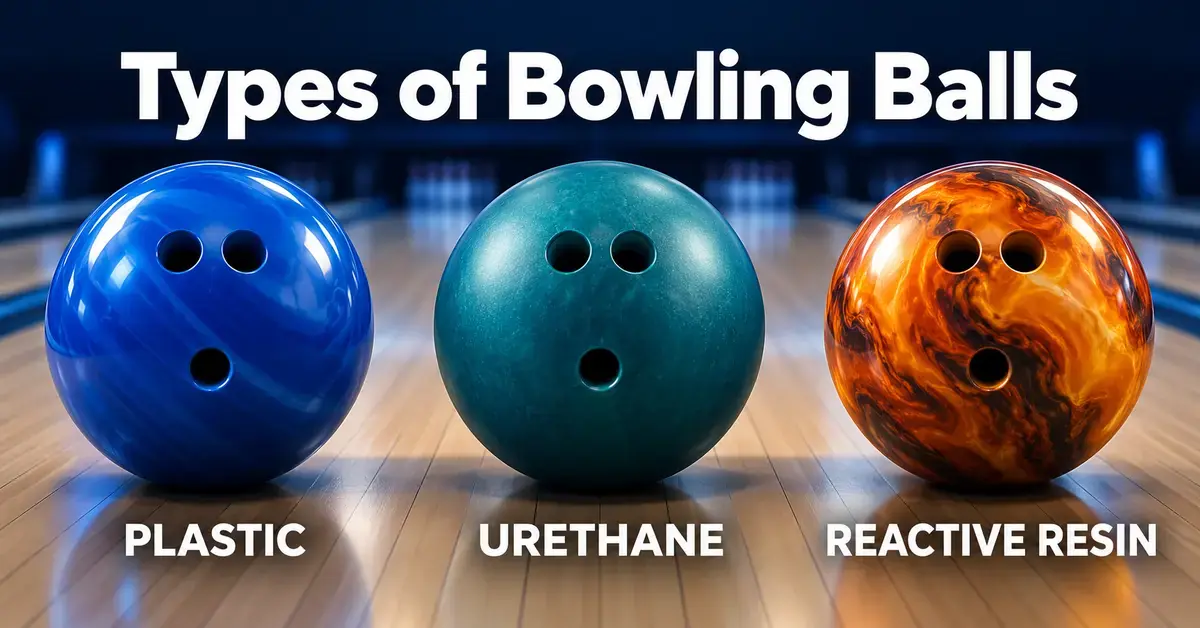
The type of bowling ball you roll matters far more than most beginners realise, because the outer shell and the hidden core decide whether the ball goes dead straight or curves hard into the pins. In ten-pin bowling there are three main families of ball, sorted by their outer layer (the coverstock): plastic, urethane and reactive resin. This guide explains what each one does, how the core works, what weight to pick and which rules a ball must meet, all in plain English so you can choose with confidence.
One quick note before we start: this article is about ten-pin bowling balls — the round, drilled balls with finger holes that you throw down an oiled lane. These are completely different from lawn bowls, which are biased (weighted to one side), have no holes and are rolled on grass. If you play the outdoor code, the material choices below do not apply to you.
Key Points
- Three main types: plastic (polyester), urethane and reactive resin — named after the coverstock, the ball’s outer shell.
- Straightest to strongest hook: plastic (straight) → urethane (smooth curve) → reactive resin (aggressive hook).
- The coverstock decides most of the motion because it is the only part that touches the lane; the core fine-tunes how the ball revs and stores energy.
- Beginners: start with a plastic ball; it doubles as a spare ball later.
- Weight guide: roughly 10% of body weight, up to the 16 lb legal maximum.
- This guide covers ten-pin balls (round, drilled), not lawn bowls (biased, no holes).
What is a coverstock, and why does it decide everything?
The coverstock is the outer shell of the ball, and it is the single biggest factor in how much the ball hooks (curves). Around 70% of a ball’s motion comes from the coverstock, because it is the only part that actually touches the lane. When a ball rolls over the thin layer of oil that lane staff apply each day, the coverstock decides how much grip, or friction, the ball creates once it reaches the drier boards near the pins.
More friction means more hook; less friction means a straighter path. That is why the same throw can look completely different depending on the ball. The three coverstock materials below are listed from least grippy to most grippy.
Plastic (polyester) bowling balls
Plastic balls go the straightest of any type and are the classic starting point for new bowlers. Made from a hard polyester resin, the plastic shell is smooth and non-porous, so it barely grips the lane and rolls in an almost straight line no matter how much oil is down.
That predictability is exactly why they are useful. The house balls sitting on the racks at your local centre are almost always plastic, and most serious bowlers still carry one in their bag as a dedicated spare ball — when you only need to knock down one or two remaining pins, a straight, no-surprises roll is what you want.
- Best for: complete beginners, children, and picking up straight spares.
- Hook potential: the lowest of all types.
- Price: the cheapest category, often the entry point for a first ball.
- Downside: very little curve, so it cannot generate the angle into the pocket that helps you strike consistently.
Urethane bowling balls
Urethane balls give a smooth, controllable curve that sits between straight plastic and aggressive reactive resin. The urethane shell is softer and slightly more textured than plastic, so it grips the lane a little and produces a gentle, rounded arc rather than a sharp turn.
Urethane absorbs almost no oil, which makes its reaction very consistent from shot to shot — you tend to get the same predictable motion every frame. This is why urethane has had a major revival among competitive bowlers on tricky, shorter oil patterns where a strong-hooking ball would over-react. For a developing bowler it is an excellent second ball: enough hook to find the pocket, but forgiving enough to control.
- Best for: improving beginners, drier or shorter oil patterns, and bowlers who want control over raw power.
- Hook potential: moderate and smooth.
- Oil handling: very low absorption, so the reaction stays predictable.
Reactive resin bowling balls
Reactive resin balls hook the hardest and are the modern standard for anyone chasing strikes. Reactive coverstock is urethane blended with special additives that open up microscopic pores in the surface. Those pores grip the lane far more aggressively and actually soak up oil, letting the ball skid through the front of the lane and then snap sharply toward the pocket at the back end.
That strong, angular finish is what carries the pins for more strikes on typical house oil. The trade-off is that reactive balls demand more skill and consistency: they react strongly to small changes in your release, and because they absorb oil they need regular cleaning to keep performing. Reactive resin splits into three sub-types, all sharing the same base chemistry but tuned for different lane conditions.
Solid reactive
Solid reactive coverstocks have the most microscopic pores, giving the earliest and strongest overall grip. They read the mid-lane sooner and are the go-to choice for heavier volumes of oil, where you need traction as soon as possible.
Pearl reactive
Pearl reactive coverstocks add mica (a shiny mineral additive) that helps the ball glide through oil and save its energy for a sharp reaction at the back end. Pearls skid longer and are best suited to drier lanes or bowlers who want a more angular, snappy finish.
Hybrid reactive
Hybrid reactive coverstocks blend solid and pearl materials to combine the earlier grip of a solid with the back-end snap of a pearl. They are the versatile middle ground and a safe pick when you are unsure what the lane conditions will be.
What about particle (proactive) balls?
Particle balls are a specialist fourth type built for the heaviest oil, and most recreational bowlers will never need one. They embed microscopic bits of grit — usually silica — into the reactive shell, so the surface bites through very deep oil the way an off-road tyre grips mud. On normal house oil they can grip too early and roll out, so they are largely a tool for high-level competition on flooded lane patterns.
Comparison
| Type | Hook potential | Oil absorption | Best for | Typical user |
|---|---|---|---|---|
| Plastic (polyester) | Lowest (near straight) | None | Straight shots, picking up spares | Beginners, children, spare ball |
| Urethane | Moderate, smooth arc | Very low | Control, drier/shorter oil patterns | Improving bowlers |
| Reactive – solid | High, early grip | High | Heavier oil volumes | League and competitive |
| Reactive – pearl | High, sharp back end | Moderate | Drier lanes, angular finish | League and competitive |
| Reactive – hybrid | High, versatile | Moderate–high | All-round, uncertain conditions | League and competitive |
| Particle (proactive) | Very high, deep bite | High | Very heavy oil | Advanced/specialist |
The core: the hidden engine inside the ball
Inside every performance ball sits a shaped weight called the core, and it controls how the ball revs up and stores energy. While the coverstock creates friction with the lane, the core determines the ball’s rolling characteristics through two key numbers you will see on any ball’s spec sheet.
- RG (radius of gyration): this measures how quickly the ball starts to roll. A lower RG means the weight sits closer to the centre, so the ball revs up early — useful on dry or short patterns. A higher RG keeps the weight toward the shell, so the ball skids longer before rolling — better for heavy oil. USBC allows an RG range of roughly 2.46 to 2.80.
- Differential: this measures how much the ball flares, or migrates, as it rolls, which translates into hook potential. Higher differential means more flare and a bigger, snappier hook; lower differential means a smoother, weaker curve. The legal maximum is 0.060.
Cores also come in two shapes. Symmetric cores have even weight distribution and produce a smooth, predictable arc, making them easier for beginners and intermediates to control. Asymmetric cores have an uneven mass bias that stores more energy and creates a sharper, more angular back-end snap, which advanced players use to attack heavy oil. Plastic and most urethane balls use simple cores; the strong reactive balls are where clever core shapes really matter.
What weight bowling ball should you choose?
A good starting point is roughly 10% of your body weight, up to the legal maximum of 16 pounds. So a 70 kg (about 154 lb) adult would start near a 15 lb ball, while a lighter person or a junior would drop accordingly. Most adult beginners land somewhere in the 11–14 lb range.
Comfort matters more than hitting the exact number, though. The right ball is heavy enough to carry through the pins with authority, but light enough that you can repeat the same smooth swing frame after frame without straining your wrist or shoulder. If a ball feels like a chore to swing by the end of a game, drop one or two pounds. Note that lighter balls also hook a little less, all else being equal, because they carry less energy into the pins.
The rules: USBC specifications every ball must meet
Any ball used in sanctioned ten-pin competition must be approved by the United States Bowling Congress (USBC), the sport’s main governing body, whose specifications are used internationally including in New Zealand leagues. The headline limits are:
- Weight: maximum 16.00 pounds, with no minimum.
- Diameter: between 8.500 and 8.595 inches (a circumference of about 27 inches).
- Surface hardness: a minimum average of 73 on the durometer D scale (raised from the long-standing 72D).
- Balance and drilling: strict limits on weight distribution and on the number and placement of holes.
There is also a recent change worth knowing. Effective 31 December 2025 for new approvals, with tournament restrictions from 1 January 2026, USBC requires slow oil-absorbing high-performance balls (those absorbing oil over a set time threshold) to be manufactured at a minimum of 78D hardness. The aim is to protect lane patterns and keep competition fair. For casual and league bowlers this changes little in practice, but it is why some very aggressive balls have been reformulated.
Which bowling ball type suits you?
Match the ball to your skill level and how you throw, not to what the professionals use. Here is a simple way to decide:
- You are brand new, or you throw the ball straight: start with a plastic ball. It is affordable, forgiving and doubles as your spare ball later.
- You have a consistent release and want to learn to hook: a urethane or entry-level reactive ball gives you a controllable curve without overwhelming you.
- You bowl in a league and want maximum strike power: a solid or hybrid reactive ball on a strong core is the standard choice for house oil.
- You always leave straight spares: keep a dedicated plastic spare ball in your bag alongside your hooking ball.
If you are getting more serious, a visit to a pro shop at one of the centres listed in our guide to ten-pin bowling in New Zealand is worth it. Staff can measure your hand, recommend a coverstock for your local lane conditions and drill the holes to fit your grip — a proper fit makes a bigger difference than most people expect. Centres in the main cities, from bowling venues in Auckland to lanes in Wellington and alleys in Christchurch, often have a pro shop on site or nearby.
Common mistakes when choosing a bowling ball
The most common mistake is buying the strongest reactive ball you can find before your release is ready for it. A powerful hooking ball reacts sharply to every flaw in your throw, so it can actually lower your scores until your form is consistent. Other frequent errors:
- Choosing a ball that is too heavy to prove strength, which wrecks your timing and risks injury. Repeatability beats raw weight.
- Ignoring the coverstock and buying on looks. Two balls that look identical can behave completely differently depending on their shell and core.
- Never cleaning a reactive ball. Reactive coverstocks absorb oil, and a dirty ball gradually loses its hook. Wipe it down after each session.
- Skipping a proper fitting. Using ill-fitting house-ball holes, or a cheap undrilled ball, causes gripping problems and strain. Get performance balls drilled to your hand.
- Owning only one ball for every condition. A single reactive ball cannot handle both heavy oil and dry lanes and cover straight spares. Even a two-ball setup (one hook ball, one plastic spare) is a big upgrade.
Whatever you buy, spend time bowling with it before league night. If you play regularly, joining a group such as an organised ten-pin travel league is a good way to learn how different balls behave across a range of lane conditions.
Sources
- USBC Equipment Specifications and Certifications Manual
- USBC — New tournament rules on slow oil-absorbing high-performance balls
- Bowling.com Knowledge Hub — Plastic, urethane and reactive coverstocks
- BowlVersity — Bowling ball coverstock classifications
- Bowling.com Knowledge Hub — Understanding bowling ball cores (RG and differential)
- Bowling.com Knowledge Hub — Choosing a ball weight
Frequently Asked Questions (FAQ)
What are the three main types of bowling balls?
The three main types are plastic (polyester), urethane and reactive resin, named after their coverstock, which is the outer shell. Plastic rolls the straightest and is ideal for beginners and spares, urethane gives a smooth controllable curve, and reactive resin hooks the hardest for the most strike power. A specialist fourth type, particle balls, adds grit for very heavy oil.
Which type of bowling ball is best for a beginner?
A plastic ball is usually the best first ball for a beginner. It goes almost straight, so it is forgiving of an inconsistent release, it is the cheapest option, and it stays useful later as your dedicated spare ball. Once your throw is repeatable and you want to learn to hook, a urethane or entry-level reactive ball is the natural next step.
What is the difference between urethane and reactive resin?
Urethane grips the lane gently and produces a smooth, predictable arc, absorbing almost no oil. Reactive resin has microscopic pores that grip much harder and soak up oil, so it skids through the front of the lane and snaps sharply into the pocket at the back for a bigger hook. Urethane favours control and drier patterns; reactive favours power on typical house oil.
How heavy should my bowling ball be?
A common guideline is about 10% of your body weight, up to the legal maximum of 16 pounds. Most adult beginners use 11 to 14 pounds. Comfort is more important than the exact figure: the ball should be heavy enough to drive through the pins but light enough that you can swing it the same way every frame without strain.
Are lawn bowls the same as ten-pin bowling balls?
No, they are completely different pieces of equipment. Ten-pin bowling balls are round, have finger holes and are thrown down an oiled indoor lane, and everything in this guide (coverstocks, cores, hook) applies to them. Lawn bowls are biased — shaped to curve to one side — have no holes, and are rolled across a grass or synthetic green outdoors.
