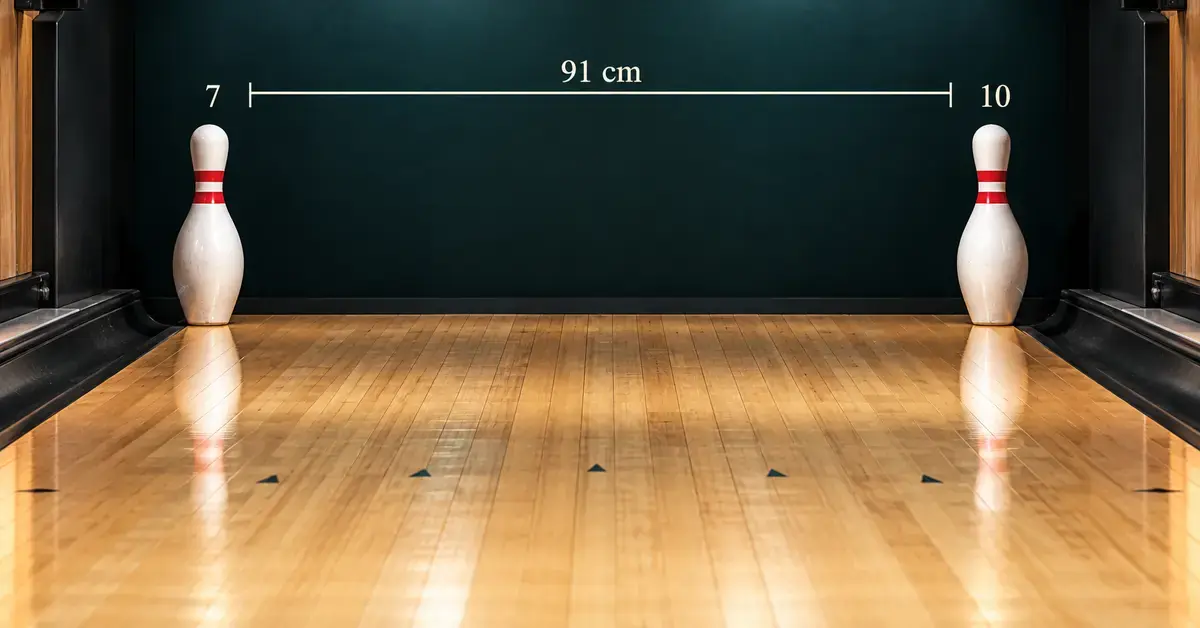
The 7-10 split is the two back corner pins left standing on opposite sides of the lane after your first ball — the single most recognised “impossible” leave in ten-pin bowling. It looks hopeless because it almost is: even professional bowlers pick it up only about once in every 145 attempts. This guide explains exactly what the 7-10 split is, why the lane itself makes it so hard, how the rare conversions actually happen, and how often anyone really makes it — with real numbers rather than lane-side folklore.
Quick Facts
| Also known as | Bedposts, goal posts, snake eyes |
|---|---|
| Pins left standing | The 7 (far left) and the 10 (far right) back corner pins |
| Distance apart | About 36 inches (91 cm), centre to centre — the widest gap on the deck |
| Pro conversion rate | About 0.7%, or roughly 1 in 145 attempts |
| Hardest split overall? | No — the Greek Church (4-6-7-9-10) is converted less often |
| Televised PBA conversions | Four ever: Roth (1980), Stayrook (1991), Mazza (1992), Neuer (2021) |
| Effect on score | None — it is scored as an ordinary spare if made |
What is the 7-10 split in bowling?
A 7-10 split is a leave in which only the 7 pin and the 10 pin remain standing after your first delivery. The pins are numbered 1 to 10 from front to back, and the back row holds the 7, 8, 9 and 10. The 7 sits in the far left corner and the 10 in the far right corner, so a 7-10 leaves the two pins that are physically as far apart as the deck allows, with nothing in between.
It earns a string of nicknames on league night — “bedposts”, “goal posts” and “snake eyes” among them — because the two lone pins stand like a pair of upright posts at opposite ends of the pin deck. You will find these and dozens of other terms in our ten-pin bowling terms glossary.
What counts as a split, and how is it scored?
A split is any leave where the first ball knocks down the headpin (the 1 pin) but leaves two or more pins that are not next to each other, with a gap between them. The 7-10 is the textbook example. Importantly, a split does not change the score — it is simply a hard spare. If you knock down both remaining pins with your second ball you have made your spare and it is scored exactly like any other spare; if you miss, you are left with an open frame. Scoreboards usually flag a split by circling the first-ball count or showing it in a different colour, which is purely a visual marker. For the full frame maths, see how to score in ten-pin bowling.
Why is the 7-10 split so hard?
The 7-10 split is hard because of basic lane geometry, not because of anything you did wrong on the shot. Two facts about the lane combine to make it close to impossible to hit both pins with one ball.
The pins are as far apart as the lane allows
Ten-pin pins are set 12 inches (about 30 cm) apart from centre to centre. The 7 and the 10 sit at either end of the four-pin back row, three gaps apart, which puts their centres roughly 36 inches (about 91 cm) — a full three feet — from each other. The lane between the gutters is only about 41.5 inches (105 cm) wide, so the two pins are pushed almost to the very edges of the playing surface. A regulation bowling ball is at most 8.5 inches across, far too small to touch both pins at once and nowhere near wide enough to bridge the gap between them.
Your ball can only reach one pin
Because the pins hug opposite gutters, your ball can realistically strike only one of them. To push a pin sideways across the full width of the lane, you would need to clip it on its outer edge — but that part of the pin sits so close to the gutter that a ball aimed there usually drops into the channel before it ever reaches the pin. That leaves you relying on the struck pin to travel sideways and knock over its partner, which asks a tall, narrow, 3.5-pound pin to fly cleanly across three feet of maple and still have the energy to topple another pin. It happens, but rarely, and never quite on demand.
How do you convert a 7-10 split?
You convert a 7-10 split by driving one corner pin sideways hard enough that it travels across the lane and knocks down the other — and in practice almost every successful conversion involves a slice of luck as the pin ricochets off the side wall or out of the pit. There is no technique that makes it a high-percentage shot, but there is a correct way to give yourself the best chance.
The idea: send one pin into the other
The goal is to hit your chosen corner pin thin on its inside-facing edge so the pin is flung flat and fast toward the opposite pin, rather than being knocked straight backwards. A heavy, fast, fairly straight ball that strikes the pin on the side nearest the centre of the lane will tend to kick it sideways. On its own, though, a pin sliding the whole way across open boards and still having enough energy left to topple a second pin is, as the United States Bowling Congress puts it, incredibly rare.
What actually makes it: the pin bounce
In reality, the conversions you see are made when the struck pin rebounds — off the flat kickback wall beside the pins, or bouncing back out of the pit behind the deck — and clatters into the standing pin from behind or the side. This is why speed matters: you want the corner pin hit hard enough to travel and bounce. It is also why the shot is so unpredictable. Many modern pinsetters fit curtains and guards that stop pins flying back out of the pit, which can make the lucky bounce even harder to produce than it was decades ago.
Right-handers versus left-handers
Right-handed bowlers usually attack the 10 pin (their natural corner on the right) and try to drive it left across the lane into the 7; left-handers usually attack the 7 pin and try to send it right into the 10. The thinking is that you have more control hitting the corner on your dominant side flush and fast. Whichever pin you choose, throw it firmly and keep the ball as straight as you can — this is not a shot for a big hook. If you are still learning to curve the ball for strikes, our guide on how to throw a hook in ten-pin bowling explains when hook helps and when a straighter ball is better.
Hardest Splits Compared
| Split | Pins left | Approx. pro conversion rate | Notes |
|---|---|---|---|
| Baby split | 2-7 or 3-10 | High (routinely made) | Pins are close together; the ball can fit between them |
| Big Four | 4-6-7-10 | Just over 1% | More pins, but the cluster can chain-react |
| 7-10 split | 7-10 | About 0.7% (1 in 145) | The famous one; two lone corner pins, no helping pins |
| 4-6-7 split | 4-6-7 | About 0.6% | Among the toughest three-pin leaves |
| Greek Church | 4-6-7-9-10 | About 0.2% (1 in 390) | Least converted leave in the PBA data set |
How often is the 7-10 split actually made?
Professional bowlers convert the 7-10 split only about 0.7% of the time — roughly once in every 145 attempts. That figure comes from an analysis of more than 447,000 frames of Professional Bowlers Association (PBA) tournament data, covering complete frame-by-frame records back to 2003. If the best players in the world make it less than once in a hundred tries, a casual bowler should treat a successful 7-10 as a happy fluke rather than a repeatable skill. By comparison, that same data set shows pros clear a single back-row corner pin (such as a lone 7 or 10) around 95% of the time, which shows just how much the distance between two corner pins, not the corner position itself, is the real obstacle.
Who has converted the 7-10 split on television?
Only four bowlers have ever converted a 7-10 split on a nationally televised PBA broadcast, which tells you how rare the shot is even among elite players. In order:
- Mark Roth — 5 January 1980, at the ARC Alameda Open in Alameda, California. The first ever, and the only right-hander of the four.
- Jess Stayrook — 13 July 1991, on the ABC Professional Bowlers Tour telecast. Left-handed.
- John Mazza — 16 February 1992, also on ABC. Left-handed.
- Anthony Neuer — 11 April 2021, during the U.S. Open stepladder finals on ESPN. Left-handed, and at 19 the youngest to do it.
All four conversions were made the same way: by bouncing a pin out of the pit so it rolled back into the standing corner pin. More than four decades separate the first and most recent, underlining that no one has found a way to make this shot reliably.
Is the 7-10 really the hardest split in bowling?
No — despite its fame, the 7-10 is not the single hardest split to convert. The same PBA frame analysis found the so-called “Greek Church” (the 4-6-7-9-10 leave, with pins on both sides and in between) is made only about 0.2% of the time, roughly once in 390 attempts, making it the least-converted leave in the sample. The “Big Four” (4-6-7-10) is actually picked up just over 1% of the time — slightly more often than the 7-10 — because its cluster of pins can chain-react, where the 7-10 offers no helping pins at all. The 7-10 is the most famous split because it is so easy to recognise and so visually hopeless, but a handful of multi-pin leaves are statistically tougher.
Common mistakes when you face a 7-10 split
The most common mistake is wasting energy and emotion on a shot that is a long shot by design. Watch for these:
- Treating it as a skill shot. Even pros make it under 1% of the time. Aim well, throw with conviction, and accept that the result is mostly out of your hands.
- Throwing it soft. A gentle ball cannot drive the corner pin hard enough to travel and bounce. Speed is one of the few things you control here.
- Using a big hook. A sharply curving ball tends to catch the pin at the wrong angle or slide into the gutter early. A firm, straight ball at your chosen corner gives the cleanest contact.
- Aiming for the gap. There is no pin in the middle to hit, so rolling the ball down the centre simply goes between the pins for nothing.
- Letting it wreck the next frame. Chasing a blown split often rushes the following shots. It is one open frame; reset and move on.
How to practise picking up corner pins
You cannot really practise the 7-10 itself, but you can practise the skills that prevent it and the single-pin spares that are far more valuable. Spend your practice converting lone corner pins — the 7 and the 10 — because clearing those cleanly is what separates competent league bowlers from beginners, and doing so reliably stops many splits from forming in the first place. Work on a repeatable approach, consistent ball speed, and hitting the “pocket” (the 1-3 gap for right-handers, the 1-2 for left-handers) so your first ball either strikes or leaves an easy single pin. The better and more consistent your first-ball strike shot, the less often you will ever see a 7-10. If you are new to the lanes, start with the basics in our guides to ten-pin bowling rules and choosing a beginner bowling ball, and brush up on bowling alley etiquette before your next league night.
Sources
Frequently Asked Questions (FAQ)
What is a 7-10 split in bowling?
It is a leave where only the 7 pin and the 10 pin are left standing after your first ball. They sit in the far left and far right back corners of the pin deck, about three feet apart, which is why it is seen as the classic near-impossible spare.
How rare is it to convert a 7-10 split?
Very rare. Analysis of more than 447,000 professional tournament frames shows pros make the 7-10 only about 0.7% of the time, or roughly once in every 145 attempts. For casual bowlers it is best thought of as pure luck rather than a shot you can rely on.
How do you actually make a 7-10 split?
You hit one corner pin hard and fairly straight so it is driven sideways and, usually with help from a bounce off the side wall or out of the pit, rolls across and knocks down the other pin. Right-handers normally attack the 10 and left-handers the 7. There is no high-percentage method.
Is the 7-10 the hardest split to convert?
No. It is the most famous split, but PBA data shows the “Greek Church” (4-6-7-9-10) is converted even less often, about once in 390 attempts. The 7-10 is simply the most recognisable because it leaves two lone pins at opposite ends of the lane.
Who has converted a 7-10 split on television?
Only four bowlers have done it on a televised PBA broadcast: Mark Roth in 1980, Jess Stayrook in 1991, John Mazza in 1992 and Anthony Neuer in 2021. All four did it by bouncing a pin out of the pit into the standing pin.
