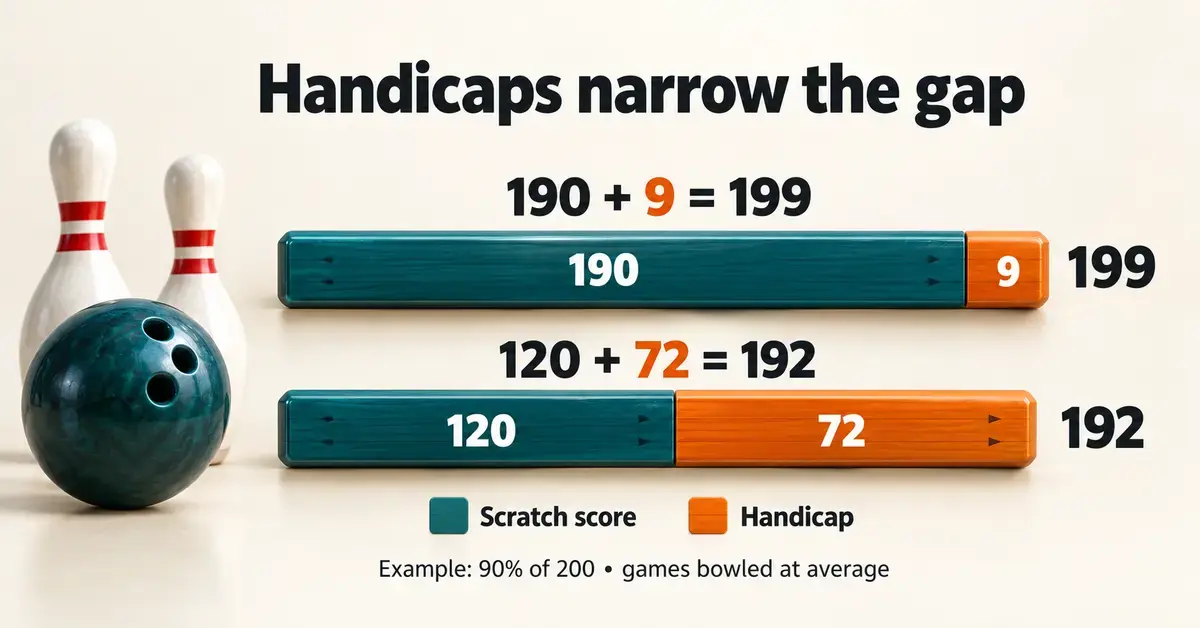
A bowling handicap is a set number of pins added to a bowler’s raw score so that players of very different standards can compete fairly in the same league or tournament. Without it, a bowler who averages 190 would beat a 120-average bowler almost every week, and the result would never be in doubt. The handicap narrows that gap by giving the lower-average bowler a head start measured in pins. This guide explains exactly how a bowling handicap is worked out, how your average is set, the difference between scratch and handicap play, how it works in New Zealand leagues, and the mistakes beginners most often make.
Key Points
- What it is: extra pins added to your raw score so bowlers of different standards compete fairly.
- The formula: Handicap = (Basis Score − Your Average) × Handicap Percentage, rounded down to whole pins.
- Typical settings: basis score 200, 210 or 220; percentage 80–100%, with 90% the most common.
- Your average: total pins ÷ games bowled, usually established over at least 21 games; it updates all season.
- Zero, never negative: if your average is at or above the basis, your handicap is 0 — pins are never subtracted.
- Mostly ten-pin: lawn bowls uses a different, club-set head-start system instead.
What is a bowling handicap?
A bowling handicap is a pin allowance added to your actual score every game to even out differences in ability. It is almost always used in ten-pin bowling leagues and handicap tournaments, where the aim is for every member to have a realistic chance of winning regardless of how long they have bowled.
The idea is simple: the further your average sits below an agreed benchmark, the more pins you are given. A strong bowler who already scores near the benchmark receives few pins or none, while a newer bowler well below it receives a generous allowance. When the handicap is added to each bowler’s raw pinfall, the two end up competing on much closer terms. Your final figure each game is your scratch score (the pins you actually knocked down) plus your handicap.
Handicapping rewards improvement and consistency rather than raw power. A bowler who lifts their game above their average on the night can win even against far more skilful opponents, which is a big part of why club and social leagues use the system.
How is a bowling handicap calculated?
A bowling handicap is calculated with one standard formula used across almost all handicap leagues:
Handicap = (Basis Score − Your Average) × Handicap Percentage
Any fraction is then dropped so the handicap is a whole number of pins (for example, 47.7 becomes 47). The two values the league sets are the basis score and the percentage. Your average is the one part that is personal to you. Each piece is explained below.
The basis score
The basis score (also called the base or benchmark) is a fixed target the league chooses at the start of the season. Common basis scores are 200, 210 and 220, and the figure is written into the league’s rules or bylaws. The basis score should sit above the highest average in the league so that every bowler, even the best, is working from a number they are below. A higher basis gives every lower-average bowler a larger cushion.
The handicap percentage
The handicap percentage decides how much of the gap between the basis score and your average you actually receive. It usually falls between 80% and 100%, and 90% is the most common choice in modern competition.
The percentage matters more than beginners expect. At 100%, the handicap closes the gap almost completely, so on an average night most bowlers finish on a similar adjusted score and the result turns on who over-performed that day. At 80%, the better bowler keeps part of their edge, so skill still counts for more. Leagues that want a purely social, anyone-can-win feel lean towards 100%; leagues that want to reward ability lean lower.
A worked example
Imagine a league using a basis score of 220 and a handicap of 90%.
- A bowler averaging 150 gets (220 − 150) × 0.90 = 63 pins of handicap per game.
- A bowler averaging 190 gets (220 − 190) × 0.90 = 27 pins per game.
Now suppose both bowl a 170 game. The 150-average bowler scores 170 + 63 = 233, while the 190-average bowler scores 170 + 27 = 197. The lower-average bowler wins the frame of the night, because 170 was a far better game relative to their usual standard. That is exactly what the handicap is designed to do. If your average is already at or above the basis score, your handicap is zero — you never receive a negative handicap that would subtract pins.
How is your bowling average set?
Your average is the total number of pins you have scored divided by the number of games you have bowled, and it is the figure that feeds the handicap formula. It is recalculated as the season goes on, so your handicap changes with your form.
Under United States Bowling Congress (USBC) rules, which most leagues worldwide follow in principle, an established average is generally based on a minimum of 21 games in a season. Until you have bowled that many, the league needs a fair starting point:
- Returning bowlers usually start the season on their average from the previous season (often called a book average) until enough new games are recorded.
- Brand-new bowlers with no history are given an entering average under the league’s rules, or bowl scratch (no handicap) until they have enough games to establish one — many events use a scratch figure such as 220 for anyone without a qualifying average.
- Re-rating: USBC rules require that a current average which finishes well above the previous season’s figure (10 or more pins, under the relevant rule) is reported and used, so a bowler cannot carry an artificially low handicap after improving sharply.
Because your average rises as you improve, your handicap shrinks over time — a sign you are getting better, not a penalty. It is each bowler’s responsibility to check their own average is correct; using a lower average than you are entitled to can disqualify a score.
Scratch vs handicap bowling: what is the difference?
Scratch bowling means no handicap is applied: bowlers compete on raw pinfall alone, so the highest actual score wins. Handicap bowling adds each bowler’s pin allowance to their raw score first, then compares the adjusted totals. The choice shapes who the competition suits.
Scratch vs Handicap
| Feature | Scratch bowling | Handicap bowling |
|---|---|---|
| Score that counts | Raw pinfall only | Raw pinfall plus pin allowance |
| Who tends to win | The most skilful bowler | Whoever beats their own average most |
| Best suited to | Experienced, high-average bowlers | Beginners, social and mixed-ability leagues |
| Allowance applied | None (0%) | Yes, from the handicap formula |
| Typical use | Scratch leagues and tournament scratch divisions | Most club and social leagues; graded divisions |
Most beginners and social players start in handicap leagues, because they can be competitive straight away. Scratch leagues and scratch tournament divisions are where stronger, more experienced bowlers go once they want to test themselves without an allowance. Many tournaments run both a scratch and a handicap division from the same entry list so there is a place for everyone.
How do handicaps work in teams and for absent bowlers?
In team formats, each member of the team has their own individual handicap based on their own average, and the handicaps are added together to give a team handicap for the match. A team of lower-average bowlers therefore carries a larger combined allowance than a team of strong bowlers, keeping team-versus-team matches close.
Leagues also need a rule for when someone cannot make it. This is usually handled with an absentee or “blind” score: the missing bowler is credited with a set figure (often their average minus a fixed number of pins) so the team is neither unfairly helped nor badly punished. The exact method is written into each league’s rules, so it is worth reading the bylaws rather than assuming. If you are weighing up joining, our guide on how to join a ten-pin bowling league in New Zealand walks through what to expect on your first nights.
How are handicaps used in New Zealand?
In New Zealand, ten-pin handicaps work the same way as the international system, and they appear in two main places: weekly club leagues and graded tournament divisions. Club leagues almost all run on handicap so that casual and serious members can share a night and a result that matters to both.
Tournaments often split entries into a scratch division and a graded (handicap) division, with an average cap controlling who can enter the graded side. Across Australasian events, a graded division commonly sets handicap at 100% of a basis such as 200 or 230, and limits entry to bowlers below a stated average (for example, under 180, or 200 and below) so that it stays a genuine development category. The precise basis, percentage and cap vary from event to event, and are always published in the entry form — verify them against the specific tournament’s rules before entering. Tenpin Bowling New Zealand (TBNZ) is the national body that sanctions these competitions. You can read more about everyday pricing in our guide to how much ten-pin bowling costs in New Zealand, and about the frame-by-frame maths in how to score in ten-pin bowling.
Do lawn bowls have handicaps too?
Lawn bowls does use handicaps, but the system is different from ten-pin and far less standardised. There is no single national pin-style formula; instead, handicap events are run by individual clubs and usually work as a head start rather than an adjustment made after play.
In a handicap singles game — often played to a “100 Up” format — each player is given a handicap number based on their grade, and the weaker player starts the game on a set number of points, or the stronger player starts on minus. For example, if the gap between two players’ handicaps is ten, the lower-graded bowler might begin on 10 before a bowl is sent down. The scoring during the game itself follows normal lawn bowls rules; only the starting position is adjusted. Because each club sets its own grades and conversion, the details differ from club to club. To understand the underlying scoring these events build on, see our guides to how to score lawn bowls and the main lawn bowls formats.
Common mistakes with bowling handicaps
Handicaps are simple once you have seen the formula, but a few misunderstandings come up again and again:
- Thinking a bigger handicap is a good thing. A large handicap means a low average, not an advantage worth keeping. As you improve, your handicap falls — that is the point.
- Confusing scratch and handicap totals. League sheets usually show both. Your scratch game is what you bowled; your handicap total is what counts for the standings. Reading the wrong column leads to arguments.
- Assuming the handicap never changes. It is recalculated from your running average, so it moves through the season, especially in your first weeks as your average settles.
- Expecting a negative handicap. If your average is above the basis score, your handicap is simply zero. Standard handicaps do not subtract pins from strong bowlers.
- Not checking your own average. Using an average that is too low can disqualify a score. It is each bowler’s job to confirm the figure on the sheet is right.
- Comparing across leagues. A handicap is only meaningful within the league that set the basis and percentage. A 40-pin handicap in one league is not the same as 40 in another.
Sources
Frequently Asked Questions (FAQ)
What is a good bowling handicap?
There is no single “good” handicap, because the number only reflects how far your average sits below the league’s basis score. A smaller handicap means a higher average, so as you improve your handicap naturally gets smaller. Rather than chasing a particular handicap figure, aim to raise your average — the handicap looks after itself.
How do I calculate my bowling handicap?
Subtract your average from the league’s basis score, then multiply by the handicap percentage, and drop any fraction. For example, with a 210 basis, a 160 average and 90%, the handicap is (210 − 160) × 0.90 = 45 pins. You add those 45 pins to your raw score each game.
What is the difference between scratch and handicap bowling?
Scratch bowling compares raw scores with no allowance, so the highest actual pinfall wins and it favours the strongest bowlers. Handicap bowling adds each player’s pin allowance before comparing totals, giving bowlers of all standards a realistic chance. Most social and club leagues use handicap; scratch divisions are for experienced players.
Does my handicap change during the season?
Yes. Your handicap is worked out from your running average, which updates as you bowl more games. Early in the season it may move a lot while your average settles, then steady as you build up games. If you improve sharply, the rules require your higher average to be used, which lowers your handicap.
Do lawn bowls use the same handicap system as ten-pin?
No. Ten-pin handicaps add pins to your score using a basis-and-percentage formula. Lawn bowls handicaps, where clubs run them, usually work as a head start — the weaker player begins the game on a set number of points based on their grade. There is no single national lawn bowls formula; each club sets its own.
