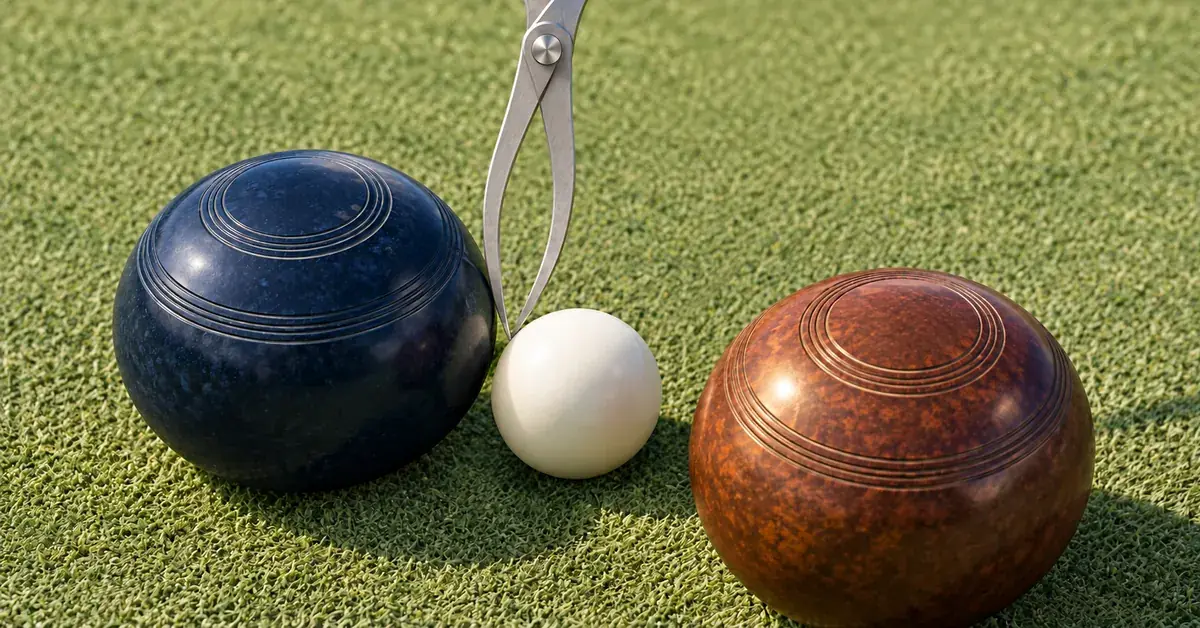
When an end of lawn bowls finishes with two bowls almost touching the jack, the naked eye often cannot tell which one is closer — and that is exactly when you need to measure. Measuring is the agreed, rule-based way of deciding how many shots a team has scored, and knowing how to do it turns a tense standoff into a fair result everyone accepts. This guide explains when you are allowed to measure, how shots are counted, which tools suit which gap, and how to settle the tightest close calls under the current World Bowls laws, with New Zealand context throughout.
A quick note on terms used below: the jack is the small white target ball; the head is the cluster of bowls and jack at the far end; a shot is one scoring bowl; an end is one full round of play, bowled in one direction; and a toucher is a bowl that touched the jack on its way down and so stays live even in the ditch.
When can you measure in lawn bowls?
You can only measure once the end is complete — that is, after the last bowl of the end has been delivered and every bowl has come to rest. Measuring a head while bowls are still moving, or before the final bowl is played, is against the laws and unfair, because a late bowl can change which bowls are shot. Wait until the head is settled, then begin.
In friendly and club play, measuring is usually done by the two players responsible for the head — the thirds (also called vices) in a four, or the players themselves in singles and pairs. Nobody should touch or remove a bowl until the count has been agreed, because once a bowl is moved it cannot reliably be put back. If a measure looks likely, surplus bowls that clearly do not count can be lifted away first, but only by agreement and only when they play no part in the decision.
Key points
- Measure only when the end is complete — every bowl must have come to rest first.
- A bowl scores for each of your bowls closer to the jack than the opponent’s nearest bowl.
- Measure between nearest points, always anchored at the jack.
- Secure leaning bowls with wedges before you measure anything.
- Match the tool to the gap: feeler gauges for near-touching, callipers for short gaps, a flexible measure for the rest.
- Equidistant bowls score nothing — the next nearest bowl decides, or the end is tied.
- If in doubt, don’t move the bowls — call an umpire, whose decision is final.
How are shots counted in lawn bowls?
A bowl scores one shot for every bowl of yours that is closer to the jack than the opponent’s nearest bowl. In other words, you find the other team’s best bowl, and then count how many of your bowls beat it. If your two bowls are both nearer the jack than any of the opposition’s, you score two shots; if only one is nearer, you score one. Only one team scores on each end.
This is why measuring usually comes down to a single comparison: your closest bowl against their closest bowl. Everything else is counted around that one decision. For the full picture of ends, shots and how a game is won, see our guide to how scoring works in lawn bowls.
Measurements are always taken between the nearest points of the jack and the bowl — the closest part of the bowl’s surface to the closest part of the jack — not from the centre of either. Because a lawn bowl is not a perfect sphere (it is flattened and carries a built-in curve called bias), the nearest point can sit slightly off to one side, so line the measure up carefully.
How to measure a close end step by step
Measuring is a short, careful routine, and doing the steps in order is what keeps it fair. Rushing or leaning on the head is what causes arguments. Here is the sequence used on greens across New Zealand.
1. Secure the head before you touch anything
Steady any leaning bowls before measuring, because a bowl resting on its edge or propped against another can topple the moment you disturb the air around it. Umpires and experienced players use small wedges to hold a leaning bowl or the jack in place. If one bowl is leaning on the bowl you need to measure, wedge the measured bowl first, then remove the one leaning on it — never the other way around.
2. Measure from the jack to the nearest bowl
Always anchor the measure at the jack and run it out to the bowl, not the reverse. Position yourself at right angles to the line between jack and bowl, work from the more open side, and keep your head directly above the line so you are not reading it at an angle. Measure the bowl that looks closest first, then the opponent’s closest bowl, and compare the two.
3. Count the remaining shots
Once the first shot is agreed, the team holding it measures its other bowls against the opponent’s nearest bowl. Each of your bowls that is closer than their best bowl adds one more shot. Do not move any bowl until both sides agree the count — if you remove a bowl too early and the count is questioned, there is no way to re-check it.
What equipment do you use to measure in lawn bowls?
The right tool depends entirely on the size of the gap you are measuring, from a few millimetres up to a couple of metres. Using the wrong one — a flexible tape on a near-touching bowl, for example — is the quickest way to nudge the head and spoil the measure. The table below sets out the main options and the gaps they suit.
Measuring tools compared
| Tool | Best for gaps of | How it is used |
|---|---|---|
| Feeler gauges | About 0–10 mm (near touching) | Thin metal blades slid into the gap; used with a white card under the contact point to decide if a bowl touches the jack. |
| Callipers | About 10–200 mm | Sprung arms set narrow then widened gently, lowered in from the top with the setting kept fixed. |
| Flexible box / string measure | About 20 cm – 3 m | Spring-loaded cord or tape; pointer held against the jack and run out to the bowl. |
| 30-metre tape | Long distances / ditch | Used with an assistant holding the jack end for measures beyond a flexible measure’s reach. |
| Wedges | Any (support, not distance) | Small plastic wedges steady a leaning bowl or the jack so the measure is not disturbed. |
Flexible box or string measure
A flexible measure is the everyday workhorse for most close ends. It is a spring-loaded cord or tape in a small case (a “box measure” or “bullet measure”) with a hooked or pointed end that rests against the jack while the cord extends to the bowl. It handles the common middle range — roughly 20 centimetres out to about 3 metres — and is what you will reach for most often at club level. Hold the pointer still against the jack and do not waggle it, and never let the pointer touch a bowl it should not reach.
Callipers
Callipers settle the very short gaps a flexible measure cannot read accurately. They look like a pair of sprung arms that you set narrower than the gap, then widen gently until they just span the distance between jack and bowl. Lower them in from the top, keep the setting fixed while they sit between the two points, and make any adjustment away from the head. Callipers suit gaps from around a centimetre up to roughly 200 millimetres or so.
Feeler gauges
Feeler gauges decide the tightest calls of all — when a bowl looks as if it might be touching the jack. They are a fan of thin metal blades, like the ones a mechanic uses, covering gaps from zero up to about 10 millimetres (one centimetre). To see the result clearly, slide a strip of white card or plastic under the contact point first, then try the blades: if even the thinnest blade will not pass, the bowl is effectively against the jack.
Wedges and other aids
Wedges are not for measuring distance but for holding the head still so the measure is honest. A set of small plastic wedges steadies a leaning bowl or the jack. For long measures beyond a flexible measure’s reach, umpires carry a 30-metre tape and use an assistant to hold the jack end. Bowls New Zealand publishes an approved-equipment list for officials, so umpire kits meet a common standard at graded events.
Measuring touchers and bowls in the ditch
A toucher in the ditch is still live and can still be the shot, so it must be measured like any other bowl. A toucher is a bowl that touched the jack during its original course; it is marked with chalk and remains in play even if it finishes in the ditch beyond the green. Before you decide the shot, check that any bowl in the ditch claimed as a scorer was properly marked as a toucher — an unmarked bowl that runs into the ditch is dead and counts for nothing.
Measuring to a bowl or jack in the ditch is awkward, so take extra care: never put a foot, knee or hand into the ditch, work from the bank above, and get an assistant to steady the measure if needed. If the jack itself has been knocked into the ditch but stayed within the rink boundaries, it is still live and the end is played out as normal.
What happens when two bowls are equidistant?
When the two nearest opposing bowls are exactly the same distance from the jack, neither one scores. You then look to the next closest bowl: if one team has the next nearest bowl, that team scores from there. If no other bowls are in contention, the end finishes with no score — recorded as a tied end that still counts as an end played, not replayed.
To test whether bowls really are equidistant, an umpire will often rotate the measure around the jack from one bowl to the other, or turn the jack slightly, to see if a tiny difference appears. Only when there is genuinely no measurable difference is the end declared tied. This is different from a dead end, which happens when the jack is driven out of bounds; a dead end is replayed, while a tied end is not.
Who measures, and how disputes are settled
At club level the players measure their own ends, and the skip has the final say for the team until the head is cleared. If the two measurers cannot agree, the two skips come in to look. If they still disagree, the rule is simple and strict: do not move the bowls, and call an umpire. The umpire’s measure and decision are final.
In graded and championship play a neutral marker (in singles) or an appointed umpire handles close measures, using approved equipment and the procedure above. Either way, the principle is the same — the bowls stay exactly where they are until the measure is complete and the result is agreed. For how these roles fit into the wider game, see our beginner’s guide to the rules of lawn bowls and the national body, Bowls New Zealand.
Common mistakes when measuring
Most measuring disputes come from avoidable errors rather than genuinely impossible calls. Knowing the usual mistakes helps you avoid them and spot them when an opponent slips up.
- Measuring before the end is complete. Starting while a bowl is still moving, or before the last bowl is bowled, can give a false result. Wait until everything has come to rest.
- Moving a bowl too soon. Once a bowl is lifted it cannot be re-measured, so never remove one until both sides agree the count.
- Not securing leaning bowls. A bowl propped on its edge can fall the instant you touch the head. Wedge it first.
- Measuring from the bowl instead of the jack. Always anchor the measure at the jack and run it out to the bowl.
- Using the wrong tool for the gap. A flexible tape on near-touching bowls will nudge them; use callipers or feeler gauges for short gaps.
- Walking through the head. Step around the bowls and jack, not between them, so you do not knock anything out of place.
- Forgetting to check touchers. A bowl in the ditch only counts if it was marked as a toucher; confirm the mark before scoring it.
If you are still learning the terms that come up in a measure — jack, head, toucher, draw and the rest — our lawn bowls glossary explains them in plain English, and the step-by-step guide to playing lawn bowls shows how an end is played from the mat to the count.
Sources
Frequently Asked Questions (FAQ)
When are you allowed to measure in lawn bowls?
You may only measure once the end is complete — after the last bowl has been delivered and every bowl has come to rest. Measuring while bowls are still moving, or before the final bowl is played, is not allowed, because a later bowl could change which bowls are closest to the jack.
Do you measure from the jack or from the bowl?
Always measure from the jack out to the bowl, taking the distance between the nearest points of each. Anchoring the measure at the jack keeps every comparison consistent and makes it easier to read the result squarely from above.
What tool do you use when two bowls are almost touching the jack?
Use feeler gauges for the tightest gaps, from touching up to about 10 millimetres. Slide a strip of white card or plastic under the contact point first so you can see clearly, then try the thin blades. For slightly larger short gaps, callipers are the right choice; a flexible measure is for longer distances.
What happens if two opposing bowls are the same distance from the jack?
If the two nearest opposing bowls are equidistant, neither scores. The next closest bowl then decides the shot, and if no other bowls are in contention the end is tied with no score. A tied end still counts as an end played and is not replayed.
Who settles a measuring dispute?
If the measurers cannot agree, the two skips look at the head; if they still disagree, no bowl is moved and an umpire is called. The umpire measures with approved equipment and their decision is final. Never move the bowls while a measure is in dispute.
