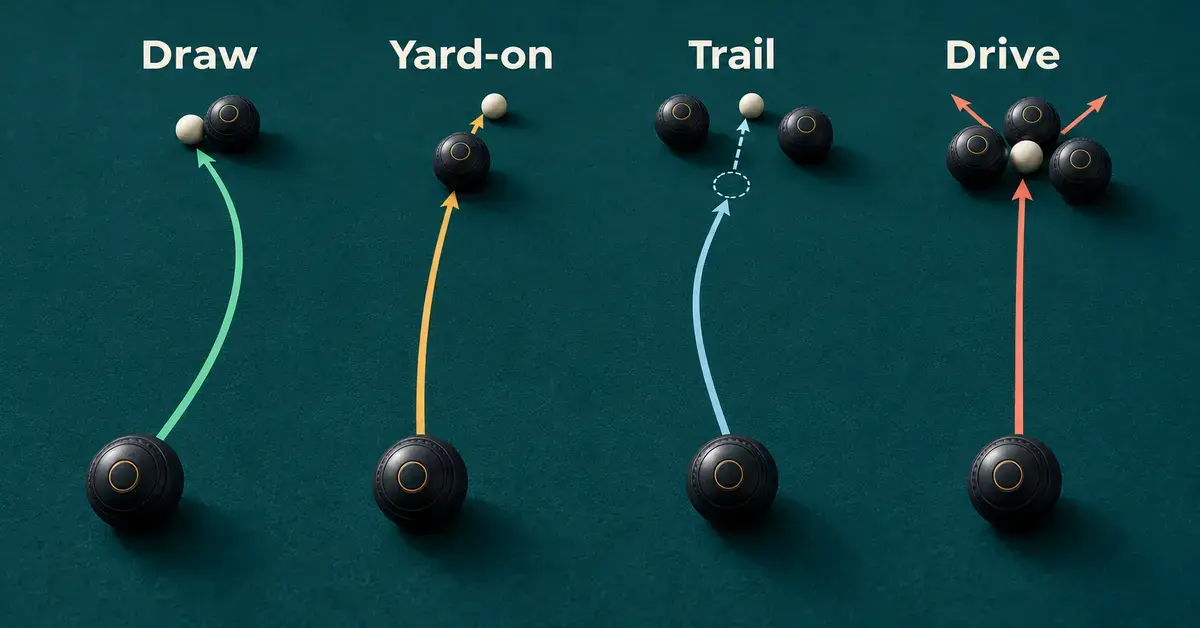
A shot in lawn bowls is the type of delivery you choose for a particular bowl — how much weight (speed) you put behind it and what you are trying to make it do. Beginners often think the game is just rolling a bowl gently towards the jack, but every experienced player picks from a small family of shots, each with its own weight, line and purpose. This guide explains the main lawn bowls shots — the draw, the drive, the yard-on and the trail — plus the running shot, the rest, the block and the wick, so you can recognise them on the green and start adding them to your own game.
Key Points
- Draw — least weight, most curve; settles the bowl at the jack. The shot you play most.
- Yard-on — about a yard of extra weight to nudge the jack or push a bowl out.
- Trail — controlled weight that carries the jack back onto your own bowls.
- Drive — full pace, almost straight; smashes the head but high risk.
- Running, rest, block and wick — weighted and tactical variations for clearing, replacing, guarding and deflecting.
- Rule of thumb: more weight means less curve, so heavier shots aim narrower and gentler shots aim wider.
What is a “shot” in lawn bowls?
A shot is a single bowl delivered with a chosen combination of weight and line. Weight is how hard you send the bowl, which decides how far it travels. Line is the path you aim along; because every bowl is weighted on one side, it curves — this built-in curve is called the bias, and reading it is central to every shot you play.
The name of a shot describes its intention, not a different technique. You still deliver every shot off the mat with the same basic action you learn in the how to play lawn bowls basics; what changes is how much weight you apply and where you aim. More weight makes the bowl travel further and curve less, because the bias has less time to pull it in. Less weight lets the bias work fully, giving the bowl its biggest curve as it slows near the end of its journey.
Understanding this trade-off between weight and curve is the key to the whole repertoire below. A gentle shot bends a lot and finishes near the jack; a hard shot runs almost straight and is used to hit something.
The draw shot: the foundation of lawn bowls
The draw is the shot you will play more than any other, and it is the first one to master. The aim is simple: deliver the bowl with just enough weight so that it curves in along the bias and comes to rest as close as possible to the jack, or to another target spot chosen by your skip.
Because the draw uses the least weight of any shot, it also uses the most bias. You aim wide of the jack — out towards the edge of the rink — and let the curve bring the bowl back in. On a faster green the bowl runs further for the same effort and needs a wider line; on a slow, heavy green you aim narrower and push a little harder. Learning to repeat a good draw on whatever green you are playing is what separates steady bowlers from the rest.
The draw is also the safest shot. Even a draw that finishes a little short or wide usually stays in play and in the head (the cluster of bowls around the jack), where it may still count or help your team. For that reason, when in doubt, good players draw.
The drive (firing shot): power with high risk
The drive is the hardest, fastest shot in bowls, delivered at almost full pace to smash into the head and knock bowls or the jack out of position. It is also called the firing shot, a fire or a strike. Because the bowl travels so quickly, the bias has very little time to act, so a drive runs on an almost straight line rather than curving.
Players usually drive when they are losing an end and a gentle shot cannot rescue it — for example, to blast the opponent’s close bowls away, to knock the jack out of a crowded head, or to push the jack into the ditch where your own back bowls are waiting. A successful drive can turn a losing end into a winning one in a single delivery.
The trade-off is risk. A drive that misses can finish well past the head, run off the end of the rink, or drop into the ditch and be dead. It can also scatter the head in the opponent’s favour. There are rules worth knowing: if your drive sends the jack into the ditch but it stays within the rink boundaries, the jack is still live and play continues; if the jack is driven wholly outside the rink, the end becomes a dead end and is replayed in the same direction. A bowl that touches the jack on its way through becomes a toucher and remains in play even if it finishes in the ditch, so a well-judged drive can leave a scoring bowl in the ditch itself.
The yard-on shot: controlled weight
The yard-on sits between the draw and the drive: it is played with enough extra weight to carry the bowl roughly a yard (about a metre) past the jack or past another target in the head. Some players call it a metre-on or simply a “weight” shot. Because it carries more weight than a draw, it curves less and needs a narrower line.
The point of a yard-on is to move something gently without the chaos of a full drive. Typical uses are pushing an opponent’s bowl off the jack, nudging the jack a short distance towards your own bowls, or removing a single bowl that is just blocking your draw. It is far more controlled than a drive and much less likely to wreck the head or run away into the ditch.
The yard-on is a key “conversion” shot — a shot that changes a shared or losing head into a winning one — and learning to play it reliably is a big step up from only being able to draw.
The trail shot: moving the jack to your bowls
The trail shot hits the jack with carefully controlled weight so that the jack is carried — or “trailed” — towards one or more of your own bowls sitting at the back of the head. Instead of drawing your bowl to the jack, you bring the jack to your bowls.
It is a precise form of weighted shot, usually needing a yard-on or a touch more. A good trail can score several shots at once: if you have two or three bowls waiting behind the jack and trail the jack back onto them, you can win an end you were losing. Trailing the jack into the ditch is also legal, provided the jack stays inside the rink boundaries, and any of your bowls that became touchers can score there too.
The trail is a tactical, high-value shot, but it demands good weight control: too little and you simply tap the jack a few centimetres; too much and you drive it past your own back bowls.
Other weighted and tactical shots
Beyond the four main shots, several more are worth knowing. They are variations on weight and line rather than different skills.
The running shot (ditch-length)
The running shot is like a yard-on but played with more weight — enough to send the bowl several yards on, often finishing near or in the ditch. It is used to clear bowls out of the head or to run the jack a longer distance. It carries more risk than a yard-on because the extra pace makes the result harder to predict, but less than a full drive.
The rest shot (wrest)
The rest shot, sometimes written as a wrest, uses controlled weight to push an opponent’s bowl out of a good position while your own bowl comes to rest in roughly the spot it vacated. In effect you replace their bowl with yours. It needs fine judgement of weight — usually a little more than a yard-on — and is one of the more satisfying shots to pull off well.
The block or guard
The block, also called a guard, is a bowl played deliberately short of the head to sit in the opponent’s path. Its job is not to score but to make the line to the jack as awkward as possible, so the opposition cannot draw or drive cleanly. A well-placed block can protect a winning bowl by forcing the other team to find a different, harder line.
The wick
The wick is a more advanced shot where you aim to clip, or glance off, another bowl on purpose so that the contact deflects your bowl towards the jack. It relies on using a bowl already in the head as a ricochet. Wicks happen by luck often enough, but playing one deliberately takes experience and a good eye for angles.
How weight and line work together
Every shot above is a balance of two things: how much weight you use and how wide you aim. Get one wrong and the shot fails, even if the other is perfect. The core rule is that more weight means less curve, so heavier shots are aimed nearer the target and gentler shots are aimed wider.
Green speed changes all of this. Green speed is measured in seconds — roughly the time a bowl takes to travel the length of the rink — and a faster green (a higher number of seconds) makes every shot run further and curve more for the same effort. New Zealand clubs play on both fast coastal greens and slower, heavier surfaces, so part of learning shots is adjusting your weight and line to the green in front of you, as covered in the lawn bowls rules and basics.
Lawn bowls shots compared
The table below sums up the main shots by how much weight they use, what they are for and how risky they are. Use it as a quick reference, then practise each one on the green.
Shot Comparison
| Shot | Weight | Main purpose | Risk |
|---|---|---|---|
| Draw | Minimum — just reaches the jack | Settle close to the jack or a target spot | Low |
| Yard-on | About a yard past the target | Nudge the jack or push a bowl out, staying in the head | Medium |
| Trail | Controlled, a yard-on or a little more | Carry the jack back onto your own bowls | Medium |
| Running shot | Several yards on, ditch length | Clear bowls or run the jack a longer distance | Medium–high |
| Rest (wrest) | Controlled, more than a yard-on | Replace an opponent’s bowl with your own | Medium |
| Drive | Full pace, almost straight | Smash the head or remove the jack | High |
| Block (guard) | Short of the head | Obstruct the opponent’s line to the jack | Low |
Common mistakes when playing shots
Most shot errors come from choosing the wrong shot or misjudging weight, not from a broken technique. Watching for these mistakes will improve your results faster than anything else.
- Using too much weight. Beginners almost always bowl too heavy. A bowl sent even slightly hard loses its curve and sails past the jack. If in doubt, play a touch lighter and let the bias work.
- Reaching for the drive too soon. The drive is dramatic but low-percentage. Driving when a draw or yard-on would do often scatters the head in the opponent’s favour.
- Ignoring the line for the weight. A shot needs the right line and the right weight together. Perfect weight on the wrong line, or the wrong hand, still misses.
- Forgetting the back of the head. Players focus only on drawing to the jack and leave nothing behind it. Bowls at the back save ends when the jack is moved or trailed.
- Never using a guard. Beginners rarely think to block a line. A simple guard can protect a good bowl and force a mistake.
- Not adjusting to the green. Playing the same line and weight on a fast green as on a slow one guarantees you are wide or short all day.
Which shots should a beginner learn first?
Beginners should spend almost all their early practice on the draw. It is the shot used most, it builds the feel for weight and bias that every other shot depends on, and it is the safest option in a game. Until you can draw reasonably close most of the time, the weighted shots will be hit-and-miss.
Once the draw is reliable, add the yard-on next, because controlled weight is the basis of the trail, the rest and the running shot. Leave the drive until last — it is the easiest to attempt but the hardest to use well, and over-driving is a common beginner habit. The number of bowls you deliver each end depends on the format you play, so you will get more shot practice in singles and pairs than in fours. Most New Zealand clubs run free coaching that will help you groove these shots in the right order.
Sources
Frequently Asked Questions (FAQ)
What is the most important shot in lawn bowls?
The draw is the most important shot. It is the delivery you play most often, it is the safest option because even a slightly off draw usually stays in the head, and it builds the feel for weight and bias that every other shot relies on. Mastering the draw should be the first goal of any new bowler.
What is the difference between a yard-on and a drive?
The difference is weight. A yard-on uses just enough extra weight to carry the bowl about a yard past the target, so it stays controlled and curves a little. A drive is played at almost full pace, runs on an almost straight line because the bias has no time to act, and is meant to smash the head apart. The yard-on is precise; the drive is powerful but high-risk.
What happens if a drive sends the jack into the ditch?
If the jack is driven into the ditch but stays within the rink boundaries, it remains live and the end continues, with any touchers in the ditch still able to score. If the jack is driven wholly outside the rink, the end becomes a dead end and is replayed in the same direction. Club play in some areas may re-spot the jack instead, so check your local rules.
What is a toucher and how does it relate to these shots?
A toucher is a bowl that touches the jack during its delivery before coming to rest. It stays in play even if it finishes in the ditch, and it is marked with chalk once it stops. Touchers matter for weighted shots like the drive and the trail, because a bowl that contacts the jack and ends up in the ditch can still count towards the score.
Which shot should a beginner practise first?
Practise the draw first and keep practising it. It teaches weight control and how to read the bias, which every other shot depends on. Once your draw is reliable, add the yard-on for controlled weight, then the trail and rest shots, and leave the drive until last because it is the easiest to attempt but the hardest to use well.
