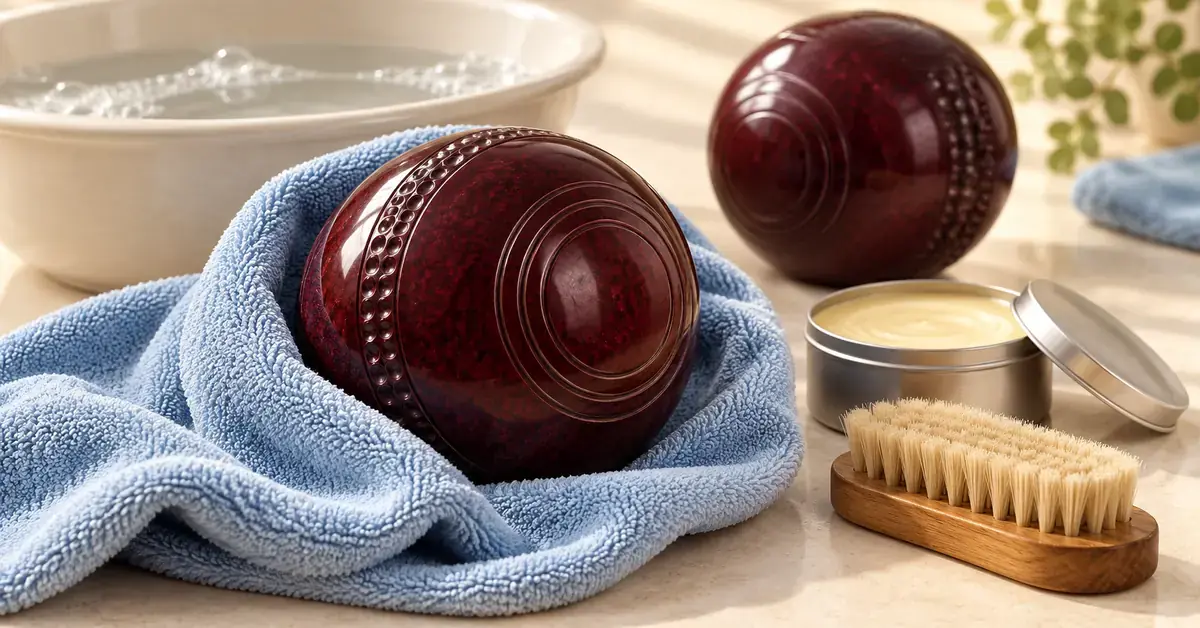
A well-kept set of lawn bowls rolls more predictably, grips better in the hand and lasts for decades — and keeping them that way takes only a few minutes of care. Modern bowls are made from a hard composite resin rather than the old lignum wood, so they are tough, but they still pick up grass, grit, ditch marks and a slippery film over a season. This guide explains exactly how to clean lawn bowls after a game, how to give them an occasional deeper clean, how to restore grip, and how to store them so the surface and the all-important bias stay in good order.
Key Points
- Wipe after every game: use a soft microfibre cloth, dry off any moisture, and clean grit from the grip grooves with a soft brush or wooden pick — never a metal tool.
- Deep clean occasionally: wash in warm water with a little mild dishwashing liquid, rinse, dry fully, then re-polish.
- Restore grip: apply a small amount of grip polish or wax (such as Henselite Grippo) and buff to a shine.
- Never use: solvents (meths, acetone), dishwashers, harsh detergents or abrasive scourers.
- Store dry and cool: keep bowls in a bag, out of direct sun and hot cars, so the resin does not warp or crack.
- Check the bias: rotate your set to spread wear and have the bias re-tested about every three years to stay within World Bowls limits.
Why cleaning and caring for your lawn bowls matters
Clean bowls are safer, more consistent and longer-lasting than neglected ones. Grass sap, fine grit and a build-up of old polish all change how a bowl feels in the hand and how its surface meets the green. Damp or dirty bowls can turn slippery, which costs you control at the point of delivery. Grit is the bigger long-term enemy: fine sand acts like sandpaper, so a bowl rubbed against gritty cloth or left sitting on sand in the bottom of a bag will wear and scratch far faster than one kept clean.
Caring for your bowls also protects their value and their legality. A matched set holds its bias (the built-in curve that makes a bowl draw) and its resale value far better when it is looked after, and even scratches that look alarming on a new bowl usually have no effect on how it runs. If you are still choosing a set, our guide to the best lawn bowls for beginners covers what to buy before you worry about upkeep.
How to clean lawn bowls after every game
The single most useful habit is a quick wipe-down before your bowls go back in the bag. This takes under a minute and prevents almost all long-term wear. Grass, moisture and grit are easiest to remove while they are fresh, and getting them off stops the slow abrasion that dulls a bowl’s finish.
Wipe them down before they go in the bag
Use a soft, dry microfibre cloth, a towel or a dedicated bowls polishing sleeve. Wipe each bowl all over, paying attention to the running surface — the band around the bowl that actually touches the green. Dry any moisture completely, because a bowl put away wet can develop a slippery film and will not grip as well next time. Henselite, one of the oldest bowls manufacturers, specifically recommends wiping bowls before placing them in a case or bag, and emptying the bag regularly so no sand or grit sits in the bottom.
Clean out the grip grooves
Most bowls have dimples or a machined pattern cut into the surface to help you hold them, and dirt packs into these grooves after outdoor play. Work it out gently with a soft toothbrush or a wooden pick (a toothpick or a wooden skewer is ideal). Never use a metal tool, a pin or anything sharp — it can gouge the surface and damage the running line. A clean grip is the difference between a confident, repeatable delivery and a bowl that slips out of your hand on a hot day.
How to deep clean lawn bowls
Every few weeks, or whenever your bowls feel dull, slippery or caked with old polish, give them a proper wash. A deep clean removes the greasy film that builds up from skin oils and layers of grip wax, and it lifts out ground-in grass stains that a dry cloth leaves behind. Do it at a sink or in a basin, not in a dishwasher.
Step by step
- Fill a basin with warm water. Add only a small amount of mild dishwashing liquid — a drop or two is plenty. Henselite says washing in warm, soapy water is the right fix when polish has built up too much.
- Wash each bowl with a soft microfibre cloth, working over the whole surface and into the grips with a soft brush.
- Rinse under clean water to remove all the soap.
- Dry thoroughly with a clean microfibre cloth or a bowls towel. Avoid rough terry-towelling, which can leave fine scratches.
- Re-polish once the bowls are completely dry (see the next section).
Removing scuff marks and ditch marks
Coloured marks where one bowl has clashed with another, or where a bowl has sat in the ditch, usually wash straight off with mild detergent and a cloth, then a polish. New, highly polished bowls also show faint scratch lines on the running surface after their first few games; this is completely normal, does not affect performance, and is not a fault. If a mark will not shift, Henselite’s own advice is that it can be buffed out with grip polish, or — for a stubborn scratch — lightly rubbed with fine steel wool and then re-polished. Many retailers advise against steel wool because a heavy hand will scratch the surface, so treat it as a last resort, use the finest grade, and rub very lightly in the direction the bowl runs.
How to polish lawn bowls and restore grip
Polishing after cleaning does two jobs at once: it brings back the shine and it restores the slightly tacky feel that helps you hold the bowl. The most widely used product is Henselite Grippo, a combined polish and grip wax; Drakes Pride Winwax and various block grip waxes do a similar job, and some players simply use a grip cloth. Whatever you choose, the method is the same.
- Apply a small amount of grip polish with your fingertips, directly onto the clean, dry bowl. You need far less than you think — too much leaves a greasy build-up that you will have to wash off later.
- Work it lightly over the surface, then let the bowl air-dry for a minute.
- Buff it up with a soft bowls cloth or a polishing sleeve until it shines.
A light polish roughly once a week during the season keeps that “new bowl” feel. If you play in the wet, a concentrated grip wax (such as Henselite Wilgrip) stays tackier than a general polish. Grip wax for your hands is different again — it is a palm block that you rub to improve hold in cold or damp weather. For a reminder of terms like running surface, bias and draw, see our lawn bowls glossary.
Your Cleaning Kit
A few inexpensive items cover everything in this guide:
- Two or three soft microfibre cloths (one for washing, one for drying and buffing)
- A bowls polishing sleeve or towel
- A soft toothbrush and a wooden pick or skewer for the grip grooves
- A basin of warm water with a drop of mild dishwashing liquid
- Grip polish or grip wax (for example, Henselite Grippo or Drakes Pride Winwax)
- A proper bowls bag or case for storage and transport
Keep solvents, scourers, wire wool and the dishwasher well away from your bowls.
What to avoid when cleaning lawn bowls (common mistakes)
Most damage to bowls comes from over-cleaning with the wrong things, not from dirt. Keep these mistakes in mind:
- Solvents. Never use methylated spirits, acetone, nail-polish remover, petrol or other solvents. They attack the composite resin and can discolour or cloud the surface permanently.
- Harsh detergents and abrasives. Strong cleaners, cream cleansers and scouring pads or wire wool can dull and scratch the finish and alter how the bowl runs. Stick to a little mild dishwashing liquid.
- Dishwashers. The heat, harsh detergent and knocking around will damage bowls. Always wash by hand.
- Metal tools in the grips. Pins, knives and wire scratch the surface. Use a wooden pick or a soft brush.
- Soaking or very hot water. Warm water is fine; prolonged soaking and boiling-hot water are not worth the risk, especially on older bowls.
- Putting bowls away wet. This causes slipperiness and, in a damp bag, encourages a film to form. Always dry first.
- Too much polish. A thick layer of grip wax attracts grit and eventually has to be washed off — less is more.
There is one genuine disagreement worth knowing about: Henselite, the manufacturer, says warm-to-hot soapy water and a light rub with fine steel wool are both acceptable, while several retailer guides warn against hot water, soaking and any wire wool. When sources differ, the cautious choice is warm (not hot) water and no steel wool unless you are confident and gentle.
How to store and transport your bowls
Store bowls clean, dry and out of extreme heat. The composite material is hard-wearing but it can warp, craze or crack if it is cooked — so never leave bowls in a hot car, a sunny windowsill or near a heater. A cool, dry cupboard is ideal.
- Keep them in a proper bowls bag or case, resting on the running surface rather than on the engraved badge.
- Empty grit and sand out of the bottom of the bag regularly, so it cannot abrade the bowls in transit.
- Do not drop bowls onto hard floors or set them down heavily — impact can chip or crack them.
- Do not let your bowls share the bag with hard objects that could knock against them.
The same “keep it dry, keep it cool” logic applies to the rest of your kit — shoes, measures and cloths all last longer stored properly, as covered in our guide to lawn bowls shoes and the dress code.
Checking the bias and when to re-test
Cleaning keeps the surface right; the bias is a separate check. Every bowl is weighted on one side so it curves as it slows, and that bias must stay within World Bowls limits to be legal in club and competition play. Uneven wear can, over many years, change how a bowl draws. Two simple habits protect it:
- Rotate your set. If you only ever use two or three of your four bowls, swap them around so wear is shared evenly and the set stays matched.
- Have the bias re-tested every three years. Henselite and World Bowls recommend a periodic test (about every three years) to confirm your bowls still comply. A bowls dealer or your club can arrange it.
If you are unsure what the bias actually does or how to read the smaller grip-ring side, our explainer on bias in lawn bowls walks through it, and the how to play lawn bowls guide shows how bias shapes every delivery.
Does cleaning actually improve how your bowls run?
Cleaning will not add distance or straighten a bowl’s line, but it keeps the bowl running the way it was made to. A clean, lightly polished running surface slides consistently off the green, while a dirty or greasy one can feel unpredictable. Good grip from clean dimples and a thin layer of wax helps you release the bowl the same way every time, which is where consistency really comes from. In short: care keeps your bowls performing to their design — it does not change the design. The skill still comes from you.
Who needs to do this — and how often
Every lawn bowler benefits, whether you play social roll-ups, club pennants or barefoot bowls with friends. A realistic routine is a quick wipe after every game, a light polish about once a week in season, a deep clean every few weeks or when the bowls feel slick, and a bias re-test every three years. Owners of older second-hand or vintage bowls should be gentler still — warm water only, no steel wool — as their surfaces can be more delicate. If you have just taken up the game, the same habits that keep your bowls healthy will help you learn faster; our guide to what size lawn bowls you need and the glossary linked above are good next reads.
Sources
Frequently Asked Questions (FAQ)
How often should I clean my lawn bowls?
Wipe them with a soft cloth after every game and dry off any moisture before they go in the bag. Give them a light polish about once a week during the season, and a proper wash with warm, mildly soapy water every few weeks or whenever they feel dull or slippery.
Can I use dish soap to clean lawn bowls?
Yes — a small amount of mild dishwashing liquid in warm water is the standard way to wash bowls. Use only a drop or two, rinse well and dry thoroughly. Avoid strong detergents, cream cleansers and solvents such as methylated spirits or acetone, which can damage the surface.
How do I get the grip back on worn lawn bowls?
Clean and dry the bowls first, then apply a small amount of grip polish or grip wax (such as Henselite Grippo) with your fingertips, let it air-dry and buff it with a soft cloth. Also clean dirt out of the grip grooves with a soft brush or wooden pick, as packed grit is a common cause of lost grip.
Can I use steel wool or a scourer on my bowls?
Be careful. Henselite says a stubborn scratch can be rubbed very lightly with fine steel wool and then re-polished, but many retailers warn that wire wool and scouring pads scratch the finish. Treat it as a last resort with the finest grade, or simply buff the mark with grip polish instead.
Do lawn bowls need to be re-tested for bias?
Yes. To stay legal in club and competition play, bowls should keep a bias within World Bowls limits. A periodic re-test — roughly every three years — confirms they still comply. Rotating all the bowls in your set also spreads wear evenly so the bias stays consistent.
