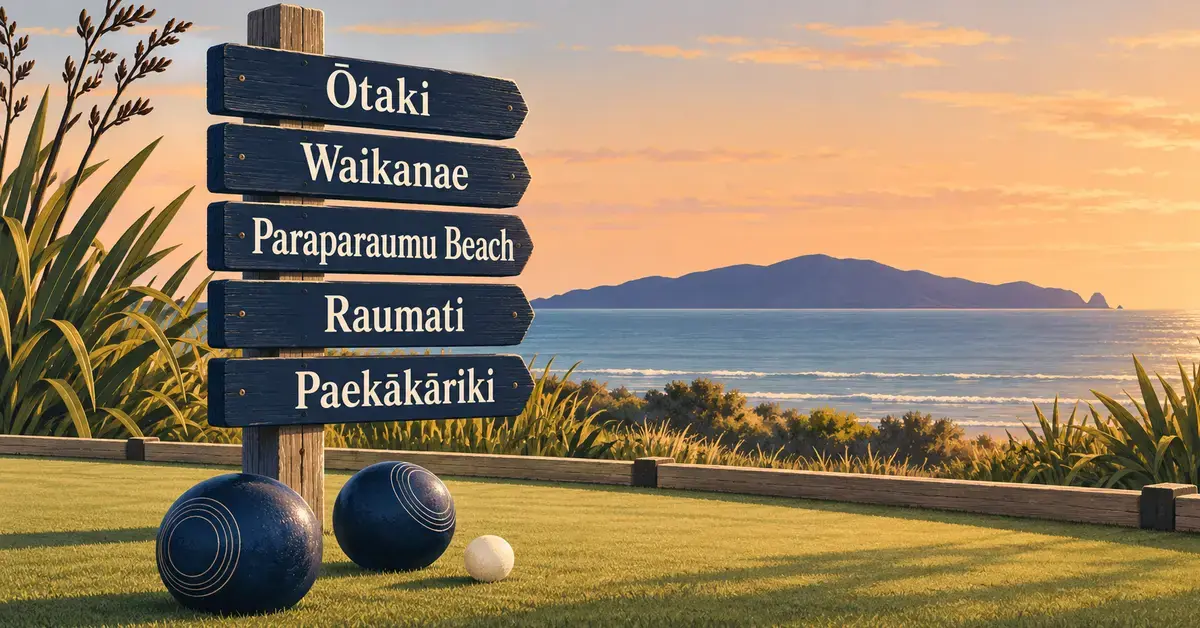
The Kāpiti Coast is lawn bowls country. Along the strip of towns running from Paekākāriki in the south up to Ōtaki in the north, five affiliated bowling clubs keep their greens open to beginners, visitors and lifelong members alike — and several of them play right through the year on all-weather artificial surfaces. This guide covers where to play, what each club offers, when the season runs, what it costs and what to bring, so you can find a green near you and roll your first bowl with confidence. It also gives an honest answer on ten-pin bowling, which the district is short on.
Key Points
- Lawn bowls dominates: the Kāpiti Coast has five lawn bowls clubs but no dependable ten-pin alley.
- The five clubs: Paraparaumu Beach, Raumati, Waikanae, Paekākāriki and Ōtaki — all under the Bowls Kāpiti Coast Centre.
- Year-round play: Raumati, Waikanae, Paekākāriki and Ōtaki have artificial greens and bowl through winter; Paraparaumu Beach plays the summer grass season.
- Cheap to try: come-and-try days are free or a few dollars, and clubs lend bowls to beginners.
- What to wear: flat-soled shoes or bare feet to protect the green; add sun protection.
- Nearest ten-pin: North City TenPin in Porirua, about a 35-minute drive south.
What bowling is on offer on the Kāpiti Coast?
Bowling on the Kāpiti Coast means lawn bowls first and foremost. The district sits within the Bowls Kāpiti Coast Centre — one of the regional Centres that make up Bowls New Zealand, the national governing body — and its member clubs are spread across the main coastal towns. Lawn bowls is an outdoor green sport in which you roll heavy, lopsided bowls toward a small white target ball called the jack; the bowls are weighted on one side so they curve as they slow, which is the skill at the heart of the game.
Ten-pin bowling — the indoor lane game with a heavy drilled ball and ten pins — is harder to find locally, and the one centre the coast once had can no longer be relied on. Because of that, the bulk of this guide is about the lawn bowls clubs, with a separate, honest section on ten-pin further down.
The coast suits newcomers well. Clubs here are used to walk-up visitors and run free or low-cost sessions where the gear is provided, so you do not need to own a set of bowls or know the rules before you turn up. If the game is completely new to you, our beginner-friendly walkthrough of how to play lawn bowls explains the rink, the jack and the delivery in plain language.
Lawn bowls clubs on the Kāpiti Coast
There are five lawn bowls clubs on the Kāpiti Coast, one in each of the main centres: Paraparaumu Beach, Raumati Beach, Waikanae, Paekākāriki and Ōtaki. Each is affiliated to the Bowls Kāpiti Coast Centre and welcomes new and social members. The table below sums them up, and the sections that follow give the detail.
Clubs at a Glance
| Club | Town | Location | Greens | Notable |
|---|---|---|---|---|
| Paraparaumu Beach Bowling Club | Paraparaumu Beach | Toru Road | Natural grass | Est. 1939; modern clubhouse and licensed bar |
| Raumati Bowling Club | Raumati Beach | Marine Gardens, 1 Matatua Road | Two artificial (TigerTurf) | Plays year-round; ph 04 904 7823 |
| Waikanae Bowling Club | Waikanae | Te Moana Road | Artificial, floodlit | Est. 1955; one of the coast’s faster greens |
| Paekākāriki Bowling Club | Paekākāriki | 10 Wellington Road | One artificial, one natural | Bowls3Five twilight; rangatahi programme |
| Ōtaki Bowling Club | Ōtaki | 15 Waerenga Road | Artificial | Est. 1908; also runs a pétanque section |
Paraparaumu Beach Bowling Club
Paraparaumu Beach Bowling Club is the coast’s longest-running club, established in 1939, and is based on Toru Road a short walk from the beach. It plays on natural grass greens and has a modern clubhouse with a licensed bar, a kitchen and venue hire — the kind of set-up that makes it a hub for both serious competition and social, twilight-style bowling. Membership runs from full playing options down to social and family memberships, and the club offers coaching and club bowls so first-timers can give it a go without buying anything. It is a good first stop if you live around central Paraparaumu. You can reach the club by email at [email protected].
Raumati Bowling Club
Raumati Bowling Club plays year-round on two artificial greens, which is its biggest draw. The club is at Marine Gardens, 1 Matatua Road, Raumati Beach, and its TigerTurf synthetic surfaces drain fast and stay playable in weather that would close a grass green, so bowls carries on through winter. (If you find it listed online under a “Kapiti Bowling Club” web address, that is the same club — the page is titled Raumati Bowling Club.) Membership types cover full and limited playing, social, associate and student, and new players can borrow club bowls and take an introductory coaching session. Phone 04 904 7823 or email [email protected] to arrange a visit.
Waikanae Bowling Club
Waikanae Bowling Club, founded in 1955, is known for having one of the faster greens on the coast. Its artificial surface is floodlit, so the club can run evening and twilight play, and the drainage means bowls resumes soon after heavy rain. The club is on Te Moana Road in Waikanae and has a strong social side alongside its playing membership, with a full calendar of club tournaments through the season. It is the natural choice if you are based in Waikanae or the northern Paraparaumu suburbs. Phone 04 293 6250 for membership and visitor details.
Paekākāriki Bowling Club
Paekākāriki Bowling Club is the coast’s southernmost club, at 10 Wellington Road in the village of Paekākāriki. It has two greens — one artificial and one natural — and runs a mix of programmes aimed at keeping bowls accessible, including a Bowls3Five twilight league (a fast, short-format version of the game played three-a-side) and a rangatahi programme for young players. Membership is flexible and coaching is available for newcomers. The club does not run a full website, so the quickest way to make contact is its Facebook page or by phoning the club on 04 905 8024.
Ōtaki Bowling Club
Ōtaki Bowling Club, at the northern end of the coast, is the oldest of the five — it dates back to 1908. It is at 15 Waerenga Road, Ōtaki, and plays on an artificial green. The club is unusual on the coast for also running a well-established pétanque section (a French boules-style game played on a gravel court), so it offers two bowling-style sports on one site, plus indoor bowls in the clubrooms over winter. It is a smaller, community-focused club — a friendly option for people in Ōtaki, Te Horo and Manakau. Phone 06 364 8315 or email [email protected].
When is the lawn bowls season on the Kāpiti Coast?
The main lawn bowls season on the Kāpiti Coast runs through the warmer months, roughly October to Easter, in line with the national summer season. That is when club competitions, pennants and most organised play take place, and when natural grass greens — such as those at Paraparaumu Beach — are open and in top condition.
Several Kāpiti clubs, though, play all year. Raumati, Waikanae, Paekākāriki and Ōtaki all have artificial greens that drain quickly and stay true in the wet, so they can keep bowling in winter, often under lights or indoors. If you want to play outside the summer season, those clubs are your best bet. It always pays to phone ahead, because open days, roll-up times and club nights vary from club to club and change between seasons.
How much does it cost to play lawn bowls here?
Trying lawn bowls on the Kāpiti Coast is cheap or free to start with. Clubs regularly host come-and-try or open days where there is no charge, the club lends you a set of bowls, and a coach or member shows you the basics. A casual visitor roll-up, where you turn up and pay a small green fee for the session, is also common and usually costs only a few dollars.
Full membership is the bigger cost, and it is still modest by sport standards. Annual club subscriptions in New Zealand typically fall in the low-to-mid hundreds of dollars a year, and many clubs offer cheaper social, student or limited-play memberships for people who only want a few games. Our national price guide to lawn bowls breaks down membership fees, gear and starting costs in detail. The key point: you do not need to spend anything on equipment to find out whether you enjoy the game, because clubs provide bowls for beginners.
What do I need to wear and bring?
For a first visit, you need almost nothing. Wear flat-soled shoes with no heel — ordinary sports shoes or sneakers are fine, and many clubs are happy for first-timers to go in flat shoes or even barefoot. The flat-sole rule exists to protect the delicate playing surface of the green, not to enforce a uniform. The club lends you the bowls, so there is no gear to buy on day one.
Once you join and start playing in competitions, clubs apply a dress code — usually club shirts and specific colours for pennant play, and flat-soled bowls shoes. Our guide to the lawn bowls dress code and shoes explains what is expected and when. Beyond footwear, bring sun protection: a hat, sunscreen and water matter on an exposed coastal green in a Kāpiti summer. If you later buy your own bowls, the right size and weight matter, and our guide to what size lawn bowls you need covers the hand tests involved.
How do I join or just try lawn bowls on the Kāpiti Coast?
The simplest way to start is to contact the club nearest you and ask about a come-and-try day or a social session — every Kāpiti club runs them, and they are designed for people who have never bowled. You do not have to commit to membership to have a go. A relaxed, social option is barefoot bowls, where groups book a green for a casual, no-experience-needed session, often with food and drinks from the clubhouse; it is ideal for a work group, a birthday or a stag or hen do.
If you decide to join properly, the process is the same everywhere: pick a club, choose a membership type that matches how much you want to play, pay the subscription and take up the club’s beginner coaching. Our step-by-step guide to joining a lawn bowls club in New Zealand walks through membership types, fees and the beginner pathway. Because all five Kāpiti clubs belong to the same Centre, you can also move between them for inter-club play once you are a member.
What about ten-pin bowling on the Kāpiti Coast?
The Kāpiti Coast does not have a reliable ten-pin bowling centre at present. A local alley, Kāpiti Tenpin, operated at 1 Te Tupe Road in Paraparaumu and once advertised fourteen lanes with automatic pinsetters, glow bowling and a licensed café. As of this guide, however, both of its websites are offline and some listings flag the venue as closed, so its status is uncertain. If you are set on ten-pin in Paraparaumu, phone ahead or check for a current Facebook page before making the trip — do not assume it is open.
For a guaranteed game of ten-pin, the nearest confirmed lanes are south of the coast. North City TenPin in Porirua, on Kenepuru Drive, is the closest full-size alley and is roughly a 35-minute drive down State Highway 1 from Paraparaumu; see our guide to bowling in Porirua for details. Further on, the capital has The Lanes, a ten-pin bar in the CBD covered in our bowling in Wellington guide. The two codes are very different games, and if you are weighing them up our comparison of lawn bowls vs ten-pin bowling lays out the rules, gear and feel of each.
Common mistakes to avoid
A few simple misunderstandings trip up newcomers on the coast. Avoiding them makes your first visit smoother.
- Turning up unannounced. Greens are often booked for competitions, maintenance or club days. Always phone or message the club before you visit so someone is there to set you up.
- Assuming it is a summer-only sport. On the Kāpiti Coast the artificial-green clubs — Raumati, Waikanae, Paekākāriki and Ōtaki — play through winter, so you do not have to wait for summer to start.
- Wearing the wrong shoes. Heeled or hard-soled shoes damage the green and may not be allowed on. Flat soles, flat sports shoes or bare feet are the rule.
- Buying bowls too soon. Clubs lend bowls to beginners. Try the game first; only buy a set once you know you enjoy it and have been sized correctly.
- Confusing the clubs and towns. Raumati, Paraparaumu Beach and Waikanae are separate clubs in separate suburbs — check the address, as the “Kapiti” name online sometimes points to the Raumati club.
- Expecting a local ten-pin alley. The coast has no dependable ten-pin venue right now; plan a trip to Porirua or Wellington instead.
Sources
- Bowls New Zealand — Paraparaumu Beach Bowling Club
- Bowls New Zealand — Raumati Bowling Club listing
- Bowls New Zealand — Paekākāriki Bowling Club
- Bowls New Zealand — Ōtaki Bowling Club
- Bowls New Zealand — Waikanae Bowling Club feature
- Bowls New Zealand — national governing body
- Kāpiti Coast District Council — sports grounds
- Porirua City Council — bowling (North City TenPin)
Frequently Asked Questions (FAQ)
How many lawn bowls clubs are there on the Kāpiti Coast?
There are five affiliated lawn bowls clubs on the Kāpiti Coast, one in each main town: Paraparaumu Beach, Raumati Beach, Waikanae, Paekākāriki and Ōtaki. All five belong to the Bowls Kāpiti Coast Centre and welcome new and social members.
Can I play lawn bowls in winter on the Kāpiti Coast?
Yes. Several Kāpiti clubs have all-weather artificial greens and play year-round, including Raumati, Waikanae, Paekākāriki and Ōtaki. Natural grass greens, such as at Paraparaumu Beach, follow the summer season from about October to Easter. Phone the club to confirm winter times.
Is there a ten-pin bowling alley on the Kāpiti Coast?
Not a reliable one. A centre called Kāpiti Tenpin operated in Paraparaumu, but its websites are now offline and its status is uncertain, so check directly before visiting. The nearest confirmed ten-pin lanes are North City TenPin in Porirua and The Lanes in Wellington.
Do I need my own bowls to start?
No. Every Kāpiti Coast club lends bowls to beginners and visitors, so you can try the game for free or for a small green fee without buying anything. Buy your own set only once you know you enjoy it and have been sized for the right bowl.
What should I wear to a lawn bowls green?
Wear flat-soled shoes with no heel to protect the green — ordinary sports shoes are fine, and many clubs allow bare feet for casual sessions. Add a hat, sunscreen and water for sunny days. Club colours and bowls shoes only come in once you play competitively.
