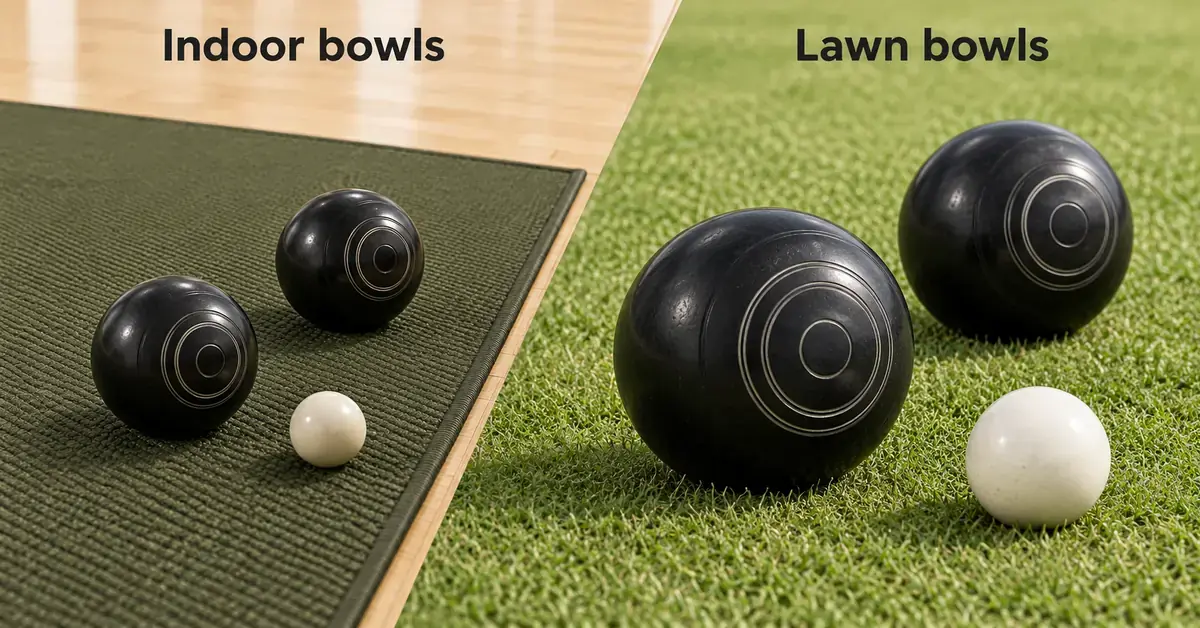
In New Zealand, indoor bowls and lawn bowls are two separate sports that share a family resemblance but differ in almost every practical way: the surface you play on, the size of the bowls, how you deliver them, and where and when you play. Both are “bowls” in the roll-toward-a-target sense, yet they are governed by different bodies and run as their own competitions. This guide explains what each game is, how it works, and the key differences, so you can decide which one suits you — or whether, like many Kiwis, you end up playing both.
First, what “indoor bowls” means in New Zealand
In New Zealand, indoor bowls is a distinct code: a miniature, mat-based version of lawn bowls played inside halls and clubrooms. It is not ten-pin bowling (the game with a heavy ball, finger holes and skittle-like pins down a timber or synthetic lane), and it is not simply lawn bowls moved under a roof. Keeping these apart matters, because the single word “bowling” gets used for all of them.
Three different things are easy to confuse:
- Indoor bowls (the mat game) — the subject of this article. Small biased bowls rolled along a narrow woollen or synthetic mat toward a jack, governed by the New Zealand Indoor Bowling Federation.
- Lawn bowls played indoors — a full-size green or rink brought under cover in a dedicated indoor arena (such as the national-level venue at Naenae in the Hutt Valley). This is still lawn bowls, with the same bowls and rules, just sheltered from the weather.
- Ten-pin bowling — a completely separate sport played at commercial alleys, unrelated to either code above.
This article compares the mat-based indoor bowls code with outdoor lawn bowls, because that is the comparison most New Zealand players actually mean.
Key Points
- Two different sports. In New Zealand, indoor bowls (a mat game) and lawn bowls (an outdoor green game) are separate codes with separate governing bodies — and neither is ten-pin bowling.
- Same aim. Both roll biased bowls toward a small jack and score one shot for each bowl closer than the opponent’s nearest.
- Surface. Lawn bowls: an outdoor green of 31-40 m. Indoor bowls: a woollen or synthetic mat about 6.7 m x 1.8 m, indoors.
- Equipment. Lawn bowls are larger (about 116-131 mm); indoor bowls are smaller and lighter (around 98 mm) with a 2-inch jack.
- Delivery. Lawn bowls is delivered standing from a mat; indoor bowls is delivered kneeling or crouching without touching the mat.
- Season. Lawn bowls is a summer, outdoor sport; indoor bowls is weatherproof and popular over winter — so many Kiwis play both.
What is lawn bowls?
Lawn bowls is an outdoor precision sport in which players roll biased (weighted) bowls across a large flat green to finish as close as possible to a small target ball called the jack. It is the larger and older of the two codes in New Zealand and is run by Bowls New Zealand, the national governing body that oversees around 450 clubs through 27 regional Centres and fields the national teams, the Blackjacks.
The green is a square of closely mown or synthetic turf, typically 31 to 40 metres along each side, surrounded by a shallow ditch. It is divided into parallel playing lanes called rinks, each roughly 4.3 to 5.8 metres wide. A full-length game sends the jack a long way down the rink — the jack must travel at least 23 metres to be in play — so the sport rewards distance control as well as a good line.
The bowls themselves are large, about 116 to 131 millimetres across, and are not perfectly round: one side is shaped so the bowl curves, or draws, as it slows. That curve is called bias, and reading it is the core skill of the game. Bowls come in a range of sizes (commonly 00 to 7) and must carry a current World Bowls stamp to be legal in competition. Players deliver standing, stepping forward from a mat, and matches are played as singles, pairs, triples and fours. If you want the full picture, our guide to how to play lawn bowls walks through a game step by step.
Because it is an outdoor sport, lawn bowls is seasonal in New Zealand. The main club season runs through the warmer months, roughly from spring to autumn (about October to Easter), with flat-soled shoes and club or whites dress codes on the green.
What is indoor bowls?
Indoor bowls is a mat-based sport in which players kneel or crouch at the end of a narrow carpet and roll small biased bowls toward a jack at the far end — the same basic aim as lawn bowls, scaled down to fit inside a hall. It is governed by the New Zealand Indoor Bowling Federation, formed in Wellington on 18 September 1948, and the national representative team is nicknamed the Mat Blacks.
The game arrived in New Zealand in 1908, when Aucklander John Jenkins brought a set home after seeing it at the Franco-British Exhibition in London; the first recorded match was played in 1912, and national championships have run since 1950 (with triples added to the programme in 1993). At its 1960s peak the sport counted tens of thousands of members, and it remains one of the country’s most widespread hall-based club activities.
Play takes place on a woollen or synthetic mat about 6.7 metres long and 1.8 metres wide (the traditional 22 feet by 6 feet), laid over a level floor. The bowls are noticeably smaller and lighter than lawn bowls — the size used in New Zealand is around 3 7/8 inches (about 98 millimetres) across — and the jack is a small white ball standardised at a 2-inch diameter. Henselite is the brand almost every New Zealand indoor player uses. Like lawn bowls, each bowl is biased and curves toward the jack, and the number of bowls per player mirrors the outdoor game: typically four each in singles and pairs, fewer in triples and fours.
The defining difference in technique is the delivery. Players bowl from a marked square at the end of the mat using one of three stances — kneeling on one knee, kneeling on both knees, or crouching — and must not touch or step onto the playing surface as they release the bowl. Because it is played indoors on a small footprint, the game is low-impact, weatherproof and well suited to community halls, which is a large part of why men and women, and a wide range of ages and abilities, compete on even terms.
Indoor bowls vs lawn bowls: the key differences
The quickest way to see how the two codes diverge is side by side. The table below compares the main features, and the sections after it explain each difference in plain terms.
Comparison
| Feature | Indoor bowls | Lawn bowls |
|---|---|---|
| Where it is played | Indoors, in halls and clubrooms | Outdoors, on a grass or synthetic green |
| Playing surface | Mat about 6.7 m x 1.8 m (22 ft x 6 ft) | Green 31-40 m, divided into rinks 4.3-5.8 m wide |
| Bowl size | Smaller and lighter, around 98 mm (3 7/8 in) | Larger, about 116-131 mm |
| Jack | Small white jack, 2-inch diameter | Larger jack, set at least 23 m down the rink |
| Delivery | Kneeling or crouching at the mat’s end | Standing, stepping forward from a mat |
| Formats | Singles, pairs, triples, fours | Singles, pairs, triples, fours |
| Scoring | One shot per bowl closer than the opponent’s nearest | One shot per bowl closer than the opponent’s nearest |
| Season | Year-round indoors; popular in winter | Summer season (roughly October to Easter) |
| Governing body (NZ) | New Zealand Indoor Bowling Federation | Bowls New Zealand |
| National team | Mat Blacks | Blackjacks |
Playing surface: an open green vs a 6.7-metre mat
The surface is the biggest single difference. Lawn bowls is played outdoors on a large flat green of 31 to 40 metres, divided into rinks, where wind, sun and the condition of the turf all change how the bowl behaves. Indoor bowls is played indoors on a single narrow mat under 7 metres long, on a level floor in stable conditions. The outdoor green gives you a long draw and room to use a variety of shots; the mat compresses the whole contest into a few metres, so small differences in line and weight matter enormously.
The bowls and the jack
Lawn bowls are large (about 116 to 131 millimetres) and relatively heavy, and must carry a World Bowls date stamp. Indoor bowls are smaller (around 98 millimetres) and lighter, which makes them easier to grip and deliver for people with smaller hands or less strength. Both are biased and curve toward the jack, but the amount of curve available on a short mat is different from the sweeping draw you get across a full green. The jack also differs: lawn bowls uses a larger jack set a long way down the rink, while indoor bowls uses a small 2-inch jack only a few metres away.
How you deliver the bowl
In lawn bowls you deliver standing, placing one foot on a mat and stepping forward as you release. In indoor bowls you kneel or crouch at the end of the mat and release without touching the playing surface. The outdoor action is a smooth, upright stride; the indoor action is a controlled, close-to-the-ground push. Players who move between the codes often say the reading of bias transfers, but the body mechanics have to be relearned.
Formats, scoring and the aim
Both games share the same object and the same scoring logic: get more of your bowls closer to the jack than your opponent’s nearest bowl, and you score one point (one “shot”) for each. Play is divided into ends, bowled first one way and then back the other. Both codes run as singles, pairs, triples and fours, so the team structures feel familiar across the two. The main scoring contrast is scale — a lawn bowls end plays out over a long rink, while an indoor end is decided within the length of the mat.
Season, setting and weather
Lawn bowls is a summer, outdoor sport, so play is weather-dependent and concentrated in the warmer half of the year. Indoor bowls is played inside and is largely weatherproof, which makes it a popular cooler-months activity. That seasonal split is exactly why so many New Zealanders play lawn bowls through summer and switch to indoor bowls over winter, keeping their eye in year-round.
Cost and how to get started
Both codes are inexpensive compared with many sports, and both let beginners start with club-supplied bowls before buying their own. Lawn bowls clubs run on seasonal membership and usually offer free coaching and open days; indoor bowls is typically organised through local clubs and centres that play weekly in a hall, often with very low fees because the venue and gear are shared. In both, the recommended first step is to turn up to a club night rather than buy equipment up front.
Which game suits you?
Choose based on setting, physical comfort and the kind of social play you want — both are genuine skill sports, so neither is “easier” once you take it seriously.
- Lawn bowls suits you if you enjoy being outdoors, like the variety of a full-size green, want a summer club social scene, and are comfortable with a standing delivery and a longer game.
- Indoor bowls suits you if you want a weatherproof, year-round game, prefer lighter bowls and a short mat, like evening club play in a hall, or find a kneeling or crouching delivery more comfortable than standing and stepping.
- Try both if you want a sport for every season — the skills overlap enough to reinforce each other, and the two calendars dovetail neatly.
If lawn bowls appeals, the practical next move is to join a lawn bowls club for its open season; for indoor bowls, look for a local indoor bowling club or centre that plays weekly through the cooler months.
Common mistakes and misconceptions
The most common mistake is assuming all three “bowling” activities are the same. Here are the misunderstandings worth clearing up before you start.
- Thinking indoor bowls is ten-pin bowling. They are unrelated. Indoor bowls uses small biased bowls and a jack on a mat; ten-pin uses a heavy ball and pins on an alley.
- Thinking indoor bowls is just lawn bowls under a roof. The mat code is its own sport with its own body, smaller bowls, a 2-inch jack and a kneeling delivery. Lawn bowls played on an indoor green is a separate thing again — still lawn bowls.
- Assuming skills transfer perfectly. Reading bias helps in both, but the delivery action and the length of draw are different, so expect to adjust your weight and line when you switch.
- Buying bowls before you play. Both codes let you borrow club bowls at first. Bias and size suit different hands, so it pays to try before you buy.
- Getting footwear wrong at lawn bowls. Greens require flat-soled shoes to protect the surface; indoor halls are more relaxed, but clean, flat, non-marking footwear is still the norm.
Can you play both codes?
Yes — and many New Zealanders do, precisely because the seasons complement each other. Lawn bowls fills the warm outdoor months and indoor bowls fills the cooler indoor ones, so a keen bowler can play most of the year. The shared aim and scoring make it easy to follow both, and if you enjoy the comparison angle you may also like our look at lawn bowls compared with bocce, another close relative in the roll-toward-the-jack family.
Sources
Frequently Asked Questions (FAQ)
Is indoor bowls the same as ten-pin bowling?
No. In New Zealand, indoor bowls is a mat-based sport that uses small biased bowls and a jack, closely related to lawn bowls. Ten-pin bowling is a separate sport played at alleys with a heavy ball and pins. The two are not connected despite both being called “bowling”.
What is the main difference between indoor bowls and lawn bowls?
The surface and scale. Lawn bowls is played outdoors on a large flat green of 31 to 40 metres with bigger bowls and a standing delivery, while indoor bowls is played indoors on a narrow mat under 7 metres long with smaller, lighter bowls delivered from a kneeling or crouching stance. The object and scoring are otherwise very similar.
Are indoor bowls and lawn bowls bowls interchangeable?
No. Indoor bowls are smaller (around 98 millimetres) and lighter and are designed for the mat, while lawn bowls are larger (about 116 to 131 millimetres) and sized for an outdoor green. Each code has its own equipment, so you cannot simply use one set for the other in competition.
Which is easier for a beginner?
Neither is clearly easier as a skill, but indoor bowls can be more accessible to start: it is weatherproof, uses lighter bowls, is played in a hall, and the kneeling or crouching delivery can suit people who find standing and stepping difficult. Both codes welcome newcomers and lend out bowls to try.
Can I play both indoor bowls and lawn bowls?
Yes. Many New Zealanders play lawn bowls in the warmer outdoor season and indoor bowls over the cooler months, since the two seasons dovetail. The shared aim of getting closest to the jack means skills carry over, even though the delivery and the length of the draw differ.
